Optimization study of GC-MS and IDMS technique for separation of benzophenone and its derivatives from food packaging paper
DOI:
https://doi.org/10.60136/bas.v7.2018.221Keywords:
Benzophenone, Gas chromatography, Isotope dilution mass spectrometryAbstract
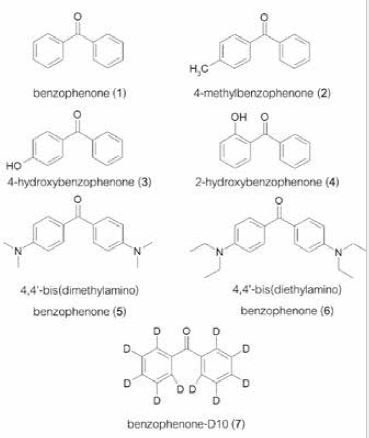
This report is a study of optimized condition for GC-MS and Isotope Dilution Mass spectrometry (IDMS) techniques to separate mixture of benzophenone and its derivatives; involving 4-methylbenzophenone, 4-hydroxybenzophenone, 2-hydroxybenzophenone, 4,4'-bis (dimethylamino) benzophenone and 4,4'-bis (diethylamino) benzophenone. These 6 carcinogenic compounds are photo-initiators; used in UV cure ink for food packaging paper. In this study, benzophenone-D10 was used as an internal standard and 50% diphenyl/50% dimethyl polysiloxane capillary column was selected as a GC-MS column. This study was performed through varying of GC oven temperature; including initial, final and increasing temperature rate under the GC-MS full scan mode. The results show 3 studied methods could obtain all 6 dangerous compounds separately in 24, 29 and 41 min, respectively. The optimized GC oven temperature was selected from the method using the shortest runtime (24 min) and the GC-MS full scan mode has been changed to a selective ion monitoring (SIM) mode instead to achieve the differences between quantified peak of benzophenone (m/z = 105) and of benzophenone-D10 (m/z= 110). Finally, the optimized condition of the GC-MS technique from this study can be used to analyze benzophenone and its 5 derivatives in food packaging paper sample by comparison to standard calibration curve that the correlation coefficient was in the limit of acceptance ( R20.990)
References
RHODES, M.C., et al. Carcinogenesis studies of benzophenone in rats and mice. Food and Chemical Toxicology. 2007, 5, 843-851.
THE EUROPEAN PAPER AND BOARD FOOD PACKAGING CHAIN. Industry guideline for the compliance of paper and board materials and articles for food contact [online]. 2012 [viewed 26 June 2013]. Available from: http://www.cepi.org/system/files/public/documents/publications/foodcontact/2012/Industry%20guideline-updated2012final.pdf
CASTLE, L., et al. Migration studies from paper and board food packaging materials. Part 2. Survey for residues of dialkylamino benzophenone UV-cure ink photoinitiators. Food Additives and Contaminants. 1997, 14, 45-52.
JOHNS, S.M., et al. Studies on Functional Barriers to Migration 1 Transfer of Benzophenone from Printed Paperboard to Microwaves Food. Deutsche Lebensmittel-Rundschau. 1995, 91, 69-73.
SARGENT, M., et al. Guidelines for Achieving High Accuracy in Isotope Dilution Mass Spectrometry (IDMS). Cambridge: The Royal Society of Chemistry. 2002, pp. 1-49.
VAN HOECK, E., et al. Analysis of benzophenone and 4-methyl benzophenone in breakfast cereals using ultrasonic extraction in combination with gas chromatography-tandem mass spectrometry (GC-MS"). Analytica Chimica Acta. 2010, 663, 55-59.
VAN DEN HOUWE, K., et al. Evaluation of the migration of 15 photo-initiators from cardboard packaging into Tenax® using ultra-performance liquid chromatography-tandem mass spectrometry (UPLC-MS/MS). Food Additives & Contaminants: Part A. 2014, 31, 767-775.
SAESAENGSEERUNG, N. Comparison of solvent and techniques for extraction of benzophenone from paper intended to come into contact with foodstuffs. Bulletin of Applied Sciences. 2016, 5, 97-102.
TECHNICAL DIVISION ON REFERENCE MATERIALS OF AOAC INTERNATIONAL. Standard format and guidance for AOAC standard method performance requirement documents [online]. 2011. [viewed 26 January 201]. Available from: http://stakeholder.aoac.org/SPIFAN/SMPR_Guidelines_v13.pdf
Downloads
Published
How to Cite
Issue
Section
License
Copyright (c) 2022 Bulletin of Applied Sciences

This work is licensed under a Creative Commons Attribution-NonCommercial-NoDerivatives 4.0 International License.