Wastewater characterization from chemical dyeing process of silk: case study household Thai silk production, One Tumbon One Product (OTOP), Surin Province
DOI:
https://doi.org/10.60136/bas.v4.2015.292Keywords:
Wastewater, Effluent, Thai silk, Household products, Dyeing processAbstract
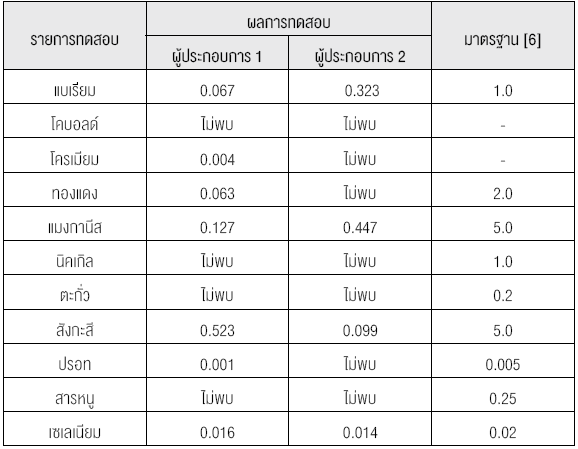
Household Thai silk production under One Tumbon One Product (OTOP) project can contribute the sustainable career and income to the local. However, household Thai silk production processes produce a number of wastewater. The chemical dyeing process is the process which produces wastewater. This wastewater usually discharges to the environment without any treatment. This study aims to characterize the quality of wastewater from chemical dyeing process prior to design the simply wastewater treatment system for household. Surin province which located at the northeast of Thailand was the sampling location. Totally 8 samples of wastewater from chemical dyeing process were collected from 4 different districts. The key parameters to characterize the wastewater are color, pH, chemical oxygen demand (COD), suspended solids (SS), total dissolved solids (TDS) and heavy metals. The results illustrate that wastewater from chemical dyeing process had pH 1.7-8.8, COD 1,847-3,439 mg/L, SS 271-1,200 mg/L and TDS 3,00022,739mg/L which was over Thailand national standard for wastewater except for pH. There was only 1 sample that over Thailand national standard for wastewater. The color was 196- 10,950 ADMI which over the USA guidelines (no Thailand national standard).In the case of heavy metals, there were very low concentrations were detected and they were in acceptable range when compared with Thailand national standard for wastewater.
References
AGRIFOOD CONSULTING INTERNATIONAL. Northeast Thailand silk value chain study. [Online]. [viewed 14 August 2014]. Available from: www.agrifoodconsulting.com.
MO, J., et al. Pretreatment of dyeing wastewater using chemical coagulants. Dyes and Pigments, 2007, 72(2), 240-245.
WANG, C.T., et al. Paired removal of color and COD from textile dyeing wastewater by simultaneous anodic and indirect cathodic oxidation. Journal of Hazardous Materials, 2009, 169(1-3), 16-22.
AMERICAN PUBLIC HEALTH ASSOCIATION, THE AMERICAN WATER WORKS ASSOCIATION, and THE WATER ENVIRONMENT FEDERATION. Standard methods for the examination of water and wastewater, 21st ed. Washington, DC : American Public Health Association, 2005.
UNITED STATES ENVIRONMENTAL PROTECTION AGENCY. Mercury in solids and solutions by thermal decomposition amalgamation and atomic absorption spectrophotometry. Method 7473.2007.
กระทรวงอุตสาหกรรม, ประกาศกระทรวงอุตสาหกรรมฉบับที่ 2 (พ.ศ. 2539) ออกตามความในพระราชบัญญัติโรงงาน พ.ศ. 2535 เรื่องกําหนดคุณลักษณะของน้ําทิ้งที่ระบายออกจากโรงงาน, 2539.
ASTHMA AND ALLERGY FOUNDATION OF AMERICA. Global Textile Effluent Guidelines. [Online]. [viewed 22 August 2014). Available from: https://www.wewear.org/assets/1/7/EffluentGuidelines.pdf.
TEXTILE LEARNER. Degumming/Scouring process of silk. [Online]. [viewed 23 August 2014]. Available from:http://textilelearner.blogspot.com/2012/03/degummingscouring-process-of-silk.htm.
CHATTHONG THAI SILK. Thai silk weaving methods. [Online]. [viewed 23 August 2014]. Available from: http://www.chattongthaisilk.net/index.php?lay=show&ac=article&id=538850688.
XIAO, S., et al. Effective removal of dyes from aqueous solution using ultrafine silk fibroin powder. Advance Powder Technology, 2014, 25(2), 574-581.
GUPTA, D., et al. Cleaner process for extraction of sericin using infrared. Journal of Cleaner Production, 2013, 52, 488-494.
นฤมล ศิริทรงธรรม, การใช้สีและสารเคมีที่ปลอดภัยสําหรับการฟอกย้อมไหม. [ออนไลน์]. [อ้างถึงวันที่ 23 สิงหาคม 2557]. เข้าถึงจาก: WWW.qsds.go.th/qthaisilk/peacock_images/safety_chemi-color.pdf.
Paula Burch's site. All about hand dyeing. How to dye silk. [Online]. [viewed 23 August 2014]. Available from: http://www.pburch.net/dyeing/FAQ/silk.shtml.
REDDY S.S., B. KOTAIAH., and N.S.P. REDDY. Color pollution in textile dyeing industry effluents using tannery sludge derived activated carbon. Bulletin of Chemical Society Ethiopia, 2008, 22(3), 369-378.
KHAN, M.A., I. HUSSAIN, and E. A. KHAN. Effect of aqueous extract of Eucalyptus camaldulensis L. on germination and growth of Maize (Zea may L.). Pakistan Journal of Weed Science Research, 2007,13(3-4), 177-182.
SINGWANE, S.S., and P. MALINGA. Impacts of pine and Eucalyptus forest plantations on soil organic matter content in Swaziland-case of Shiselwentforest. Journal of Sustainable Development in Africa, 2012, 14(1), 137-151.
CHEN, J., et al. Research and application of biotechnology in textile industries in china. Enzyme and Microbial Technology, 2007, 40, 1651-1655.
BOONLERDPORN, N., B. NANTHAKOD, and P. WONGHAD. Azo dyes removal in water using vacuum ultraviolet process. Project report No.ENV2012-06. Khonkaen University. 2013.
Downloads
Published
How to Cite
Issue
Section
License
Copyright (c) 2022 Bulletin of Applied Sciences

This work is licensed under a Creative Commons Attribution-NonCommercial-NoDerivatives 4.0 International License.