Developing the quality of palm oil with herbal extracts
DOI:
https://doi.org/10.60136/bas.v7.2018.222Keywords:
Palm oil, Herbal extract, Peroxide valueAbstract
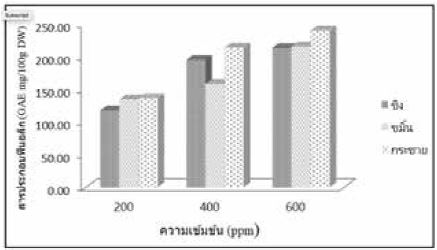
The purpose of this study was to produce palm oil with antioxidants for reduced rancidity in fried food products. The three types of herbal; ginger, turmeric and finger root were used in this experiment. The higher concentration of herbal extracts, the higher of total phenolic contents (TPC). The palm oil samples were mixed with 2%, 4%, and 6% of herbal powder and were mixed with 200, 400 and 600 mg./kg. of herbal extracts by ethanol. The quality determination of palm oil by using Peroxide value (P.V.) and Acid value (A.V.). The selected formulations of palm oil with herbal powder were 2% ginger, 4% turmeric and 2% finger root, their P.V. were 5.500.22 6.20
0.04 6.18
0.08 meq/kg, respectively. While the palm oil with herbal extracts were ginger 200, turmeric 400 and finger root 400 mg./ kg, their PV. were 4.48
0.03 5.60
0.02 5.82
0.01 meg/kg., respectively. All samples also had A.V. lower than 0.6 in mg./g. The quality determination of fried palm oil, the P.V. of palm oil with ginger extract was lower than that of turmeric and finger root extract. For fried chips sensory testing by 30 panelists, they accepted chips that fried in palm oil with ginger extract, finger root extract, turmeric extract and control, respectively. The palm oil with herbal extracts had stored at least one year shelf life.
References
กฤติกา นรจิตร. คุณสมบัติของสารสกัดจากพืชวงศ์ขิง: อิทธิพลของวิธีการสกัดต่อการยับยั้งการเจริญเติบโตของเชื้อ แบคทีเรียและการเป็นสารต้านอนุมูลอิสระ. กรงเทพฯ : มหาวิทยาลัยเทคโนโลยีพระจอมเกล้าธนบุรี, 2548.
ธนศักดิ์ แซ่เลี้ยว ศศิธร จันทนวรางกูร และวรรณี จิรภาคย์กุล. ผลของตัวทําละลายต่อปริมาณสารประกอบฟีนอลิกและ ความสามารถต้านออกซิเดชันของกระชายเหลือง (Boesenbergia pandurata). กรุงเทพฯ : มหาวิทยาลัยเกษตรศาสตร์, 2552.
นิธิยา รัตนาปนนท์. วิทยาศาสตร์การอาหารของไขมันและน้ำมัน, กรุงเทพฯ : โอ.เอส.พรินติง เฮ้าส์. 2548.
สํานักงานมาตรฐานผลิตภัณฑ์อุตสาหกรรม. มอก.288-2521. มาตรฐานผลิตภัณฑ์อุตสาหกรรมน้ำมันปาล์ม.
ศิรินุช ทองฤทธิ์. การคัดเลือกและการใช้สมุนไพร/เครื่องเทศเป็นสารต้านออกซิชันในน้ำมันทอด. สงขลา : มหาวิทยาลัย สงขลานครินทร์, 2552.
ARUOMA, O.I., J.P.E. SPENCER, D. WARREN, P. JENNER, J. BUTLER and B. HALLIWELL. Characterization of food antioxidants, illustrate using commercial garlic and ginger preparation. Food Chem. 1997, 60,149-156.
DEPARTMENT OF MEDICAL SCIENCES, MINISTRY OF PUBLIC HEALTH. Thai herbal pharmacopoeia. 1998, 1, 38-44.
JASWIR, IRWANDI and YAAKOB B.CHE MAN. Use optimization of natural antioxidants in refined, bleached, and deodorized palm olein during repeated deep-fat frying using response surface methodology. JAOCS. 1999, 76(3), 341-348.
ALLEN J.C. and R.J. HAMILTON. Rancidity in foods. 3 rd ed. New York: Blackie academic & professional. 1994.
MENDES, L. Method and formulation for enhancing life of edible oil. 2008. U.S. Patent 0311268 A1.
CHE MAN Y.B. and C.P. TAN. Effects of natural and synthetic antioxidants on changes in refined, bleached, and deodorized palm olein during deep-fat frying of potato chips. JAOCS. 1999, 76(3), 331-339.
Downloads
Published
How to Cite
Issue
Section
License
Copyright (c) 2022 Bulletin of Applied Sciences

This work is licensed under a Creative Commons Attribution-NonCommercial-NoDerivatives 4.0 International License.