The production of recycle corrugated paper from used corrugated container
DOI:
https://doi.org/10.60136/bas.v6.2017.216Keywords:
American old corrugated container, Recycled pulp, Local old corrugated containerAbstract
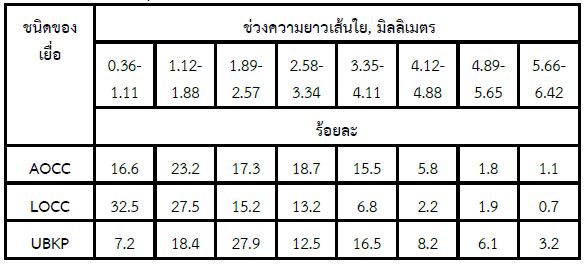
The objective of this research project was to develop a condition and suitable mixing ratios between 2 widely used corrugated containers, which were American Old Corrugated Container (AOCC) and Local Old Corrugated Container (LOCC), in order to produce usable recycle paper. This studied was found that the pulp from AOCC contained higher ratio of long-fiber pulp than from LOCC and this ratio was also close to that of Unbleached Softwood Kraft Pulp (UBKP), which was a virgin pulp. At the same degree of refining, AOCC pulp provides the physical properties including tensile index tear index and ringcrush higher than LOCC pulp. The recycle paper produced from the mixture of AOCC and LOCC, where the ratio of AOCC to LOCC was greater than 50% had physical properties including tensile index over 21.0 kN.m/kg tear index over 10.2 Nm2/kg and ringcrush over 115 N. Therefore, it was possible to use a mixture of LOCC and AOCC to produce usable recycle paper, complied with the Thai Industrial Standard for corrugated paper which the industries could use the result to further develop into an industrial scale to reduce the use of virgin pulp and production cost in the future.
References
รุ่งอรุณ วัฒนวงศ์, ความรู้เบื้องต้นเกี่ยวกับกระดาษ. ใน: เอกสารการอบรมเรื่องเทคโนโลยีการผลิตเยื่อและกระดาษ รุ่นที่ 2 15-17 มิถุนายน 2542. กรุงเทพฯ ห้องปฏิบัติการเยื่อและกระดาษ กองการวิจัย กรมวิทยาศาสตร์บริการ, 2542
รุ่งอรุณ วัฒนวงศ์ และ ธีระชัย รัตนโรจน์มงคล, กระดาษรีไซเคิล. ใน: เอกสารการอบรมเรื่อง เทคโนโลยีการผลิตเยื่อและกระดาษ รุ่นที่ 2 15-17 มิถุนายน 2542. กรุงเทพฯ: ห้องปฏิบัติการเยื่อและกระดาษ กองการวิจัย กรมวิทยาศาสตร์
บริการ, 2542
สมชาติ รุ่งอินทร์. ความเข้าใจเบื้องต้นเกี่ยวกับงานวิเคราะห์ทดสอบเบื่อและกระดาษและคําอธิบายศัพท์ที่ใช้ในงานวิเคราะห์ทดสอบ. กรุงเทพฯ: ห้องปฏิบัติการเยื่อและกระดาษ กองการวิจัย กรมวิทยาศาสตร์บริการ, 2528.
TECHNICAL ASSOCIATION OF THE PULP AND PAPER INDUSTRY. Tappi Standard. T 233 cm-15: Fiber length of pulp by classification.
TECHNICAL ASSOCIATION OF THE PULP AND PAPER INDUSTRY. Tappi Standard. TAPPI T 205 Handsheet forming.
TECHNICAL ASSOCIATION OF THE PULP AND PAPER INDUSTRY. Tappi Standard. T 410 om-08: Grammage of Paper And Paperboard (weight per unit area).
TECHNICAL ASSOCIATION OF THE PULP AND PAPER INDUSTRY. Tappi Standard. T 411 om-10: Thickness (caliper) of Paper, Paperboard, And Combined Board.
TECHNICAL ASSOCIATION OF THE PULP AND PAPER INDUSTRY. Tappi Standard. T 404 cm-92: Tensile Breaking Strength and Elongation of Paper and Paperboard (using Pendulum-type Tester).
TECHNICAL ASSOCIATION OF THE PULP AND PAPER INDUSTRY. Tappi Standard. T 414 om-12: Internal Tearing Resistance of Paper (Elmendorf-Type Method).
INTERNATIONAL ORGANIZATION FOR STANDARDIZATION. ISO 12192:2011, Paper and board -- Determination of compressive strength -- Ring crush method.
สำนักงานมาตรฐานผลิตภัณฑ์อุตสาหกรรม. มอก. 321-2530. มาตรฐานผลิตภัณฑ์อุตสาหกรรมกระดาษทําลูกฟูก
CHEN Y., J. WAN, Q. WU, Y. MA and M. HUANG. Effect of recycling on fundamental properties of hardwood and wheat straw pulp fibers, and of handsheets made thereof. Cellulose chemistry and technology, 2016, 50(9-10), 1061-1067.
BIRICIK Y. and C. ATIK. Effect of cellulase treatment of long fiber fraction on strength properties of recycled corrugated medium. African Journal of Biotechnology, 2012, 11(58), 12199-12205.
Downloads
Published
How to Cite
Issue
Section
License
Copyright (c) 2022 Bulletin of Applied Sciences

This work is licensed under a Creative Commons Attribution-NonCommercial-NoDerivatives 4.0 International License.