Case study of safety status of laboratory workers in a chemical industrial plant
DOI:
https://doi.org/10.60136/bas.v6.2017.197Keywords:
Laboratory, Safety, Chemical industrial plantAbstract
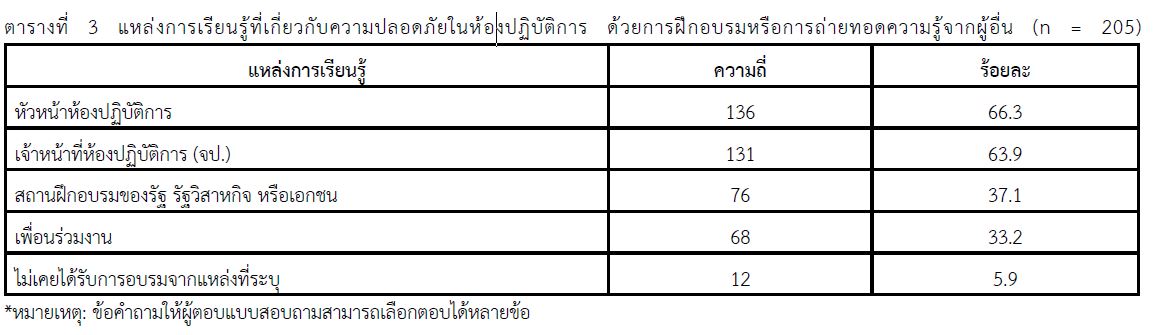
This case study quantitatively examines the safety status of laboratory staff of a private chemical factory, by focusing on the aspects of safety training, practices, and safety management system. Questionnaires are used as a data collection tool. The opinions of 205 staffs are collected. The statistical analysis used is frequency, percentage, and average using Microsoft Excel. The results showed that the majority of laboratory personnel have been trained on safety before working in the laboratories and the safety knowledge is gained from both within and outside the organization. There is also an exchange of knowledge between staff in the agency. In addition, the workers have put knowledge of using Personal Protective Equipment (PPE) and Safety Data Sheet (SDS) into practice, and most of them agree that the organization has a good safety management system. Even though the majority of laboratory personnel have been trained on safety and the organization has a good safety management system, chemical accidents did occur and there were cases of being admitted to hospital or medical facility. These facts show that the organization's safety system still needs further improvement. For example, the staffs of laboratory agree that the organization must have knowledge refresher trainings, continuously promote in-depth understanding on safety issues. Also the organization should promote cultural awareness on chemical operations, regular conduct risk assessments, and improve guidelines to achieve true safety. This case study can be used as an example for other agencies to conduct surveys in a similar manner to improve and promote safety at work
References
KEMSLEY, J.N. Learning from UCLA: Details of the experiment that led to a researcher's death prompt evaluations of academic safety practices. Chemical & Engineering News. 87(31), 29-31, 33-34. [online] 3 August 2009 [viewed 27February 2016]. Available from: http://cen.acs.org/articles/87/31/Learning-UCLA.html
DEMATTEO, R., et al. Chemical exposures of women workers in the plastics industry with particular reference to breast cancer and reproductive hazards. New Solutions. 2012. 22(4), 427-448.
EYAYO, F. Evaluation of occupational health hazards among oil industry workers: a case study of refinery workers. IOSR Journal of Environmental Science, Toxicology and Food Technology. 2014. 8(12), 22-53.
วงศ์วรุตม์ บุญญานุโกมล และ จุฬาลักษณ์ บางเหลือ. คู่มือความปลอดภัยในห้องปฏิบัติการ (Manual of laboratory safety) ห้องปฏิบัติการกลางสำหรับการเรียนการสอนและวิจัย โครงการจัดตั้งวิทยาเขตอำนาจเจริญ มหาวิทยาลัยมหิดล. [ออนไลน์]. 2557. [อ้างถึงวันที่ 29 กันยายน 2559]. เข้าถึงจาก: http://www.am.mahidol.ac.th/web/images/research_dept/Manual%20of%20Laboratory%20Safety.pdf
ธรรมรักษ์ ศรีมารุต และคณะ. พฤติกรรมความปลอดภัยในการปฏิบัติงานของพนักงานระดับปฏิบัติการฝ่ายผลิต. [ออนไลน์]. 2555. [อ้างถึงวันที่ 29 กันยายน 2559]. เข้าถึงจาก: www.ssruir.ssru.ac.th/bitstream/ssruit/788/1/197-55.pdf
วารุณี พันธ์วงศ์, วารางคณา วิเศษมณี ลี, และ ภัทรพร ยุบลพันธ์. ปัจจัยที่เกี่ยวข้องกับปริมาณสารตะกั่วในเลือด กรณีศึกษา: โรงงานผลิตอะไหล่รถยนต์ จ.สมุทรปราการ. การประชุมวิชาการและนำเสนอผลงานวิจัยระดับชาติและนานาชาติ ครั้งที่ 6, 422-430. [ออนไลน์]. 2558. [อ้างถึงวันที่ 29 กันยายน 2559]. เข้าถึงจาก: journalgrad.ssru.ac.th/index.php/5-01/article/download/137/232 [7] COCHARN, W.G. 1963. Sampling Techniques, 2nd Ed., New York: John Wiley and Sons.
Downloads
Published
How to Cite
Issue
Section
License
Copyright (c) 2022 Bulletin of Applied Sciences

This work is licensed under a Creative Commons Attribution-NonCommercial-NoDerivatives 4.0 International License.