Quality assurance for the production and performance testing of alcohol gel for hand sanitizers
DOI:
https://doi.org/10.60136/bas.v14.2025.3621Keywords:
Ethanol, Cosmetics, Alcohol meter, Critical control pointAbstract
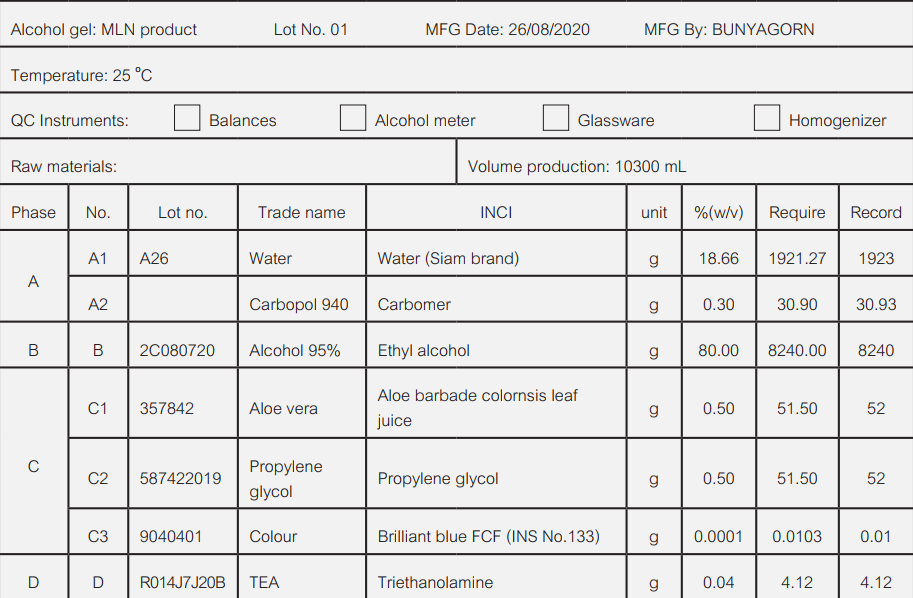
The demand for alcohol-based hand sanitizers containing at least 65% alcohol by weight has increased. However, the quality of these products has often been inconsistent. This research aims to ensure the quality of alcohol gel production and to test the efficiency of alcohol measurement devices in the factory. Two critical control points (CCPs) have been identified. The first critical control point (CCP1) involved verifying the quality of the main raw materials - denatured alcohol, gelling agents, and pure water by utilizing the certificate of analysis results to ensure compliance with acceptance criteria. The second critical control point (CCP2) was to measure the alcohol content before packaging using an alcohol hydrometer with an accuracy of no more than 1.25%. This measurement required a sample prepared with 5M hydrochloric acid (HCl). Additional control points include the accuracy and precision of the balances, as well as the cleanliness and neutrality of the glassware and mixing equipment. All processes were traceable via a digital data recording system, implemented using spreadsheet software (e.g. Microsoft Excel), to ensure reproducibility. The final product could be stable, with a pH of 5.8 and an ethanol content of 77% by volume. The product was considered bactericidal effective when log reduction (lg R) of the reference bacterial amount after one minute contact time was ≥ 5. This quality assurance process in alcohol gel production ensures compliance with legal standards and guarantees product effectiveness.
References
Boyce JM, Pittet D. Guideline for hand hygiene in health-care settings: Recommendations of the Healthcare Infection Control Practices Advisory Committee and the HICPAC/SHEA/APIC/IDSA hand hygiene task force. MMWR [Internet]. 2002 [cited 2025 Mar 10];51(RR-16):1-45. Available from:
https://www.cdc.gov/mmwr/preview/mmwrhtml/rr5116a1.htm
Choorich A. Quality of alcohol-based hand sanitiser for donated during the coronavirus disease (COVID-19) pandemic. Thai Food and Drug Journal. 29(3):62-73.
กระทรวงสาธารณสุข. ประกาศกระทรวงสาธารณสุข เรื่อง กำหนดลักษณะของเครื่องสําอางที่มีส่วนผสมของเเอลกอฮอล์เพื่อสุขอนามัยสำหรับมือที่ห้ามผลิต นําเข้า หรือขาย พ.ศ. 2563. ราชกิจจานุเบกษา เล่มที่ 137 ตอนพิเศษ 54 ง, 9 มีนาคม 2563. 6.
กองบรรณาธิการนิตยสารฉลาดซื้อ. ผลทดสอบเจลแอลกอฮอล์. นิตยสารฉลาดซื้อ [อินเทอร์เน็ต]. 2563 [เข้าถึงเมื่อ 13 มกราคม 2568]. เข้าถึงได้จาก: https://www.chaladsue.com/article/3420
U.S. Food and Drug Administration. Is your hand Sanitizer on FDA’s list of products you should not use? [Internet]. 2020 [cited 2025 Jan 13]. Available from: https://www.fda.gov/drugs/drug-safety-and-availability/fda-updates-hand-sanitizers-consumers-should-not-use#products
สํานักงานมาตรฐานผลิตภัณฑ์อุตสาหกรรม (สมอ.). มาตรฐานผลิตภัณฑ์อุตสาหกรรม เอทานอลใช้ทางเภสัชกรรม. มอก. 640 เล่ม 1-2553. กรุงเทพฯ: สมอ.; 2553.
กระทรวงอุตสาหกรรม. ประกาศกระทรวงอุตสาหกรรม ฉบับที่ 6460 (พ.ศ. 2564) เรื่อง กำหนดมาตรฐานผลิตภัณฑ์อุตสาหกรรม ผลิตภัณฑ์ที่มีส่วนผสมของแอลกอฮอล์เพื่อสุขอนามัยสำหรับมือ. ราชกิจจานุเบกษา เล่มที่ 139 ตอนพิเศษ 78 ง, 4 เมษายน 2565. 31.
กรมสรรพสามิต. ประกาศกรมสรรพสามิต เรื่อง หลักเกณฑ์ วิธีการ และเงื่อนไขการขอใช้สิทธิเสียภาษีในอัตราภาษีศูนย์สำหรับสุราสามทับที่นำไปทำการแปลงสภาพ เพื่อใช้ในการทำผลิตภัณฑ์ทำความสะอาด. ราชกิจจานุเบกษา เล่มที่ 140 ตอนพิเศษ 187 ง, 7 สิงหาคม 2566. 14-19.
Rodrigues GBC, de Oliveira Filho JG, Jakelaitis A, da Silva EC, Placido GR, de Oliveria Marcionilio SML, et al. Hand sanitizer gel formulations: Influence of polymer type on the rheological properties. Research Society and Development. 2024;13(4):e6313445531. doi: 10.33448/rsd-v13i4.45531.
กรมวิทยาศาสตร์การแพทย์, สำนักคุณภาพและความปลอดภัยอาหาร. คู่มือมาตรฐานน้ำดื่มประเทศไทย. นนทบุรี: กระทรวงสาธารณสุข; 2562.
Adelnia H, Ensandoost R, Moonshi SS, Gavgani JN, Vasafi EI, Ta HT. Freeze/thawed polyvinyl alcohol hydrogels: Present, past and future. European Polymer Journal. 2021;164(11):110974. doi: 10.1016/j.eurpolymj.2021.110974.
World Health Organization. Guide to local production: WHO-recommended handrub formulations [Internet]. 2009 [cited 2025 Jan 13]. Available from: https://www.who.int/publications/i/item/WHO-IER-PSP-2010.5
Lacerda JP, Oliveira SS, Marcante A. A rapid and effective method for determination of ethanol content sanitizers (Alcohol gel). Revista IPT Tecnologia e Inovação. 2020;4(14):57-64. doi: 10.34033/2526-5830-v4n14-4.
คณะเภสัชศาสตร์ มหาวิทยาลัยมหิดล. ไวรัสโคโรน่าสายพันธุ์ใหม่ 2019 กับแอลกอฮอล์ฆ่าเชื้อโรค [อินเทอร์เน็ต]. 2563 [เข้าถึงเมื่อ 13 มกราคม 2568]. เข้าถึงได้จาก: https://pharmacy.mahidol.ac.th/th/knowledge/article/482
สุวรรณา เธียรอังกูร, ปรียา ปิ่นนิล, กนกอร กรีเหลี่ยง, สิราวรรณ อ้นเกตุ. ประสิทธิภาพเชิงปริมาณในการฆ่าเชื้อแบคทีเรียของเจลทามือในประเทศไทย ชนิดที่มีแอลกอฮอล์เป็นส่วนประกอบ เมื่อทดสอบด้วย Modified EN 1276: 2009 method. วารสารกรมวิทยาศาสตร์การแพทย์. 2562;61(2):60-72.
Downloads
Published
How to Cite
Issue
Section
License
Copyright (c) 2025 Bulletin of Applied Sciences

This work is licensed under a Creative Commons Attribution-NonCommercial-NoDerivatives 4.0 International License.