Active substances in cleaning and disinfecting products from Thailand's online market in 2023
DOI:
https://doi.org/10.60136/bas.v14.2025.2993Keywords:
Hydrochloric acid, Active oxygen, Available chlorine, Cleaning and disinfecting productsAbstract
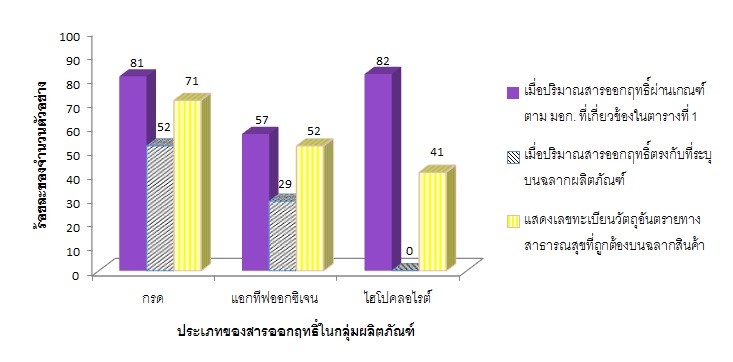
Cleaning and disinfecting products contain active ingredients such as acid, active oxygen, and hypochlorite that are chemical products are easily accessible to the public and widely used. Although the quality of these products has been registered by responsible Thailand government agency before placing on market for sale, post-market surveillance is still important; especially checking the amount of active ingredients mixed in these products. It is because the amount of substances that do not match the product label may affect cleaning and disinfecting effectiveness. Therefore this research focused on randomly sampling of 59 products, which divided into 3 groups according to active ingredients such as acid, active oxygen, and hypochlorite for 21, 21, and 17 samples, respectively. Acid-base titration method was used to quantify amount of hydrochloric acid in acid cleaning products and redox titration method was used to determine amount of active oxygen (calculated as H2O2) and available chlorine in the latter two groups of products, respectively. The survey results found that only 42% of hydrochloric acid products and 29% of active oxygen products among the sampled items were detected with hazardous substance registration numbers and had active ingredient levels that matched those specified on their labels and met the criteria set by Thai industrial standards. However, none of the hypochlorite products had available chlorine levels that matched those stated on their labels.
References
วรรณพร ศรีสุคนธรัตน์. สารต้านเชื้อจุลินทรีย์ที่ใช้ในบ้านเรือนหรือทางสาธารณสุข. นนทบุรี: กลุ่มพัฒนาระบบวัตถุอันตรายสำนักควบคุมเครื่องสำอางและวัตถุอันตราย; 2558.
World Health Organization. Cleaning and disinfection of environmental surfaces in the context of Covid-19: Interim guidance [Internet]. 2020 [cited 2021 May 15]. Available from: https://iris.who.int/bitstream/handle/10665/332096/WHO-2019-nCoV-Disinfection-2020.1-eng.pdf?sequence=1
Kampf G. Potential role of inanimate surfaces for the spread of coronaviruses and their inactivation with disinfectant agent. Infect Prev Pract. 2020;2(2):100044. doi: 10.1016/j.infpip.2020.100044.
กระทรวงสาธารณสุข, กรมอนามัย. คำแนะนำในการทำความสะอาด ทำลายและฆ่าเชื้อโรคในสถานการณ์การระบาดของโรคติดเชื้อไวรัสโคโรนา 2019 (Covid-19) [อินเทอร์เน็ต]. 2564 [เข้าถึงเมื่อ 2 พฤษภาคม 2564]. เข้าถึงได้จาก: https://covid19.anamai.moph.go.th/web-upload/2xdccaaf3d7f6ae30ba6ae1459eaf3dd66/m_document/6734/35233/file_download/98444bccc2b9af6f3742fd2e9ce01538.pdf
Clarkson RM, Moule AJ, Podlich HM. The shelf-life of sodium hypochlorite irrigating solutions. Aust Dent J. 2001;46(4):269-76.
สำนักงานมาตรฐานผลิตภัณฑ์อุตสาหกรรม (สมอ.). มาตรฐานผลิตภัณฑ์อุตสาหกรรม ผลิตภัณฑ์ทำความสะอาดประเภทกรดสำหรับกระเบื้องและเครื่องสุขภัณฑ์เซรามิก. มอก. 329-2542. กรุงเทพฯ: สมอ.; 2542.
สำนักงานมาตรฐานผลิตภัณฑ์อุตสาหกรรม (สมอ.). มาตรฐานผลิตภัณฑ์อุตสาหกรรม ผลิตภัณฑ์ฟอกผ้าประเภทเพอร์ออกไซด์. มอก. 2274-2549. กรุงเทพฯ: สมอ.; 2549.
สำนักงานมาตรฐานผลิตภัณฑ์อุตสาหกรรม (สมอ.). มาตรฐานผลิตภัณฑ์อุตสาหกรรม ผลิตภัณฑ์ฟอกผ้าประเภทไฮโปคลอไรต์. มอก. 2232-2548. กรุงเทพฯ: สมอ.; 2548.
สำนักงานมาตรฐานผลิตภัณฑ์อุตสาหกรรม (สมอ.). มาตรฐานผลิตภัณฑ์อุตสาหกรรม ผลิตภัณฑ์ทำความสะอาดกระเบื้องและเครื่องสุขภัณฑ์เซรามิก ประเภทไฮโปคลอไรต์. มอก. 2239-2550. กรุงเทพฯ: สมอ.; 2550.
American Society for Testing and Materials International (ASTM). Standard test method for active oxygen in bleaching compounds. ASTM D2180-17. West Conshohocken (PA): ASTM International; 2017.
American Society for Testing and Materials International (ASTM). Standard test method of sampling and chemical analysis of chlorine-containing bleaches. ASTM D2022-89. West Conshohocken (PA): ASTM International; 2016.
American Society for Testing and Materials International (ASTM). Standard practice for preparation, standardization, and storage of standard and reagent solutions for chemical analysis. ASTM E200-16. West Conshohocken (PA): ASTM International; 2016.
สำนักงานคณะกรรมการอาหารและยา. ประกาศกระทรวงสาธารณสุข เรื่อง กำหนดเกณฑ์ค่าคลาดเคลื่อนจากปริมาณที่กำหนดไว้ของสารสำคัญในวัตถุอันตรายที่สำนักงานคณะกรรมการอาหารและยารับผิดชอบ พ.ศ. 2555 (2558). ราชกิจจานุเบกษา เล่มที่ 129 ตอนพิเศษ 107 ง, 6 กรกฎาคม 2555. 46-47.
Solvay America, Inc. Product safety summary: Sodium percarbonate (sodium carbonate peroxyhydrate) [อินเทอร์เน็ต]. 2556 [เข้าถึงเมื่อ 29 พฤษภาคม 2567]. เข้าถึงได้จาก: https://www.solvay.com/sites/g/files/srpend221/files/2021-01/PSS-Sodium-Percarbonate.pdf
Piskin B, Türkün M. Stability of various sodium hypochlorite solutions. Journal of endodontics. 1995;21(5):253-5.
Downloads
Published
How to Cite
Issue
Section
License
Copyright (c) 2025 Bulletin of Applied Sciences

This work is licensed under a Creative Commons Attribution-NonCommercial-NoDerivatives 4.0 International License.