
The Influence of Online Customer Relationship Management on Electronic Loyalty: Mediating Effect of Service Quality of Smart Brain Institute
Article Sidebar
Main Article Content
Abstract
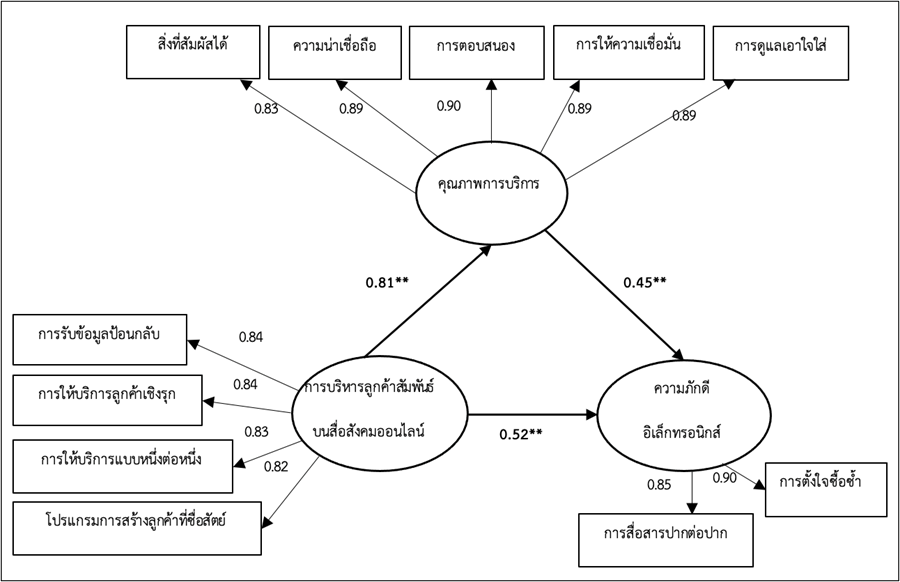
The purposes of the research were to study as follows. 1) The level of customer opinions toward online customer relationship management, service quality and electronic loyalty of Smart Brain Institute. 2) Online customer relationship management affects electronic loyalty. 3) Online customer relationship management affects service quality. 4) Service Quality affects electronic loyalty. 5) Online customer relationship management affects electronic loyalty toward the service quality of Smart Brain Institute. The sample group were 380 parents who consumed the service of Smart Brain Institute. The research instrument was a questionnaire. The statistics used to analyze data were percentage, mean, standard deviation, and the structural equation model techniques (Structural Equation Modeling: SEM) for data analysis.
The study found the following. 1) The level of customers’ opinions toward online customer relationship management, service quality, and electronic loyalty was highly appreciated. 2) Online customer relationship management positively affects electronic loyalty. 3) Online customer relationship management positively affects service quality. 4) The service quality positively affects electronic loyalty. 5) Service quality is a passing variable in the relationship between online customer relationship management and electronic loyalty at a significant level of .01. The study results will benefit executives to apply in planning and formulate customer relationship management strategies to develop the service quality of Smart Brain institute and services that meet customers' needs. Besides, other tutoring institutes can use the findings to improve and develop business management to achieve effective management.
Article Details

This work is licensed under a Creative Commons Attribution-NoDerivatives 4.0 International License.
บทความที่ได้รับการตีพิมพ์เป็นลิขสิทธิ์ของวารสาร มรภ.กพ. วิทยาศาสตร์ คณิตศาสตร์ และเทคโนโลยี
ข้อคิดเห็นใดๆ ที่ปรากฎในวารสารเป็นวรรณกรรมของผู้เขียนโดยเฉพาะ ซึ่งมหาวิทยาลัยราชภัฏกำแพงเพชรและบรรณาธิการไม่จำเป็นต้องเห็นด้วย
References
วิชุดา จันทร์เวโรจน์, กิตติวงค์ สาสวด, ปรีชา ดิลกวุฒิสิทธิ์, และวรรณี นนท์ธนประกิจ. (2564). มุมมองแนวคิดและทฤษฎี.วารสารชุมชนวิจัย มหาวิทยาลัยราชภัฏนครราชสีมา, 15(2), 13–26.
วัชระ เวชประสิทธิ์, ฐานิดา สุริยะวงศ์, ชนิดาภา อาษาบาล, มณฑนา สมพงษ์, และอารยา จงใจรักษ์ (2564). คุณภาพการบริการอิเล็กทรอนิกส์ของผู้จำหน่ายสินค้าออนไลน์ที่ส่งผลต่อความภักดีของลูกค้าในจังหวัดเพชรบุรีและจังหวัดประจวบคีรีขันธ์. วารสารวิชาการมหาวิทยาลัยราชภัฏเพชรบุรี, 11(1), 115–123.
ศูนย์วิจัยกสิกรไทย. (2563) ไม่เปลี่ยนไม่ได้ ธุรกิจการศึกษา ปรับตัวหลังวิกฤตโควิด–19. สืบค้น 25 มิถุนายน 2563. จาก https://www.kasikornbank.com/SiteCollectionDocuments/business/sme/knowledge/article/KSMEAnalysis/education_covid/education_covid.pdf
นวลรัตน์ วัฒนา, และภัทรวรรณ แท่นทอง. (2561). ความภักดีของนักท่องเที่ยวในบริบทโซเซียลคอมเมิร์ซ. วารสารอิเล็กทรอนิกส์ Veridian มหาวิทยาลัยศิลปากร สาขามนุษยศาสตร์ สังคมศาสตร์ และศิลปะ. 11(2), 632–650.
กัลยา วานิชย์บัญชา. (2560). หลักสถิติ. สำนักพิมพ์สามลดา.
นงลักษณ์ วิรัชชัย. (2542). สถิติวิเคราะห์สำหรับการวิจัย (พิมพ์ครั้งที่ 3). สำนักพิมพ์แห่งจุฬาลงกรณ์มหาวิทยาลัย.
Hair, J. F., Jr., Black, W. C., Babin, B. J., and Anderson, R. E., (2010). Multivariate Data Analysis: A Global Perspective. 7th ed. Upper Saddle River, New Jersey : Prentice – Hall.
Hair, J. F., Jr., Black, W. C., Babin, B. J., Anderson, R. E., and Tatham, R. L., (2006). Multivariate Data Aanalysis. 6th ed. Upper Saddle River, New Jersey : Prentice Hall.
Field, A., (2005). Discovering Statistics using SPSS. 2nd ed. London : Sage.
Pedhazur. E. J., (1997). Multiple Regression in Behavioral Research: Explanation and Prediction. 3rd ed. Fort Worth, Orlando, Florida : Harcourt Brace College.
Lin, J. C – C., and Lu, H., (2000). Towards an Understanding of the Behavioral Intention to Use a Web Site. International Journal of Information Management, 20(3), 197–208.
ทัศนาภรณ์ ธีรพงษ์พิพัฒน์. (2562) ความสัมพันธ์ระหว่างการบริหารลูกค้าสัมพันธ์บนสื่อสังคมออนไลน์และคุณค่าตราสินค้าของผู้บริโภคต่อธุรกิจเครื่องสำอางนำเข้าจากประเทศเกาหลี. มหาวิทยาลัยมหิดล.
กุลยา อุปพงษ์, สรณ โภชนจันทร์, และภูษณิษา เตชเถกิง. (2564). อิทธิพลของการจัดการลูกค้าสัมพันธ์ทางสื่อสังคมต่อผลประโยชน์ทางการเงินองค์กร: หลักฐานเชิงประจักษ์ธุรกิจสปาในประเทศไทย. วารสารบริหารธุรกิจ นิด้า, 28(พฤษภาคม 2564), 51–72.
เซ่าหยี แซ่ฟัง, ปรีดา ศรีนฤวรรณ, ภูษณิศา เตชเถกิง, และอรุณี ยศบุตร. (2563). ปัจจัยเชิงสาเหตุของการตลาดเชิงสัมพันธ์ออนไลน์ที่มีอิทธิพลต่อความภักดีอิเล็กทรอนิกส์ของลูกค้าในการใช้บริการ MOBILE BANKING. วารสารสังคมศาสตร์และมานุษยวิทยาเชิงพุทธ, 5(12), 256–271.
ดวงกมล สุขมงคล, ธนโชติ วีระธรรมมานนท์, และเมทนี มหาพรหม. (2562). ความสัมพันธ์ระหว่างองค์ประกอบของคุณภาพการบริการของสื่อออนไลน์กับความจงรักภักดี ในการใช้สื่ออออนไลน์ของผู้ใช้บริการชาวไทยที่มีต่อเว็บไซต์ที่ให้บริการด้านการท่องเที่ยว. วารสารวิทยาลัยดุสิตธานี, 13(1), 89–106.
อนุวัต สงสม “ปัจจัยเชิงเหตุความภักดีทางอิเล็กทรอนิกส์: กรณีศึกษาการซื้อสินค้าจากร้านค้าออนไลน์ของกลุ่มผู้บริโภคเจเนอร์เรชั่นซี.” วารสารวิชาการ Veridian E – Journal มหาวิทยาลัยศิลปากร ฉบับภาษาไทย สาขามนุษยศาสตร์ สังคมศาสตร์ และศิลปะ, 11(1), 2515–2529.
