Study on the efficiency of automatic village water disinfection system using ultraviolet radiation
DOI:
https://doi.org/10.60136/bas.v15.2026.4053Keywords:
Efficiency, Disinfection system, Village tap water, UltravioletAbstract
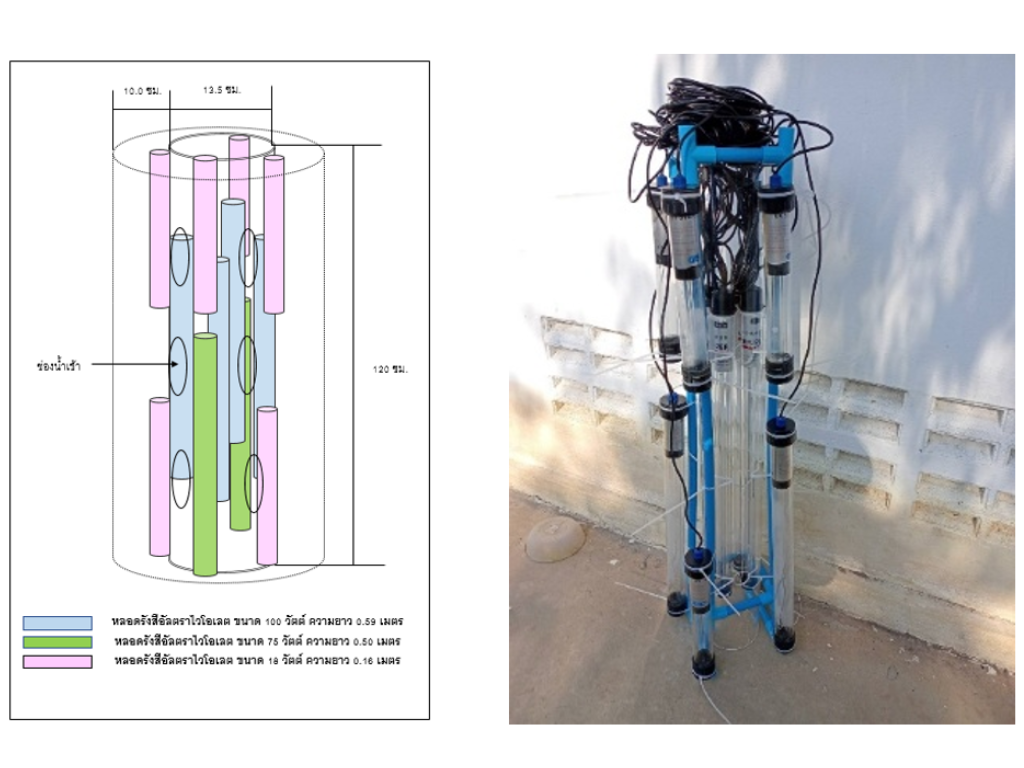
This research study aimed to evaluate the efficiency of an automatic ultraviolet (UV) disinfection system for village tap water, beginning with the system’s design and development and followed by real-world application testing in target communities. The findings revealed that the automatic UV disinfection system effectively functioned and was appropriately designed for integration into various village tap water systems across Thailand. The system includes twelve low-pressure mercury UV lamps with a total power consumption of 658 watts. Lamps rated at 100, 75, and 18 watts produced UV doses of 9.314, 7.737, and 4.643 milliwatt-seconds per square centimeter, respectively, resulting in a significant microbiological reduction of Escherichia coli and most pathogens by 90% (1-log or D90). At a water flow rate of 32 liters per second, the UV radiation achieved a 99% reduction (2-log or D99) in microbial contamination. Field implementation was conducted at a large surface water village supply system in Moo 2, Phon Khrok Sub-district, Tha Tum District, Surin Province, where the system was installed at the main distribution pipe connected to the elevated water tank. The results confirmed effective disinfection; however, pathogen contamination was still detected at the endpoints due to pipeline recontamination. To address this, drinking water filtration systems developed by the Department of Science Service were installed to ensure compliance with the potable water quality standards of the Department of Health. This research is scalable for addressing village tap water quality nationwide and aligns with the 20-Year Master Plan for Water Resource Management (2018–2037), which mandates that every village have access to clean water for consumption and household use that meets quality standards.
References
กรุงเทพธุรกิจ. น้ำประปาหมู่บ้าน แค่ 4% ผ่านรับรองความปลอดภัย [อินเทอร์เน็ต]. 2568 [เข้าถึงเมื่อ 6 พฤษภาคม 2568]. เข้าถึงได้จาก: https://www.bangkokbiznews.com/health/public-health/1162649
ศูนย์การศึกษาเพื่อชุมชนในเขตภูเขา. รายการข้อมูลที่นำมาใช้ (วิเคราะห์สถานการณ์) ตัวชี้วัดที่ 3.32 : รอบ 5 เดือนแรก ประจำปีงบประมาณ 2568 ศูนย์การเรียนรู้ชุมชนชาวไทยภูเขา “แม่ฟ้าหลวง” เข้าถึงน้ำบริโภคสะอาดตามมาตรฐานกรมอนามัย [อินเทอร์เน็ต]. 2568 [เข้าถึงเมื่อ 6 พฤษภาคม 2568]. เข้าถึงได้จาก: https://hhdc.anamai.moph.go.th/web-upload/40x2bbc9a2164f1c536be9c0394dc58f0e6/filecenter/pa/pa2568/3.32/01_First_Round/3.32-01.pdf
Sun W, Ao X, Lu D, Zhang Y, Xue Y, He S, et al. Ultraviolet technology application in urban water supply and wastewater treatment in China: Issues, challenges and future directions. Water Research X. 2024;23:1-8. https://doi.org/10.1016/j.wroa.2024.100225
Paidalwar AA, Khedikar IP. Overview of water disinfection by UV technology – A review. International Journal of Science Technology & Engineering. 2016;2(9):213-219. https://doi.org/10.13140/RG.2.2.30976.25608
Caroline K. Misleading math: Kill claims and log reduction [Internet]. 2019 [cited 2024 Dec 12]. Available from: https://infectioncontrol.tips/2019/06/17/kill-claims-and-log-reduction/
กระทรวงทรัพยากรธรรมชาติและสิ่งแวดล้อม, กรมทรัพยากรน้ำ, สำนักบริหารจัดการน้ำ. แบบมาตรฐานระบบประปาหมู่บ้านแบบผิวดินขนาดใหญ่. กรุงเทพฯ: สำนักบริหารจัดการน้ำ; 2546.
Downloads
Published
How to Cite
Issue
Section
License
Copyright (c) 2025 Bulletin of Applied Sciences

This work is licensed under a Creative Commons Attribution-NonCommercial-NoDerivatives 4.0 International License.