Determination of lead in paper for food contact by inductively coupled plasma mass spectrometry
DOI:
https://doi.org/10.60136/bas.v13.2024.2986Keywords:
Inductively coupled plasma mass spectrometry, Paper for food contact, Lead, Microwave digestionAbstract
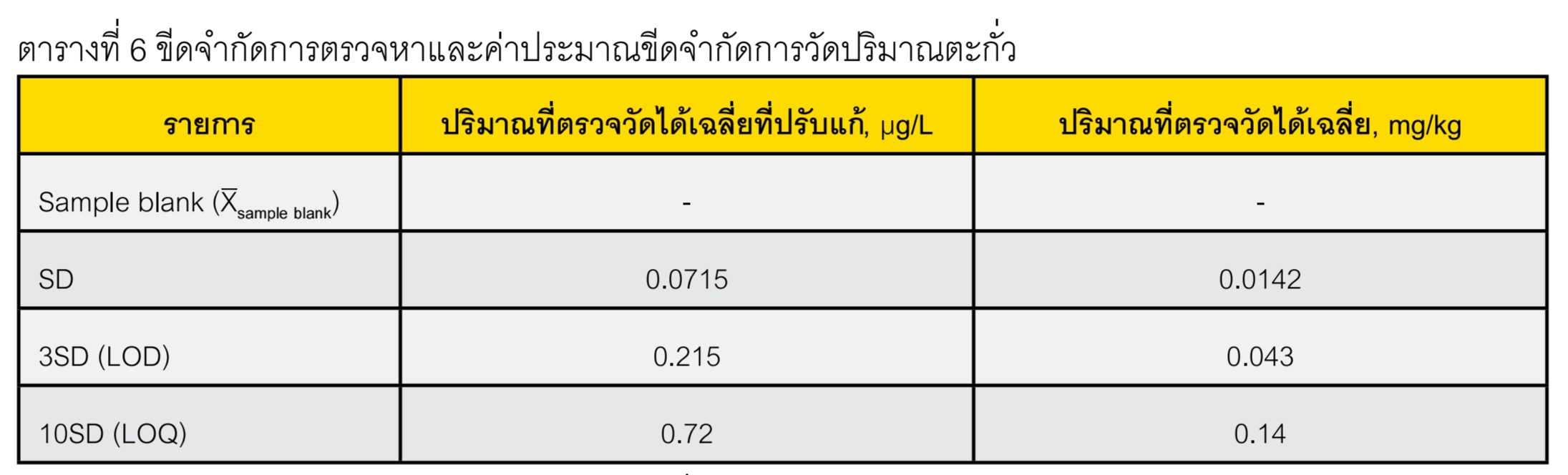
This study aimed at the method validation for determination of lead contamination in paper for food contact materials (FCMs). They were digested with acid and using the microwave digestion. Then the amount of lead in the solution was determined by inductively coupled plasma mass spectrometer and the performance characteristics which are linearity, limit of determination (LOD), limit of quantitation (LOQ), bias, precision and matrix effect were studied. The target uncertainty associated with the quantification of lead in paper, should be no bigger than ±15%. From the study, it was found that LOD and LOQ are 0.043 mg/kg and 0.40 mg/kg, respectively, while working range of this method was 0.40–4.0 mg/kg. The method bias was evaluated from the recoveries of the standard substance added to the lead-free paper at 3 concentration levels (low, medium and high) of the working range under repeatability conditions. It showed that the recoveries were 97.0–103.2%. The precision study, the same concentration of the bias study was added to the samples showed that the relative standard deviation was less than 10% and the matrix effect was investigated by considering the relationship between the concentration and the amount of lead in the paper sample solution. It was found that the coefficient of determination, R2 approached 1. This indicates that there is no matrix effect. The information obtained from the bias and precision can be used to estimate measurement uncertainty. It was found that the expanded uncertainties of this method at the confidence level of 95% was ±15%. Therefore, the proposed method for determination of lead in paper is accurate, precise, reliable, and fit for the intended use.
References
สำนักงานมาตรฐานผลิตภัณฑ์อุตสาหกรรม (สมอ.). มาตรฐานผลิตภัณฑ์อุตสาหกรรมกระดาษสัมผัสอาหาร.มอก. 2948-2562. กรุงเทพฯ: สมอ.; 2562.
สำนักงานมาตรฐานผลิตภัณฑ์อุตสาหกรรม (สมอ.). มาตรฐานผลิตภัณฑ์อุตสาหกรรมกระดาษสัมผัสอาหารสำหรับปรุงอาหารด้วยความร้อน. มอก. 3438-2565. กรุงเทพฯ: สมอ.; 2565.
British Standard Institution (BSI). Paper and board-Paper and board intended to come into contact with foodstuffs - Determination of cadmium, chromium and lead in an aqueous extract. BS EN 12498:2018. London: BSI; 2018.
British Standard Institution (BSI). Paper and board intended to come into contact with foodstuffs - Preparation of a hot water extract. BS EN 647:1994. London: BSI; 1994.
British Standard Institution (BSI). Paper and board intended to come into contact with foodstuffs - Preparation of a cold water extract. BS EN 645:1994. London: BSI; 1994.
จิตวิไล เวฬุวนารักษ์. การตรวจสอบความใช้ได้ของวิธีทดสอบปริมาณแคดเมียมและตะกั่วที่แพร่จากกระดาษสัมผัสอาหาร: เอกสารผลงานที่เสนอเพื่อการประเมินแต่งตั้งให้ดำรงตำแหน่ง นักวิทยาศาสตร์ชำนาญการพิเศษ; 2567.
Magnusson B, Örnemark U, editors. Eurachem Guide: The fitness for purpose of analytical methods – a laboratory guide to method validation and related topics. [place unknown]: Eurachem; 2014.
Barwick VJ, Ellison SLR. VAM Project 3.2.1 Development and harmonisation of measurement uncertainty principles part (d): protocol for uncertainty evaluation from validation data version 5.1 [Internet]. Teddington (UK): LGC (Teddington) Limited; 2000 [cited 2023 Dec 20]. Available from: http://www.demarcheiso17025.com/private/Protocol%20for%20uncertainty%20evaluation%20from%20validation%20data.pdf
Analytik Jena AG. TOPwave Microwave system for pressure digestion. Jena: Analytik Jena AG; 2014.
PerkinElmer Inc. Syngistix for ICP-MS software reference guide. Shelton (CT): PerkinElmer; 2014.
AOAC International. Appendix F: guidelines for standard method performance requirements [Internet]. 2016 [cited 2023 Dec 20]. Available from: https://www.aoac.org/wp-content/uploads/2019/08/app_f.pdf
Downloads
Published
How to Cite
Issue
Section
License
Copyright (c) 2024 Bulletin of Applied Sciences

This work is licensed under a Creative Commons Attribution-NonCommercial-NoDerivatives 4.0 International License.