
Light Curve Analysis of KIC 12109575 and Nova Test Approach
Article Sidebar
Main Article Content
Abstract
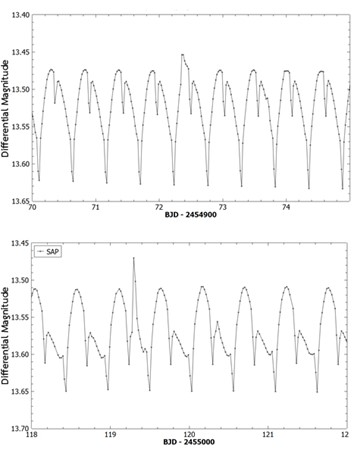
The aim of the study is to provide an applicable method to investigate the physical parameters of binary systems listed in the big data on-line Kepler archive whose radial velocity curves are not available. An eclipsing binary star KIC 12109575 was selected due to its 0.5-day period which is the lower limit of novae population. An unpublished light curve of KIC 12109575 was collected and analyzed by using the Wilson & Devinney code to derive the relative physical parameters. We found that light curves presented the changing of primary and secondary minima with time. This can be due to the existing of an accretion disc or spots. Even though the detailed observations and more complicated investigations were promised to be made, we presented here the light curve solution for selected time. Preliminary result was suggested that the temperature of the primary and secondary stars
could be
and
. Meanwhile the radius were
and
, respectively with the inclination of
degree. In order to get a better fitting, at least one hot spot on the secondary star with a temperature fraction around
should be located on the secondary. On the assumption that the secondary star is a white dwarf with radius range of
, yielding
with mass
for the white dwarf whit mass of
, respectively. Such small radius and mass of the primary suggest that it could be also another white dwarf which rule out the system to be a nova. Moreover, considering the temperature of the secondary star
if it is a white dwarf, it would be a cool low-mass white dwarf
which is too low and would not be able to accrete mass up enough to ignite the thermonuclear runaway as a nova in the future.
Article Details

This work is licensed under a Creative Commons Attribution-NoDerivatives 4.0 International License.
บทความที่ได้รับการตีพิมพ์เป็นลิขสิทธิ์ของวารสาร มรภ.กพ. วิทยาศาสตร์ คณิตศาสตร์ และเทคโนโลยี
ข้อคิดเห็นใดๆ ที่ปรากฎในวารสารเป็นวรรณกรรมของผู้เขียนโดยเฉพาะ ซึ่งมหาวิทยาลัยราชภัฏกำแพงเพชรและบรรณาธิการไม่จำเป็นต้องเห็นด้วย
References
Kang Y. W. (2008). Light Curve Analyses of the Eclipsing Binaries in the Small Magellan Cloud, J. Astron. Space Sci. Vol. 25 Issue 2 pp. 77-86
Surina F. and Kang Y. W. (2009). Absolute Dimensions of Four Eclipsing Binaries, ASP Conf. Ser., Vol. 404 pp. 178-183.
ฟ้ารุ่ง สุรินา บุญทิศ (2565) ฟิสิกส์ดาราศาสตร์เบื้องต้นของโนวา (Introduction to Astrophysics of Nova Eruption). กรุงเทพ : ดีเซมเบอรี่ จำกัด
Wilson R. E. and Devinney E. J. (1971). Realization of Accurate Close-Binary Light Curves: Application to MR Cygni, Astrophys. J. Astrophysical Journal, vol. 166, pp. 605-619.
Qian S. B., Zhang J., He J. J., Zhu L. Y., Zhao E. G., Shi X. D., Zhou X. and Han Z. T. (2018). Physical Properties and Evolutionary States of EA-type Eclipsing Binaries Observed by LAMOST, Astrophys. J. Suppl. Ser. Vol. 235 Issue 5 pp. 1-12.
Shuntov M 2018 Master Degree Report Aix Marseille Université.
Kang Y. W., Hong K. S. and Lee J. (2007). Eclipsing Binaries: The Primary Distance Indicator, ASP Conf. Ser. Vol. 362 pp. 19-25.
Aindang A., Inkum R., Sarotsakulchai T. and Surina F. (2021). Kepler-TESS light curve analysis of KIC 10417986 as a practical example for astronomical research in schools, J. Phys Conf. Ser. Vol. 1719 pp. 012017.
Surina F., Bode M. F. and Darnley M. J. (2015). Investigation of Halactic Classical and Recurrent NOVAE with Ground-Base Observations and the Solar Mass Ejection Imager (SMEI), Pub. of Korean Astron. Soc. Vol. 30 Issue 2 pp30 237-240.
Knote M. F., Caballero-Nieves S. M. , Gokhale V. Johnston K. B. and Perlman E. S. (2022). Characteristics of Kepler Eclipsing Binaries Displaying a Significant O'Connell Effect, Astrophys. J. Suppl. Ser. Voi. 262 Issue 1 pp. (32p).
