
Effects of heating methods on the quality of ready-to-drink roselle juice mixed with chinese jujubes
Article Sidebar
Main Article Content
Abstract
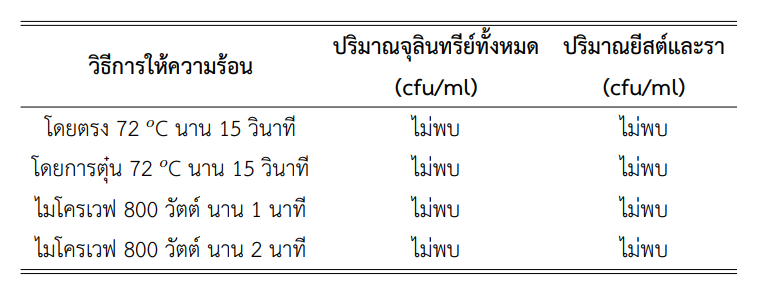
This research aims to study the result of heating’s effects on ready-to-drink roselle juice mixed with Chinese jujubes qualities by studying 4 heating methods: Method 1, direct heating at 72 degrees Celsius for 15 seconds; Method 2, heating by steaming at 72 degrees Celsius for 15 seconds; Method 3, heating by using an 800 watts microwave for 1 minute; and Method 4, heating by using an 800 watts microwave for 2 minutes. The research found the 4 heating methods caused ready-to-drink to have color values of L*, a*, and b* differed in a statistically significant way. The pH values were between 2.82 to 3.03 which were not different. Conversely, phenolic compounds, antioxidant activities by DPPH method, and anthocyanins differed in a statistically significant way. Method 3 heating by using 800 watts for 1 minute caused ready-to-drink roselle juice mixed with Chinese jujubes to have the most quantities of phenolic compounds (0.43 mg of gallic acid/100 g), antioxidant activities (85.53 µM T.E/100 g), and anthocyanins (177.50 mg/L of Delphinidin-3-glucoside). In addition, this method had the highest satisfaction scores in the sensory test which consisted of appearance; color; taste; and overall satisfaction when compared to other heating methods. The total viable count, total yeasts and molds count were undetectable in ready-to-drink roselle juice mixed with Chinese jujubes that went through the 4 heating methods.
Article Details

This work is licensed under a Creative Commons Attribution-NoDerivatives 4.0 International License.
บทความที่ได้รับการตีพิมพ์เป็นลิขสิทธิ์ของวารสาร มรภ.กพ. วิทยาศาสตร์ คณิตศาสตร์ และเทคโนโลยี
ข้อคิดเห็นใดๆ ที่ปรากฎในวารสารเป็นวรรณกรรมของผู้เขียนโดยเฉพาะ ซึ่งมหาวิทยาลัยราชภัฏกำแพงเพชรและบรรณาธิการไม่จำเป็นต้องเห็นด้วย
References
สถาบันอาหาร. (2562 ธันวาคม). ส่วนแบ่งตลาดเครื่องดื่มเพื่อสุขภาพจากธรรมชาติ ปี 2561. ศูนย์อัจฉริยะเพื่ออุตสาหกรรมอาหาร. http://fic.nfi.or.th/FoodMarketShareInThailandDetail.php?id=295.
ณัฐยา เหล่าฤทธิ์ และมยุรี กัลยาวัฒนกุล. (2555). รายงานวิจัยฉบับสมบูรณ์ เรื่อง ฤทธิ์ทางชีวภาพและความคงตัวของสีจากเศษเหลือทิ้งในอุตสาหกรรมการผลิตน้ำกระเจี๊ยบ. มหาวิทยาลัยแม่ฟ้าหลวง.
ศุภาพิชญ์ ขัดทา. (2551). การพัฒนาชาชงผสมลำไย พุทราจีนและใบหม่อน. การค้นคว้าแบบอิสระ วิทยาศาสตรมหาบัณฑิต สาขาวิทยาศาสตร์และเทคโนโลยีการอาหาร บัณฑิตวิทยาลัย มหาวิทยาลัยเชียงใหม่.
ทีมแพทย์แผนไทยประยุกต์ HD. (2563). พุทราจีน (Jujube) : ประโยชน์และสรรพคุณทางยาของพุทราจีน. https://hd.co.th/jujube.
แพรภัทร ยอดแก้ว. (ม.ป.ป.). น้ำกระเจี๊ยบผสมพุทราจีน. Gotoknow. http://www.gotoknow.org/posts/371535.
ณัฎวลิณคล เศรษฐปราโมทย์, ชณิชา จินาการ และสุกัญญา วงวาท. (2556). ผลของการให้ความร้อนด้วยไมโครเวฟต่อคุณภาพน้ำฟักข้าวผสมน้ำเสาวรส. วารสารวิชาการและวิจัย มทร.พระนคร. ฉบับพิเศษ การประชุมวิชาการมหาวิทยาลัยเทคโนโลยีราชมงคล ครั้งที่ 5, 274-279.
บทที่ 8 การใช้ไมโครเวฟในการแปรรูปอาหาร. (ม.ป.ป.). http://conf.agi.nu.ac.th/agmis/download/publication/204_file.pdf.
Finocchaiaro, F., Ferrari, B. and Gianinetti, A. (2010). A study of biodiversity of flavonoid content in the rice caryopsis evidencing simultaneous accumulation of anthocyanins and proanthocyanidins in a black-grained genotype. Journal of Cereal Science, 51, 28-34.
Singleton, V.L., Orthofer, R. and Lamuela-Raventós, R.M. (1999). Analysis of total phenols and other oxidation substrates and antioxidants by means of folin- ciocalteu reagent. Methods in Enzymology. 299: 152-178.
Dasgupta, N. and Bratati, De. (2004). Antioxidant activity of Piper betle L. leaf extract in vitro. Food Chemistry, 88 (2), 219-224.
บุษกร อุตรภิชาติ. (2552). จุลชีววิทยาทางอาหาร. (พิมพ์ครั้งที่ 4). สงขลา: ศูนย์หนังสือมหาวิทยาลัยทักษิณ.
รุ่งทิวา วงค์ไพศาลฤทธิ์, ดวงฤทัย ธำรงโชติ และวิภาวัน จุลยา. (2551). ความคงตัวของแอนโทไซยานินในผลิตภัณฑ์เครื่องดื่มบางชนิด. รายงานการวิจัย. มหาวิทยาลัยเทคโนโลยีราชมงคลกรุงเทพ.
พัชรี สิริตระกูลศักดิ์ และสกุลกานต์ สิมลา. (2558). ผลของกรรมวิธีการประกอบอาหารต่อปริมาณสารต้านอนุมูลอิสระในดอกชมจันทร์. แก่นเกษตร, 43 (ฉบับพิเศษ 1), 875-880.
วชิระ จิระรัตนรังษี และปิยะพร บุตรพรหม. (2560). ผลของกระบวนการแปรรูปที่แตกต่างกันต่อปริมาณสารประกอบฟีนอลิก ปริมาณแอนโธไซยานิน ความสามารถในการต้านอนุมูลอิสระ และการยอมรับจากผู้บริโภคของผลิตภัณฑ์ชาใบข้าวก่ำ. วารสารมหาวิทยาลัยศรีนครินทรวิโรฒ (สาขาวิทยาศาสตร์และเทคโนโลยี). 9 (17), 91-103.
มาตรฐานผลิตภัณฑ์ชุมชน มผช.535/2554. (2554). น้ำกระเจี๊ยบ. กรุงเทพฯ: กระทรวงอุตสาหกรรม.
Juan A. C., José, E.C., Johannes de B. and Leslie, V.V. (2002). Pasteurisation of apple juice by using microwaves. LWT-Food Science and Technology. 35 (5), 389-392.
Zhi Q., Zhongwei T., Fang L., Shyam S. S., Carolyn F. R., Sindhuja S. and Juming T. (2021). Quality of green beans (Phaseolus vulgaris L.) influenced by microwave and hot water pasteurization. Food Control. 124, 1-9.
Gabriella M-O, Amanda J. D, M. Fernanda S M-G, Osvaldo H. C. (2020). Microwave pasteurization of apple juice: modeling the inactivation of Escherichia coli O157:H7 and Salmonella typhimurium at 80–90 °C. Food Microbiology. 87, 1-12.
