Product Development of Jasmine Rice Crackers Fortified with Coffee Pulp Powder
Article Sidebar
Main Article Content
Abstract
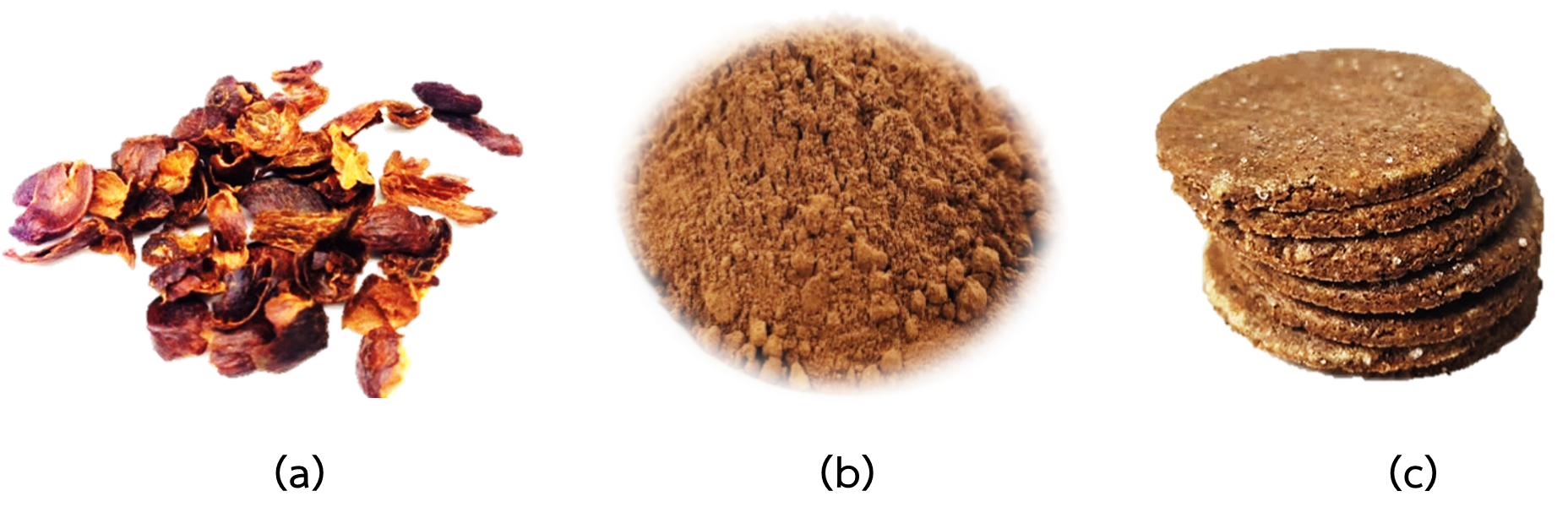
This research aims to analyze the chemical composition of coffee pulp powder and investigate the suitable amount of coffee pulp powder in Jasmine rice crackers. The result shows that coffee pulp powder has a moisture content of 8.6 (% by wt.), aw of 0.48, and fiber, protein, ash content, and fat at 30.85, 13.67, 10.01, and 2.75 (% by wt.) respectively. The total phenolics content is 12.54 (mg. GAE/g.) and the antioxidant activity of 74.14 (% DPPH inhibition). The use of coffee pulp powder as a flour alternative at 4, 6, and 8% resulted in a significant change (p<0.05) in moisture, fiber, ash, protein, and total phenolic content as well as antioxidant activity. The consumer rating on color, smell, taste, and texture reduced significantly statistically (p<0.05). Jasmine rice cracker with 6 (% by wt.) coffee pulp powder has an evaluation score in the medium range at 7.15. Therefore, the Jasmine rice cracker with 6 (% by wt.) coffee pulp powder was selected as the protocol product. The protocol product has moisture, fiber, ash, and protein content of .82, 16.76, 3.28, and 7.46 (% by wt.). The total phenolic content is 1.73 (mg. GAE/g.), and the antioxidant activity is 63.94 (% DPPH inhibition). It is concluded that coffee pulp powder can be used as a nutrient enrichment ingredient in food and phytochemicals that can increase antioxidant activity in food products.
Article Details

This work is licensed under a Creative Commons Attribution-NoDerivatives 4.0 International License.
บทความที่ได้รับการตีพิมพ์เป็นลิขสิทธิ์ของวารสาร มรภ.กพ. วิทยาศาสตร์ คณิตศาสตร์ และเทคโนโลยี
ข้อคิดเห็นใดๆ ที่ปรากฎในวารสารเป็นวรรณกรรมของผู้เขียนโดยเฉพาะ ซึ่งมหาวิทยาลัยราชภัฏกำแพงเพชรและบรรณาธิการไม่จำเป็นต้องเห็นด้วย
References
Blinová, L., Sirotiak, M., Bartošová, A. & Soldán, M. (2017). Review: Utilization of Waste From Coffee Production. Research Papers Faculty of Materials Science and Technology Slovak University of Technology, 25(40), 91-101. https://doi.org/10.1515/rput-2017-0011.
วิภา สุโรจนะเมธากุล. (2556). โรคแพ้กลูเตนและความสำคัญของอาหารปราศจากกลูเตน. อาหาร, 43 (3), 16-21.
Irakli, M., Katsantonis, D. & Kleisiaris, F. (2015). Evaluation of quality attributes, nutraceutical components and antioxidant potential of wheat bread substituted with rice bran. J. of Cereal Science, (65), 74-84.
Wanyo, P., Meeso, N. & Siriamornpun, S. (2014). Effect of different treatment on the antioxidant properties and phenolic compounds of rice bran and rice husk. Food Chemistry, (157), 457-463.
Esquivel, P. and Jimenez, M. V. (2012). Functional properties of coffee and coffee by product. Food Research International, 46, 488-495.
ชุติมณฑน์ พลอยประดับ, พุทธพร เจียมศุภกิตต์ และ นิรมล ปัญญ์บุศยกุล. (2553). ฤทธิ์การต้านออกซิเดชั่นของส่วนต่างๆ ของผลกาแฟอาราบิก้า และกากกาแฟ. ว.วิทย์. กษ., 41(3/1) (พิเศษ), 577-580.
สถาบันโภชนาการมหิดล. (2563, 25 พฤศจิกายน). องค์ประกอบทางโภชนาการแป้งข้าวกล้อง. https://inmu2-.mahidol.ac.th/thaifcd/home.php.
สำนักงานมาตรฐานผลิตภัณฑ์อุตสาหกรรม. (2555). มาตรฐานผลิตภัณฑ์ชุมชน เรื่อง ขนมปังกรอบ มผช. 523/2555
สายใจ ปอสูงเนิน และ ธีระ ธรรมวงศา. (2561). องค์ประกอบทางเคมีบางประการ และคุณสมบัติต้านอนุมูลอิสระของข้าวพื้นเมืองในจังหวัดนครราชสีมา. ว.วิทยาศาสตร์บูรพา, 23(2), 971-984.
Moreno, J., Cozzano, S., Perez, A. M., Arcial, P. and Curutchet, A. (2019). Coffee Pulp Waste as a Functional Ingredient: Effect on Salty Cookies Quality. J. of Food and Nutrition Research, 7(9), 632-638.
