Development of Learning Outcomes on Volume Measurement Problem Solving through Cooperative Learning with STAR Strategies for 1st Year Secondary School Students at Thepsatri Rajabhat University Demonstration School
Article Sidebar
Main Article Content
Abstract
This research aims to 1) compare the mathematics learning outcomes on volume measurement problem-solving for first year secondary school students at Thepsatri Rajabhat University Demonstration School before and after implementing cooperative learning with STAR strategies. 2) To compare the students' problem-solving abilities in mathematics before and after the cooperative learning with STAR strategies against the 70% criterion, promoting participation, analytical thinking, and collaborative problem-solving. The sample consisted of forty-five secondary school students in the first year, selected through purposive sampling. The research instruments included a lesson plan using group work methods and a test on volume measurement problem-solving. The statistics for data analysis included mean, standard deviation, and t-test.
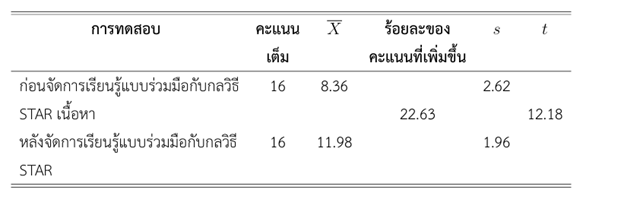
The results of the research were as follows 1) The students' mathematics learning outcomes on volume measurement problem-solving after the cooperative learning with STAR strategies were higher than before the intervention, with a mean score of 11.98, which increased by 3.62 points, representing a percentage increase of 22.63%. The t-test results met the criteria. 2) The students' ability to solve mathematical problems after the cooperative learning with STAR strategies exceeded the 70% criterion, with a mean score of 11.98 and a standard deviation of 1.96.
Article Details

This work is licensed under a Creative Commons Attribution-NoDerivatives 4.0 International License.
บทความที่ได้รับการตีพิมพ์เป็นลิขสิทธิ์ของวารสาร มรภ.กพ. วิทยาศาสตร์ คณิตศาสตร์ และเทคโนโลยี
ข้อคิดเห็นใดๆ ที่ปรากฎในวารสารเป็นวรรณกรรมของผู้เขียนโดยเฉพาะ ซึ่งมหาวิทยาลัยราชภัฏกำแพงเพชรและบรรณาธิการไม่จำเป็นต้องเห็นด้วย
References
กระทรวงศึกษาธิการ. (2560). หลักสูตรแกนกลางการศึกษาขั้นพื้นฐาน พุทธศักราช 2551 (ฉบับปรับปรุงพ.ศ. 2560). พิมพ์ครั้งที่ 1. กรุงเทพฯ: โรงพิมพ์ชุมนุมสหกรณ์การเกษตรแห่งประเทศไทย จำกัด.
ธนะชาติ ถนอมกุลบุตร. (2552). การศึกษาผลสัมฤทธิ์ทางการเรียนวิชาคณิตศาสตร์เรื่อง “การแปรผกผัน” โดย
การใช้กลวิธี STAR ของนักเรียนชั้นมัธยมศึกษาปีที่ 2 โรงเรียนบางบัวทอง จังหวัดนนทบุรี (วิทยานิพนธ์ปริญญามหาบัณฑิต ไม่ได้รับการตีพิมพ์). มหาวิทยาลัยเกษตรศาสตร์.
นัฎกัญญา เจริญเกียรติบวร. (2547). การศึกษาความสามารถในการแก้ปัญหาทางคณิตศาสตร์ เรื่องฟังก์ชันของนักเรียนระดับประกาศนียบัตรวิชาชีพ ชั้นปีที่ 2 โดยใช้การเรียนแบบร่วมมือ. สารนิพนธ์ กศ.ม. (การมัธยมศึกษา). กรุงเทพฯ: บัณฑิตวิทยาลัยมหาวิทยาลัยศรีนครินทรวิโรฒ.
นุตริยา จิตตารมย์. (2548). ผลของการสอนแก้ปัญหาคณิตศาสตร์โดยใช้กลวิธี STAR ที่มีต่อความสามารถในการแก้โจทย์ปัญหาและความคงทนในการเรียนคณิตศาสตร์ของนักเรียนชั้นมัธยมศึกษาปีที่ 1 จังหวัดสุราษฎร์ธานี (วิทยานิพนธ์ปริญญามหาบัณฑิต ไม่ได้ตีพิมพ์). จุฬาลงกรณ์มหาวิทยาลัย.
ประจบ แสงสีบับ. (2556). ผลการจัดการเรียนรู้แบบร่วมมือโดยใช้กลวิธี STAR เรื่องโจทย์ปัญหาสมการเชิงเส้นตัวแปรเดียวและการแปรผันที่มีต่อความสามารถในการแก้ปัญหาและทักษะการเชื่อมโยงทางคณิตศาสตร์ของนักเรียนชั้นมัธยมศึกษาปีที่ 2 (วิทยานิพนธ์ปริญญามหาบัณฑิต ไม่ได้รับการตีพิมพ์). มหาวิทยาลัยศรีนครินทรวิโรฒ.
ปาจรีย์ เยาดำ. (2552). การศึกษาผลสัมฤทธิ์ทางการเรียนวิชาคณิตศาสตร์ เรื่อง “การประยุกต์ของสมการเชิงเส้นตัวแปรเดียว” โดยการใช้กลวิธี STAR ของนักเรียนชั้นมัธยมศึกษาปีที่ 2 โรงเรียนสวัสดิ์รัตนาภิมุข จังหวัดตรัง. วิทยานิพนธ์ปริญญาศึกษาศาสตรมหาบัณฑิต (การสอนคณิตศาสตร์). กรุงเทพฯ: บัณฑิตวิทยาลัยมหาวิทยาลัยเกษตรศาสตร์.
พิชิต ฤทธิ์จรูญ. (2552). หลักการวัดประเมินผลการศึกษา (พิมพ์ครั้งที่ 5). กรุงเทพฯ: เฮ้าส์ออฟเคอร์มิสท์.
เมธิญา กาญจนรัตน์. (2552). ผลสัมฤทธิ์ทางการเรียนและความสามารถในการแก้โจทย์ปัญหาทางคณิตศาสตร์ของนักเรียนชั้นประถมศึกษาปีที่ 4 โดยการใช้การเรียนแบบร่วมมือเทคนิค STAR (วิทยานิพนธ์ปริญญามหาบัณฑิต ไม่ได้รับการตีพิมพ์). มหาวิทยาลัยทักษิณ.
สำนักงานปฏิรูปการศึกษา. (2545). แนวทางการบริหารและการจัดการศึกษาในเขตพื้นที่การศึกษาและสถานศึกษา (พิมพ์ครั้งที่ 2). กรุงเทพฯ: สำนักงานปฏิรูปการศึกษา.
