Effects of the Mixing Ratio of Wood and Plastic on Physical and Mechanical Properties of Wood-Plastic Composite Materials
Keywords:
Wood-plastic composites (WPCs), Tensile strength, Compressive strength, Flexural strengthAbstract
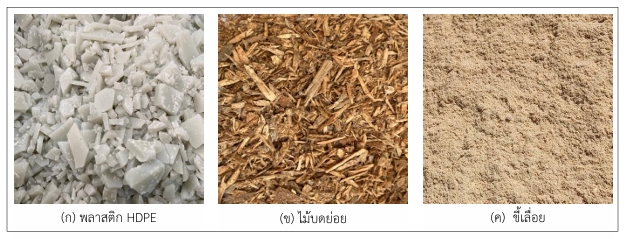
This research aims to develop a composite material made from HDPE plastic combined with either ground wood or sawdust to develop composite materials from waste materials. The raw materials used have particle sizes ranging from 0.2 to 0.7 millimetres and are mixed at ratios of 20 to 50 wt%. The mixture is then heated at 185°C for 20 minutes, followed by cooling for 40 minutes, depending on the type and ratio of the mixture. The physical and mechanical properties of the composites are then tested. The results of the relative density tests show that the density of the composite increases with a higher ratio of wood to plastic. Additionally, composites made with ground wood have a higher density than those made from sawdust at all wood-to-plastic ratios. The water absorption tests indicate that the water absorption of the composite ranges from 4.34 to 34.25%, increasing with the wood-to-plastic ratio. The tensile strength tests reveal that at a 20 wt% ratio, the composite containing sawdust achieves the highest average tensile strength of 16.70 MPa. The compressive strength tests of the composite do not show a clear trend with changing wood-to-plastic ratios, ranging from 13.83 to 16.67 MPa. The flexural strength tests indicate that the flexural strength of the composite decreases with an increasing wood-to-plastic ratio. When the composite plastic is molded into three types of prototype products: load-bearing products, indoor-use products, and outdoor-use products, it is found that the composite plastic is suitable for use in indoor and outdoor products. However, it is not yet highly suitable for use as a load-bearing material, and the mixing ratios or production processes may need to be adjusted for better suitability.
References
Arnandha, Y., Satyarno, I., Awaludin, A., Irawati, I. S., Prasetya, Y., Prayitno, D. A., Winata, D. C., Satrio, M. H., & Amalia, A. (2017). Physical and mechanical properties of WPC board from sengon sawdust and recycled HDPE plastic. Procedia Engineering, 171, 695-704. https://doi.org/10.1016/j.proeng.2017.01.412
Beg, M. D. H., & Pickering, K. L. (2008). Mechanical performance of Kraft fibre reinforced polypropylene composites: Influence of fibre length, fibre beating and hygrothermal ageing. Composites Part A: Applied Science and Manufacturing, 39(11), 1748-1755. https://doi.org/10.1016/j.compositesa.2008.08.003
Bouafif, H., Koubaa, A., Perré, P., & Cloutier, A. (2009). Effects of fiber characteristics on the physical and mechanical properties of wood plastic composites. Composites Part A: Applied Science and Manufacturing, 40(12), 1975-1981. https://doi.org/10.1016/j.compositesa.2009.06.003
Delviawan, A., Kojima, Y., Kobori, H., Suzuki, S., Aoki, K., & Ogoe, S. (2019). The effect of wood particle size distribution on the mechanical properties of wood–plastic composite. Journal of Wood Science, 65. Article 67. https://doi.org/10.1186/s10086-019-1846-9
Faruk, O., Bledzki, A. K., Fink, H.-P., & Sain, M. (2014). Progress report on natural fiber reinforced composites. Macromolecular Materials and Engineering, 299(1), 9-26. https://doi.org/10.1002/mame.201300008
Friedrich, D. (2022). Success factors of wood-plastic composites (WPC) as sustainable packaging material: A cross-sector expert study. Sustainable Production and Consumption, 30, 506-517. https://doi.org/10.1016/j.spc.2021.12.030
Khamtree, S., Srivabut, C., Khamtree, S., & Kaewmai, R. (2024). Effects of natural fiber waste, content, and coupling agent on the physical and mechanical properties of wood species–plastic composites as green materials. Fibers and Polymers, 25(4), 1391-1402. https://doi.org/10.1007/s12221-024-00493-9
Kim, J.-W., Harper, D. P., & Taylor, A. M. (2009). Effect of wood species on the mechanical and thermal properties of wood-plastic composites. Journal of Applied Polymer Science, 112(3), 1378-1385. https://doi.org/10.1002/app.29522
Li, L., Zuo, J., Chang, R., & Du, L. (2025). Converting plastic waste into wood-plastic composite products – A practical environmental impacts assessment using primary data. Resources, Conservation and Recycling, 218, Article 108267. https://doi.org/10.1016/j.resconrec.2025.108267
Miki, T., Seki, M., Tanaka, S., Sobue, N., Shigematsu, I., & Kanayama, K. (2014). Preparation of wood plastic composite sheets by lateral extrusion of solid woods using their fluidity. Procedia Engineering, 81, 580-585. https://doi.org/10.1016/j.proeng.2014.10.043
Raj, S. S., Michailovich, K. A., Subramanian, K., Sathiamoorthyi, S., & Kandasamy, K. T. (2021). Philosophy of selecting ASTM standards for mechanical characterization of polymers and polymer composites. Materiale Plastice, 58(3), 247-256. https://doi.org/10.37358/mp.21.3.5523
Ratanawilai, T., Leelasilapasart, V., Srivabut, C., & Ratanawilai, S. (2023). Lifetime prediction under dead-load long-term creep test and models analysis of wood-plastic composites for building materials. Plastics, Rubber and Composites: Macromolecular Engineering, 52(9-10), 506-515. https://doi.org/10.1080/14658011.2023.2232666
Toghyani, A., Matthews, S., & Varis, J. (2020). Forming challenges of extruded wood plastic composite products in a post-production process. Procedia CIRP, 93, 502-507. https://doi.org/10.1016/j.procir.2020.04.156
Turku, I., Kärki, T., & Puurtinen, A. (2018). Durability of wood plastic composites manufactured from recycled plastic. Heliyon, 4(3), Article e00559. https://doi.org/10.1016/j.heliyon.2018.e00559
Zhang, X., Zhang, J., & Wang, R. (2019). Thermal and mechanical behavior of wood plastic composites by addition of graphene nanoplatelets. Polymers, 11(8), Article 1365. https://doi.org/10.3390/polym11081365
Zhou, H., Li, W., Hao, X., Zong, G., Yi, X., Xu, J., Ou, R., & Wang, Q. (2022). Recycling end-of-life WPC products into ultra-high-filled, high-performance wood fiber/polyethylene composites: A sustainable strategy for clean and cyclic processing in the WPC industry. Journal of Materials Research and Technology, 18, 1-14. https://doi.org/10.1016/j.jmrt.2022.02.091
Downloads
Published
How to Cite
Issue
Section
License
Copyright (c) 2025 Chandrakasem Rajabhat University

This work is licensed under a Creative Commons Attribution-NonCommercial-NoDerivatives 4.0 International License.
บทความที่ได้รับการตีพิมพ์เป็นลิขสิทธิ์ของมหาวิทยาลัยราชภัฏจันทรเกษม
ข้อความที่ปรากฎในบทความแต่ละเรื่องในวารสารวิชาการเล่มนี้เป็นความคิดเห็นส่วนตัวของผู้เขียนแต่ละท่าน ไม่เกี่ยวข้องกับมหาวิทยาลัยราชภัฏจันทรเกษม และคณาจารย์ท่านอื่นในมหาวิทยาลัยแต่อย่างใด ความรับผิดชอบองค์ประกอบทั้งหมดของบทความแต่ละเรื่องเป็นของผู้เขียนแต่ละท่าน หากมีความผิดพลาดใดๆ ผู้เขียนแต่ละท่านจะรับผิดชอบบทความของตัวเองแต่เพียงผู้เดียว
 For Author