Efficiency of Bioextract from Urea Cow Manure and Goat Manure on the Growth and Quality of Brassica alboglabra L.H
Abstract
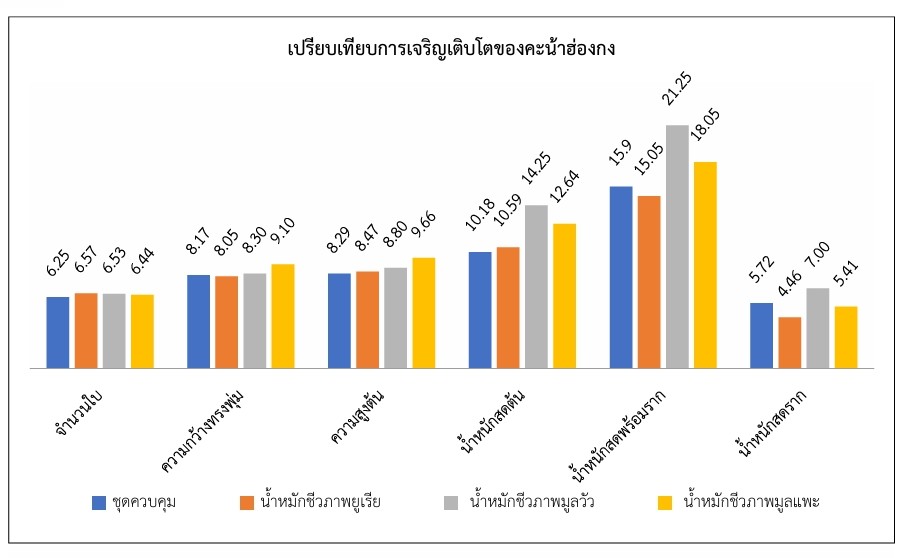
This study aimed to evaluate the effectiveness of different bio-fermented liquid fertilizers on the growth of Hong Kong kale (Brassica alboglabra) cultivated in pots. A Completely Randomized Design (CRD) was employed with four treatments: Treatment 1 (control, plain water), Treatment 2 (urea-based bio-fermented liquid fertilizer), Treatment 3 (cow manure-based bio-fermented liquid fertilizer), and Treatment 4 (goat manure-based bio-fermented liquid fertilizer). Each treatment was applied at 20 ml per 20 liters of water. The results indicated that Treatment 3, using cow manure-based fertilizer, produced the highest fresh weight with roots (21.25 grams) and shoot fresh weight (14.25 grams). Meanwhile, Treatment 2 resulted in the greatest number of leaves, averaging 9.96 leaves per plant. Treatment 4 exhibited the best canopy width and plant height, measuring 12.36 cm and 14.36 cm, respectively. In contrast, the control group (plain water) showed the lowest performance in all parameters, with an average of 8.19 leaves, a canopy width of 11.32 cm, a plant height of 12.32 cm, a fresh weight with roots of 15.90 grams, and a shoot fresh weight of 10.18 grams. Statistical analysis revealed that canopy width and plant height differed significantly among treatments (P<0.05), suggesting that the type of bio-fermented liquid fertilizer significantly influences certain growth traits of Hong Kong kale.
References
กองโภชนาการ กรมอนามัย. (ม.ป.ป.). ผักคะน้าราชินีผักใบเขียว. กรมอนามัย กระทรวงสาธารณสุข. https://nutrition2.anamai.moph.go.th/th/infographic/4536
ชินกร จิรขจรจริตกุล. (2566). ประสิทธิภาพของปุ๋ยน้ำหมักจากมูลวัวและมูลแพะต่อการเจริญเติบโตและผลผลิตของผักกาดกวางตุ้งฮ่องเต้. วารสารวิจัยและพัฒนาวไลยอลงกรณ์ ในพระบรมราชูปถัมภ์ สาขาวิชาวิทยาศาสตร์และเทคโนโลยี, 18(2), 107-119.
ภาควิชาปฐพีวิทยา คณะเกษตร มหาวิทยาลัยเกษตรศาสตร์. (2548). ปฐพีวิทยาเบื้องต้น (พิมพ์ครั้งที่ 10). มหาวิทยาลัยเกษตรศาสตร์.
มหาวิทยาลัยมหิดล และมูลนิธิโตโยต้าประเทศไทย. (2542). มหัศจรรย์ผัก 108 (พิมพ์ครั้งที่ 5). สำนักพิมพ์คบไฟ.
เยาวพล ชุมพล. (2564). ประสิทธิภาพของปุ๋ยน้ำหมักชีวภาพจากเมล็ดถั่วเหลืองและสัปปะรดในการเพิ่มผลผลิตคะน้า. วารสารเกษตรพระวรุณ มหาวิทยาลัยราชภัฏมหาสารคาม, 18(1), 34-40. https://doi.org/10.14456/paj.2021.4
สำนักวิจัยพัฒนาปัจจัยการผลิตทางการเกษตร กรมวิชาการเกษตร. (2548). วัสดุอินทรีย์และปุ๋ยคอกในพื้นที่ทำการเกษตร (พิมพ์ครั้งที่ 1). กรมวิชาการเกษตร.
หฤษฏ์ นิ่มรักษา. (2552). ประสิทธิภาพของปุ๋ยอินทรีย์ชีวภาพจากมูลแพะที่มีผลต่อการเจริญเติบโตของผักจำนวน 4 ชนิด [วิทยานิพนธ์ปริญญามหาบัณฑิต]. มหาวิทยาลัยราชภัฏจันทรเกษม.
Bailey, L. H. (1922). Various binomials. Gentes Herbarum; Occasional Papers on the Kinds of Plants, 1(1), 53-108.
Charoenpakdee, S. (2020). Using animal manure to grow lettuce (Lactuca sativa L.) in a Homemade Hydroponics System. Agriculture and Natural Resources, 54(4), 543–550.
Chen, J., Liu, X., Liu, C., Mao, B., Liu, W., & Zhang, H. (2018). Environmentally friendly fertilizers: A review of materials used and their effects on the environment. Science of The Total Environment, 613-614, 829-839. https://doi.org/10.1016/j.scitotenv.2017.09.186
Das, H., Devi, N. S., Venu, N., & Borah, A. (2023). Chemical fertilizer and its effects on the soil environment. In Research and review in agriculture sciences (Vol. 7, pp. 31-51). Bright Sky Publications.
FitAudit. (n.d.). Chinese broccoli —Nutrition Facts. https://fitaudit.com/food/122431
Shaviv, A. (2005). Advances in controlled-release fertilizers. Advances in Agronomy, 87, 1-74. https://doi.org/10.1016/S0065-2113(05)87001-4
Downloads
Published
How to Cite
Issue
Section
License
Copyright (c) 2025 Chandrakasem Rajabhat University

This work is licensed under a Creative Commons Attribution-NonCommercial-NoDerivatives 4.0 International License.
บทความที่ได้รับการตีพิมพ์เป็นลิขสิทธิ์ของมหาวิทยาลัยราชภัฏจันทรเกษม
ข้อความที่ปรากฎในบทความแต่ละเรื่องในวารสารวิชาการเล่มนี้เป็นความคิดเห็นส่วนตัวของผู้เขียนแต่ละท่าน ไม่เกี่ยวข้องกับมหาวิทยาลัยราชภัฏจันทรเกษม และคณาจารย์ท่านอื่นในมหาวิทยาลัยแต่อย่างใด ความรับผิดชอบองค์ประกอบทั้งหมดของบทความแต่ละเรื่องเป็นของผู้เขียนแต่ละท่าน หากมีความผิดพลาดใดๆ ผู้เขียนแต่ละท่านจะรับผิดชอบบทความของตัวเองแต่เพียงผู้เดียว
 For Author