Energy Conservation of a Split Air-Conditioner by Installing PVC Filling at Condensing Unit
Keywords:
CO2 emission, Energy conservation, Energy efficiency, PVC filling, Split air-conditioningAbstract
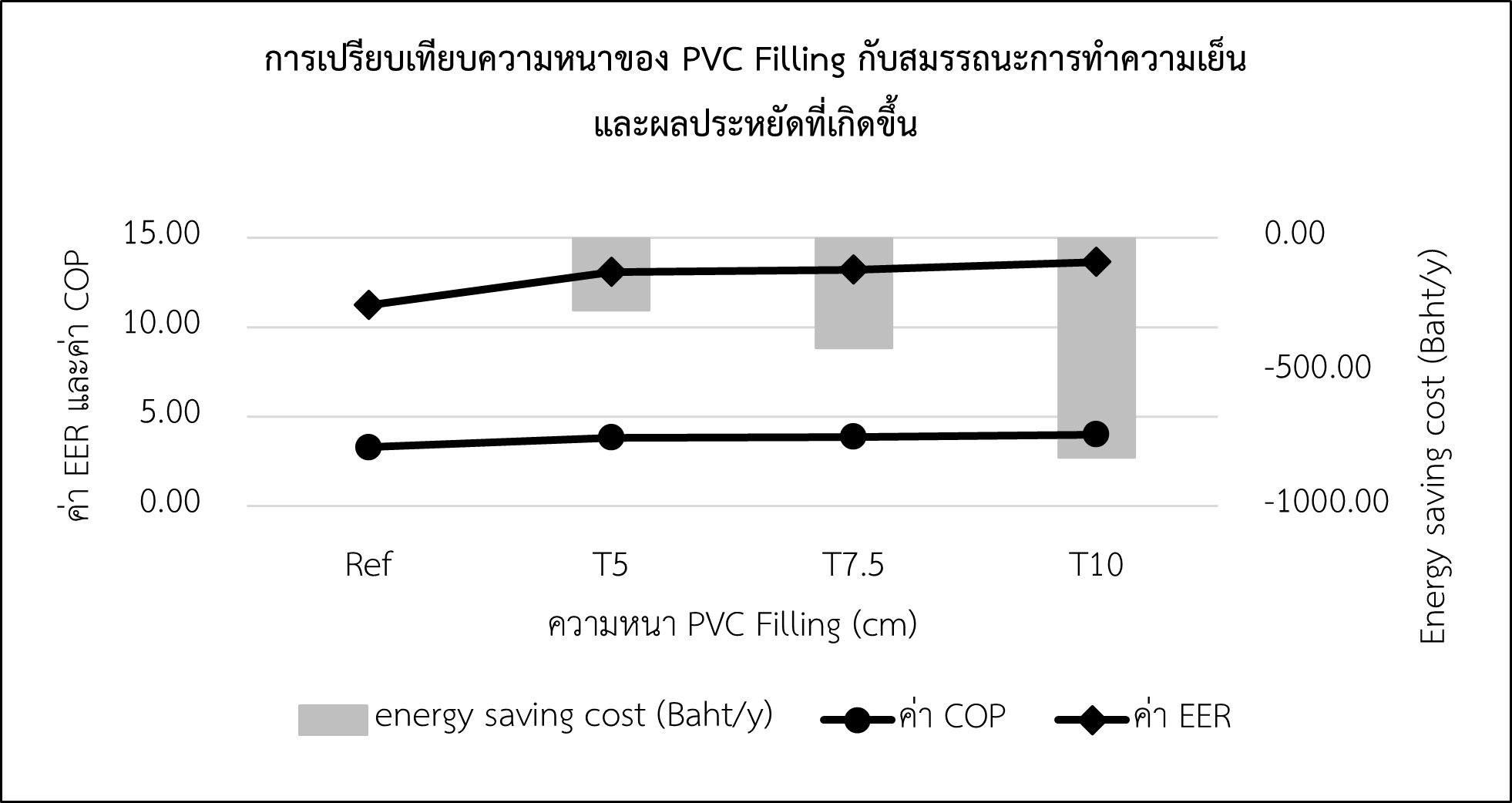
This study aims to examine the installation of PVC filling media pads within an air-cooled condenser that exchanged the heat between water and hot air before the air entered the condenser. The study compared the coefficient of performance (COP), energy efficiency ratio (EER) and energy-saving cost in two cases: 1) the non-installation of PVC filling and 2) the installation of PVC filling of thicknesses 5, 7.5, and 10 cm. An air-cooled, split-type air conditioner, brand Focus, with a cooling capacity of 25,000 Btu/h. The air conditioner was set to a temperature of 25°C, with an airflow speed of 1 m/s and a cooling water flow rate of 2,500 L/h. The results showed that the PVC filling with a thickness of 10 cm provided the best energy efficiency. The EER and COP increased by 21.33% and 21.58%, respectively. Additionally, energy consumption was reduced by 5.67%, and the energy-saving cost was 817.61 baht/year. Moreover, energy conservation through the installation of PVC filling at the condenser could reduce CO2 emissions by 96.90 kgCO2/year.
References
การไฟฟ้านครหลวง (สำนักงานใหญ่). (2567, 27 มีนาคม). กกพ. ประกาศตรึงค่าเอฟที 39.72 สตางค์/หน่วย ค่าไฟฟ้าเรียกเก็บเฉลี่ย 4.18 บาท/หน่วย ถึง ส.ค.67. การไฟฟ้านครหลวง. https://www.erc.or.th/th/news-release/3029
ชาติชาย พิสุทธิบริบูรณ์. (2551). การกำหนดประสิทธิภาพเครื่องปรับอากาศโดยคำนึงถึงสภาพภูมิอากาศ. สมาคมวิศวกรรมปรับอากาศแห่งประเทศไทย, 16, 82–91.
ธงไชย เดิมดา, & นุภาพ แย้มไตรพัฒน์. (2553). การศึกษาสมรรถนะของเครื่องปรับอากาศที่ติดตั้งแผ่นลดอุณหภูมิร่วมกับอินเวอร์เตอร์. วิศวสารลาดกระบัง, 27(4), 49–54.
ธีรพงศ์ บริรักษ์, & พงษ์สวัสดิ์ คชภูมิ. (2556). การลดอุณหภูมิก่อนเข้าคอนเดนเซอร์เพื่อเพิ่มสมรรถนะระบบปรับอากาศแบบแยกส่วนด้วยการใช้ PVC Filling. วารสารวิชาการมหาวิทยาลัยอีสเทิร์นเอเชีย, 6(2), 147–155. https://he01.tci-thaijo.org/index.php/EAUHJSci/article/view/25741/21863
นพรัตน์ อมัติรัตน์, & สาธิต ทูลไธสง. (2562). ศึกษาการลดอุณหภูมิก่อนเข้าเครื่องควบแน่นของเครื่องปรับอากาศแบบแยกส่วนชนิดระบายความร้อนด้วยอากาศด้วยแผ่นระเหย. ใน การประชุมวิชาการเครือข่ายวิศวกรรมเครื่องกลแห่งประเทศไทย ครั้งที่ 33. มหาวิทยาลัยมหาสารคาม.
ศูนย์ภูมิอากาศ กรมอุตุนิยมวิทยา. (ม.ป.ป.). สถิติภูมิอากาศ. กรมอุตุนิยมวิทยา. http://climate.tmd.go.th/content/category/29
สหประชาชาติประเทศไทย. (ม.ป.ป.). การเปลี่ยนแปลงสภาพภูมิอากาศ. สหประชาชาติประเทศไทย. https://thailand.un.org/th/173511-การเปลี่ยนแปลงสภาพภูมิอากาศ
สำนักกำกับและอนุรักษ์พลังงาน. (2553). คู่มือผู้รับผิดชอบด้านพลังงาน (อาคาร) พ.ศ.2553 (พิมพ์ครั้งที่ 1). http://berc.dede.go.th/?page_id=842
องค์การบริหารก๊าซเรือนกระจก. (2565). Emission Factor (CFO). องค์การบริหารก๊าซเรือนกระจก. https://thaicarbonlabel.tgo.or.th/index.php?lang=TH&mod=YjNKbllXNXBlbUYwYVc5dVgyVnRhWE56YVc5dQ
Atmaca, I., Senol, A., & Caglar, A. (2022). Performance testing and optimization of a split-type air conditioner with evaporatively-cooled condenser. Engineering Science and Technology, an International Journal, 32, 1–10. https://doi.org/10.1016/j.jestch.2021.09.010
Chirarattananon, S. (2005). Building for energy efficiency. Asian Institute of Technology.
Harby, K., & Al-Amri, F. (2019). An investigation on energy savings of a split air-conditioning using different commercial cooling pad thicknesses and climatic conditions. Energy, 182, 321–336. https://doi.org/10.1016/j.energy.2019.06.031
Harby, K., Gebaly, D. R., Koura, N. S., & Hassan, M. S. (2016). Performance improvement of vapor compression cooling systems using evaporative condenser: An overview. Renewable and Sustainable Energy Reviews, 58, 347–360. https://doi.org/10.1016/j.rser.2015.12.313
Martinez, P., Ruiz, J., Cutillas, C. G., Martinez, P. J., Kaiser, A. S., & Lucas, M. (2016). Experimental study on energy performance of a split air-conditioner by using variable thickness evaporative cooling pads coupled to the condenser. Applied Thermal Engineering, 105, 1041–1050. https://doi.org/10.1016/j.applthermaleng.2016.01.067
Phatidamrongkul, T., & Varodompun, J. (2012). Field efficiency of split-type air conditioners with evaporative-cooled condensers. Journal of Architectural/Planning Research and Studies, 9(1), 101–112. https://doi.org/10.56261/jars.v9i1.168601
Winyuchakrit, P., Limmeechokchai, B., Matsuoka, Y., Gomi, K., Kainuma, M., Fujino, J., & Suda, M. (2011). Thailand’s low-carbon scenario 2030: Analyses of demand side CO2 mitigation options. Journal of Energy for Sustainable Development, 15(4), 460–466. https://doi.org/10.1016/j.esd.2011.09.002
Downloads
Published
How to Cite
Issue
Section
License
Copyright (c) 2025 Chandrakasem Rajabhat University

This work is licensed under a Creative Commons Attribution-NonCommercial-NoDerivatives 4.0 International License.
บทความที่ได้รับการตีพิมพ์เป็นลิขสิทธิ์ของมหาวิทยาลัยราชภัฏจันทรเกษม
ข้อความที่ปรากฎในบทความแต่ละเรื่องในวารสารวิชาการเล่มนี้เป็นความคิดเห็นส่วนตัวของผู้เขียนแต่ละท่าน ไม่เกี่ยวข้องกับมหาวิทยาลัยราชภัฏจันทรเกษม และคณาจารย์ท่านอื่นในมหาวิทยาลัยแต่อย่างใด ความรับผิดชอบองค์ประกอบทั้งหมดของบทความแต่ละเรื่องเป็นของผู้เขียนแต่ละท่าน หากมีความผิดพลาดใดๆ ผู้เขียนแต่ละท่านจะรับผิดชอบบทความของตัวเองแต่เพียงผู้เดียว
 For Author