
Organization Carbon Footprint Assessment: A Case Study of SME in Fashion Industry
Keywords:
Carbon footprint, Greenhouse gases, Fashion industry, Global warmingAbstract
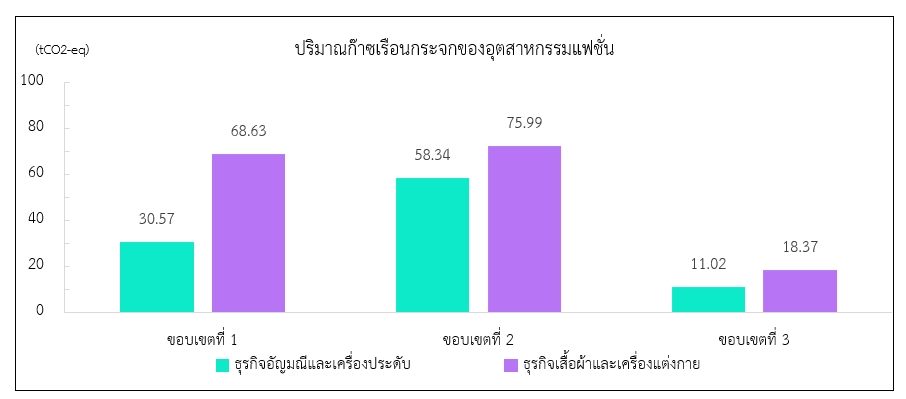
The objective of this research is to evaluate the carbon footprint of 25 SMEs in the fashion industry, which includes seventeen apparel businesses and eight jewelry businesses. These businesses participated in activities organized by the Department of Industrial Promotion during the fiscal year 2024. Greenhouse gas emissions data for the baseline year were collected between October 2023 and September 2024, following the assessment framework of the Thailand Greenhouse Gas Management Organization (Public Organization). The assessment is categorized into three scopes: Scope 1 (direct greenhouse gas emissions), Scope 2 (indirect emissions from energy use), and Scope 3 (other indirect emissions). The results indicate that the total greenhouse gas emissions of the fashion industry amount to 262.92 tons of carbon dioxide equivalent (tCO2-eq). Energy consumption in Scope 2 contributes the highest emissions at 134.33 tCO2-eq, followed by direct emissions in Scope 1 at 99.20 tCO2-eq, and other indirect emissions in Scope 3 at 29.39 tCO2-eq, accounting for 51.09%, 37.73%, and 11.18% of the total emissions, respectively. Electricity usage is the most significant source of greenhouse gas emissions, followed by gasohol fuel consumption for transportation and tap water usage, contributing 51.09%, 28.19%, and 8.68%, respectively. Recommendations to mitigate greenhouse gas emissions include routine maintenance of machinery to reduce repairs and enhance production efficiency, adjusting air conditioner temperatures to optimal levels, transitioning to LED lighting, adopting energy-saving technologies, and using clean energy for transportation. Organizations should also implement policies encouraging employees to conserve energy and water while optimizing resource use. These measures can significantly reduce greenhouse gas emissions and effectively address global warming.
References
กุลภรณ์ บุญชู, ชนกกานต์ พึ่งชาติ, ฐปนก วงศ์ศิริ, ณัฐฐา นาคศิริ และ สรศักดิ์ ชูเถื่อน. (2565). การปรับปรุงเส้นทางการเดินรถเพื่อสนับสนุน แนวคิด Green Logistics: กรณีศึกษา บริษัท ABC จำกัด. วารสารวิทยาการจัดการ มหาวิทยาลัยเกษตรศาสตร์, 1(1), 22-40.
การุณย์ ชัยวณิชย์. (2563). การประเมินก๊าซเรือนกระจกระดับเมืองและแนวทางการลดการปล่อยก๊าซเรือนกระจก กรณีศึกษา เทศบาลตำบลภาชี. วารสารวิชาการโรงเรียนนายร้อยพระจุลจอมเกล้า, 19(1), 65-75.
จิตลดา หมายมั่น, อติกร เสรีพัฒนานนท์, บัณฑิต รัตนไตร และสมบัติ ทีฆทรัพย์. (2560). คาร์บอนฟุตพริ้นท์ขององค์กร. วารสารวิชาการมหาวิทยาลัยอิสเทิร์นเอเชีย ฉบับวิทยาศาสตร์และเทคโนโลยี, 11(1), 57-66.
ฉัตรชัย โกสุม, ปานฤทัย โกสุม, เกชา อยู่แก้ว, ประกิจ ธรรมนิทัศนา. (2565). เครื่องกำหนดกำลังงานไฟฟ้าสำหรับการใช้อุปกรณ์ไฟฟ้า. วารสารวิทยาศาสตร์และเทคโนโลยี มหาวิทยาลัยธนบุรี, 6(1), 13-27.
ชาตรี บ้านเกาะ, วีระพล โมนยะกุล, ศิริชัย เทพา และ สุกิจ นิตินัย. (2548). การประหยัดพลังงานในเครื่องปรับอากาศทั่วไปด้วยอินเวอร์เตอร์เฟสเดี่ยว. วารสารวิจัยและพัฒนา มหาวิทยาลัยพระจอมเกล้าธนบุรี, 28(1), 29-42.
ชาริกา ชาญนันทพิพัฒน์, สลิลธร ทองมีนสุข, ขจรพงศ์ ประศาสตรานุวัตร, พิชญ์พล จิรวงศาพันธุ์, กรธวัช จีระเรืองรัตนา และ เอกปวีณ อนุสนธิ์. (2566). เตรียมธุรกิจไทย…ให้พร้อมสู่ยุคคาร์บอนต่ำด้วยข้อมูลก๊าซเรือนกระจก และการสนับสนุนทางการเงิน. TDRI Annual Public Conference 2023. สามย่านมิตรทาวน์ฮอลล์.
ฐิติกร หมายมั่น, สมบัติ ทีฆทรัพย์, อติกร เสรีพัฒนานนท์ และ บัณฑิต รัตนไตร. (2561). การประเมินคาร์บอนฟุตพริ้นท์ขององค์กรของมหาวิทยาลัยอีสเทิร์นเอเชีย. วารสารวิชาการมหาวิทยาลัยอีสเทิร์นเอเชีย ฉบับวิทยาศาสตร์และเทคโนโลยี, 12(2),
-209.
นวพร เหลืองยวง และ สุพรรณนิกา วัฒนะ. (2565). การประเมินคาร์บอนฟุตพริ้นท์องค์กร กรณีศึกษา โรงงานอุตสาหกรรมผลิตเครื่องดื่ม. การประชุมวิชาการเสนอผลงานวิจัยระดับบัณฑิตศึกษาระดับชาติ ครั้งที่ 23. มหาวิทยาลัยขอนแก่น.
นิตยา ศิริวัน และ ชลิตา สุวรรณ. (2559). คาร์บอนฟุตพริ้นท์ของผลิตภัณฑ์เสื้อจากผ้าบาติก. วารสารวิชาการเทคโนโลยีอุตสาหกรรม มหาวิทยาลัยพระจอมเกล้าพระนครเหนือ, 12(3), 83-95.
ผไทมาศ เปรื่องปรีชาศักดิ์, ฤทธิรงค์ จังโกฏิ, พฤกษ์ ตัญตรัยรัตน์ และ เทพภมร คำสอง. (2562). การจัดทำคาร์บอนฟุตพริ้นท์องค์กรของคณะสาธารณสุขศาสตร์ มหาวิทยาลัยขอนแก่น. วารสารวิจัยสาธารณสุขศาสตร์ มหาวิทยาลัยขอนแก่น, 13(3), 34-43.
พิรียุตม์ วรรณพฤกษ์. (2555). การปรับปรุงนโยบายการจัดการขยะมูลฝอยของประเทศไทย [วิทยานิพนธ์ดุษฎีบัณฑิต, มหาวิทยาลัยสงขลานครินทร์]. มหาวิทยาลัยสงขลานครินทร์.
พุทธ กิติวิริยกุล. (2561). การประเมินคาร์บอนฟุตพริ้นท์องค์กรของ บริษัท เอเซีย แปซิฟิค ปิโตรเคมิคอล จำกัด (ที่คลังสินค้า T86) [วิทยานิพนธ์มหาบัณฑิต, มหาวิทยาลัยบูรพา]. มหาวิทยาลัยบูรพา.
ไพรัช อุศุภรัตน์ และ หาญพล พึ่งรัศมี. (2557). การประเมินคาร์บอนฟุตพรินท์องค์กรของมหาวิทยาลัยธรรมศาสตร์ ศูนย์รังสิต. วารสารวิทยาศาสตร์และเทคโนโลยี มหาวิทยาลัยธรรมศาสตร์, 22(1), 1-12.
รัชชานนท์ สุขสวัสดิ์ และ นที สุริยานนท์. (2566). คาร์บอนฟุตพรินต์องค์กร: กรณีศึกษา โรงหล่อชิ้นส่วนสำเร็จรูป บริษัท กาญจน์กนก พร็อพเพอร์ตี้ จำกัด. การประชุมวิชาการวิศวกรรมโยธาแห่งชาติ ครั้งที่ 28, 1-9.
สถาบันพัฒนาอุตสาหกรรมสิ่งทอ. (25 เมษายน 2562). นโยบายที่มุ่งเน้นความยั่งยืนของธุรกิจแฟชั่น. https://www.thaitextile.org/th/insign/detail.1030.1.0.html
สถาบันวิจัยและพัฒนาอัญมณีและเครื่องประดับแห่งชาติ. (24 มีนาคม 2564). อุตสาหกรรมอัญมณีและเครื่องประดับตั้งเป้าลดคาร์บอนฟุตพรินท์. https://infocenter.git.or.th/th/article/article-20210324
สุเมธ องกิตติกุล. (2566). ชาร์จพลังประเทศไทย…ไปสู่เมืองน่าอยู่ ระบบขนส่งสาธารณะพร้อม การขนส่งคาร์บอนต่ำ. TDRI Annual Public Conference 2023. สามย่านมิตรทาวน์ฮอลล์.
สุวิทย์ ภูลี และ ปารเมศ ชุติมา. (2555). การปรับปรุงงานบำรุงรักษาเพื่อเพิ่มประสิทธิภาพการใช้พลังงานในกระบวนการผลิต. Journal of Energy Research, 9(1), 30-46.
สำนักงานนโยบายและแผนพลังงาน. (2567). สถานการณ์พลังงานปี 2566 และแนวโน้มปี 2567. https://www.eppo.go.th/ images/Energy-Statistics/energyinformation/Forecast/ShorttermForecast/EnergyForecast2023.pdf
องค์การบริหารจัดการก๊าซเรือนกระจก (องค์การมหาชน). (2561). แนวทางการประเมินคาร์บอนฟุตพริ้นท์ขององค์กร (พิมพ์ครั้งที่ 6).
องค์การบริหารจัดการก๊าซเรือนกระจก (องค์การมหาชน). (2562). มาตรการลดการปล่อยก๊าซเรือนกระจกในภาคอุตสาหกรรม.
อานนท์ เศรษฐเกรียงไกร. (2556). นวัตกรรมสิ่งทอสีเขียว. สถาบันพัฒนาอุตสาหกรรมสิ่งทอ. สำนักนโยบายอุตสาหกรรมรายสาขา 2 กรมส่งเสริมอุตสาหกรรม.
Al Mamun, A., Uddin, M. A., Shohag, M. A. S., Bappy, M. M., and Talukder, A. (2024). Energy consumption modeling in industrial sewing operations: A case study on carbon footprint measurement in the apparel industry. Manufacturing Letters, 41, 1635-1644. https://doi.org/10.1016/j.mfglet.2024.09.190
Armstrong, C. M., Niinimäki, K., Kujala, S., Karell, E., and Lang, C. (2015). Sustainable product-service systems for clothing: exploring consumer perceptions of consumption alternatives in Finland. Journal of Cleaner Production, 97, 30-39. https://doi.org/10.1016/j.jclepro.2014.01.046
Awanthi, M. G. G. and Navaratne, C. M. (2018). Carbon footprint of an organization: A tool for monitoring impacts
on global warming. Procedia Engineering, 212, 729-735. https://doi.org/10.1016/j.proeng.2018.01.094.
Bauck, W. (2017). The fashion industry emits as much greenhouse gas as all of Russia. https://fashionista.com/ 2017/09/fashion-industry-greenhouse-gas-climate-change-sustainability.
Chen, Y., Geever, L. M., Killion, J. A., Lyons, J. G., Higginbotham, C. L., and Devine, D. M. (2016). Review of multifarious applications of poly (lactic acid). Polymer-Plastics Technology and Engineering, 55(10), 1057-1075. https://doi.org/10.1080/03602559.2015.1132465
Intergovernmental Panel on Climate Change. (2006). 2006 IPCC Guidelines for National Greenhouse Gas Inventories Volume 2: Energy and Volume 5: Waste.
https://www.ipcc-nggip.iges.or.jp/public/2006gl/index.html
Janangkakan, B., Chavalparit, O., and Kanchanapiya, P. (2012). Carbon footprint of an academic organization: A case study of the department of environmental of environmental engineering, Chulalongkorn University. Applied Environmental Research, 34(1), 23-35.
Joanes, T., Gwozdz, W., and Klöckner, C. A. (2020). Reducing personal clothing consumption: A cross-cultural validation of the comprehensive action determination model. Journal of Environmental Psychology, 71, 101396. https://doi.org/10.1016/j.jenvp.2020.101396
Juan, A. A., Mendez, C. A., Faulin, J., De Armas, J., and Grasman, S. E. (2016). Electric vehicles in logistics and transportation: A survey on emerging environmental, strategic, and operational challenges. Energies, 9(2), 86. https://doi.org/10.3390/en9020086
Khurana, K. (2020). Sustainable approaches in fashion logistics: A step forward to sustainability. Routledge.
Li, Z., Zhou, Y., Zhao, M., Guan, D., and Yang, Z. (2024). The carbon footprint of fast fashion consumption and mitigation strategies-a case study of jeans. Science of the Total Environment, 924, 171508. https://doi.org/ 10.1016/j.scitotenv.2024.171508
Manley, A., Seock, Y. K., and Shin, J. (2023). Exploring the perceptions and motivations of Gen Z and Millennials toward sustainable clothing. Family and Consumer Sciences Research Journal, 51(4), 313-327.
Niinimäki, K., Peters, G., Dahlbo, H., Perry, P., Rissanen, T., and Gwilt, A. (2020). The environmental price of fast fashion. Nature Reviews Earth & Environment, 1(4), 189-200. https://doi.org/10.1038/s43017-020-0039-9
Peters, G., Li, M., and Lenzen, M. (2021). The need to decelerate fast fashion in a hot climate-A global sustainability perspective on the garment industry. Journal of Cleaner Production, 295, 126390.
Pleerux, N. and Aimkuy, N. (2021). Carbon footprint of mangosteen farm level evaluation in eastern Thailand. Current Applied Science and Technology, 21(3), 419-430.
Sachs, J. D., Schmidt-Traub, G., Mazzucato, M., Messner, D., Nakicenovic, N. and Rockström, J. (2019). Six transformations to achieve the sustainable development goals. Nature Sustainability, 2(9), 805-814. https://doi.org/10.1038/s41893-019-0352-9
Singh, J. and Bansal, S. (2024). The impact of the fashion industry on the climate and ecology. World Journal of Advanced Research and Reviews, 21(1), 210-215.
Song, J. S. and Lee, K. M. (2010). Development of a low-carbon product design system based on embedded GHG
emissions. Resources, Conservation and Recycling, 54(9), 547-556.
Usapein, P. and Tongcumpou, C. (2016). Greenhouse gas emission in jewelry industry: A case study of silver flat ring. Applied Environmental Research, 38(1), 11-17.
Wren, B. (2022). Sustainable supply chain management in the fast fashion Industry: A comparative study of current efforts and best practices to address the climate crisis. Cleaner Logistics and Supply Chain, 4, 100032.
Downloads
Published
How to Cite
Issue
Section
License
Copyright (c) 2025 Chandrakasem Rajabhat University

This work is licensed under a Creative Commons Attribution-NonCommercial-NoDerivatives 4.0 International License.
บทความที่ได้รับการตีพิมพ์เป็นลิขสิทธิ์ของมหาวิทยาลัยราชภัฏจันทรเกษม
ข้อความที่ปรากฎในบทความแต่ละเรื่องในวารสารวิชาการเล่มนี้เป็นความคิดเห็นส่วนตัวของผู้เขียนแต่ละท่าน ไม่เกี่ยวข้องกับมหาวิทยาลัยราชภัฏจันทรเกษม และคณาจารย์ท่านอื่นในมหาวิทยาลัยแต่อย่างใด ความรับผิดชอบองค์ประกอบทั้งหมดของบทความแต่ละเรื่องเป็นของผู้เขียนแต่ละท่าน หากมีความผิดพลาดใดๆ ผู้เขียนแต่ละท่านจะรับผิดชอบบทความของตัวเองแต่เพียงผู้เดียว
 For Author