The Effect of Ladder Interval Training on Agility in Woman Futsal Case Study: Thailand National Sports University Sukhothai Campus
Keywords:
ladder, interval, agility, woman futsalAbstract
This research aimed to study the effect of ladder interval training on agility in female futsal players at the National Sports University, Sukhothai Campus. The sample group used in the research was 20 female futsal players at
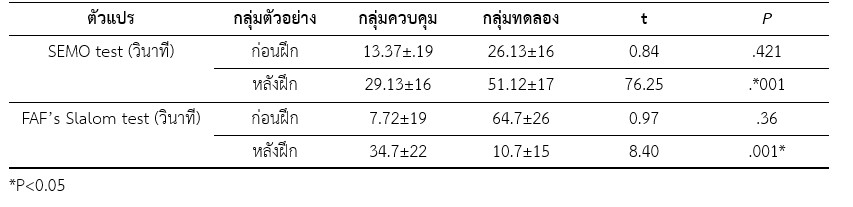
the National Sports University, Sukhothai Campus, divided into 2 groups: a control group trained in the normal futsal program and an experimental group trained in the normal futsal program combined with ladder interval training at 90-95 percent of maximum heart rate. There were 10 poses, 15 seconds per pose, 15 seconds rest period, 2 rounds per pose, totaling 20 rounds per day. The training was conducted 2 days per week, Monday and Thursday, for 8 weeks. The agility test was performed using the SEMO test and FAF’s Slalom test. The data were analyzed using statistics, mean, standard deviation, Dependent sample t-test, and Independent sample t-test. The results of
the research found that after 8 weeks of training, the experimental group had significantly better agility than before training. The control group did not have any differences. When comparing the experimental group with the control group after 8 weeks of training, the experimental group and the control group had significantly different agility at the 0.05 level. Therefore, it can be concluded that training in ladder movement to the rhythm of music can help develop agility and the relationship of the nervous system and muscles in futsal athletes.
References
ถาวร กมุทศรี. (2560). การเสริมสร้างสมรรถภาพทางกาย. วิทยาลัยวิทยาศาสตร์และเทคโนโลยีการกีฬา มหาวิทยาลัยมหิดล.
ทศพล ชวนบุญ. (2558). ผลของการฝึกวิ่งแบบหนักสลับเบาที่ความหนักระดับสูงที่มีต่อสมรรถภาพแอโรบิกและแอนแอโรบิก
ในนักกีฬาฟุตบอล [วิทยานิพนธ์ปริญญามหาบัณฑิต]. มหาวิทยาลัยเกษตรศาสตร์.
ทิสยา ทิศเสถียร. (15 ตุลาคม 2564). บันไดลิงอัจฉริยะ Smart Ladder for Agility. สถาบันวิจัยและพัฒนาแห่งมหาวิทยาลัยเกษตรศาสตร์. https://www3.rdi.ku.ac.th/?p=61359
ธนากาญจน์ เสถียรพูนสุข. (2564). การพัฒนาแบบทดสอบความคล่องแคล่วว่องไวบนพื้นทรายสำหรับนักกีฬาแฮนด์บอลชายหาด. วารสารสุขศึกษา พลศึกษา และสันทนาการ, 47(2), 340-352.
มัชฌิมา ยาวิไชย. (2558). ผลของการฝึกความคล่องแคล่วและพลังของกล้ามเนื้อต่อความเร็วของการวิ่งในนักกรีฑา: การศึกษานำร่อง [การค้นคว้าอิสระปริญญามหาบัณฑิต]. มหาวิทยาลัยเชียงใหม่.
สุรชัย แซ่ด่าน. (2560). ผลการฝึกโดยใช้ตารางเก้าช่องและบันไดลิงที่มีต่อความคล่องตัวในกีฬากาบัดดี้ [วิทยานิพนธ์ปริญญามหาบัณฑิต]. มหาวิทยาลัยทักษิณ.
อำนาจ ธูปบูชา และ สมเกียรติ เนตรประเสริฐ. (2558). ผลการฝึกเสริมด้วยโปรแกรมการฝึกความคล่องแคล่วว่องไวที่มีต่อความสามารถ
ในการเลี้ยงลูกฟุตบอลของนักกีฬาฟุตบอลชาย อายุ 16-18 ปี. วารสารวิชาการเครือข่ายบัณฑิตศึกษามหาวิทยาลัยราชภัฏภาคเหนือ, 5(8). 131-142.
Makaje, N., Ruangthai, R., Arkarapanthu, A., & Yoopat, P. (2012). Physiological demands and activity profiles during futsal match play according to competitive level. Journal of Sports Medicine and Physical Fitness, 52(4), 366-374.
Downloads
Published
How to Cite
Issue
Section
License
Copyright (c) 2025 Chandrakasem Rajabhat University

This work is licensed under a Creative Commons Attribution-NonCommercial-NoDerivatives 4.0 International License.
บทความที่ได้รับการตีพิมพ์เป็นลิขสิทธิ์ของมหาวิทยาลัยราชภัฏจันทรเกษม
ข้อความที่ปรากฎในบทความแต่ละเรื่องในวารสารวิชาการเล่มนี้เป็นความคิดเห็นส่วนตัวของผู้เขียนแต่ละท่าน ไม่เกี่ยวข้องกับมหาวิทยาลัยราชภัฏจันทรเกษม และคณาจารย์ท่านอื่นในมหาวิทยาลัยแต่อย่างใด ความรับผิดชอบองค์ประกอบทั้งหมดของบทความแต่ละเรื่องเป็นของผู้เขียนแต่ละท่าน หากมีความผิดพลาดใดๆ ผู้เขียนแต่ละท่านจะรับผิดชอบบทความของตัวเองแต่เพียงผู้เดียว
 For Author