ผลของอัตราส่วนผสมระหว่างไม้และพลาสติกต่อสมบัติทางกายภาพและเชิงกลของวัสดุผสมไม้และพลาสติก
คำสำคัญ:
วัสดุผสมไม้และพลาสติก, ความต้านทานแรงดึง, ความต้านทานแรงอัด, ความต้านทานแรงดัดบทคัดย่อ
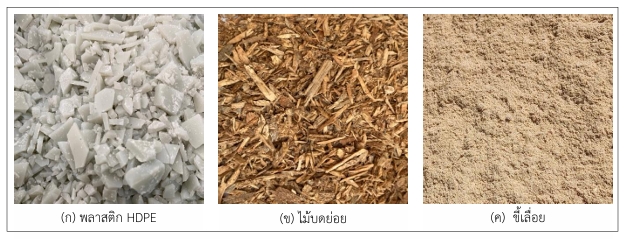
โครงการวิจัยนี้มีวัตถุประสงค์เพื่อพัฒนาวัสดุผสมระหว่างพลาสติก HDPE และเศษไม้ย่อยหรือขี้เลื่อย เพื่อพัฒนาวัสดุผสมจากวัสดุเหลือใช้ โดยใช้วัตถุดิบที่มีขนาดตั้งแต่ 0.2 ถึง 7.0 มิลลิเมตร ที่อัตราส่วน 20-50 wt% มาผสมและอบหลอมที่อุณหภูมิ 185°C เป็นระยะเวลา 20 นาที ปล่อยให้เย็นตัวเป็นระยะเวลา 40 นาที ตามชนิดและอัตราส่วนผสม จากนั้นนำมาทดสอบสมบัติทางกายภาพและสมบัติเชิงกล ผลการทดสอบทดสอบความหนาแน่นสัมพัทธ์แสดงให้เห็นว่าความหนาแน่นของวัสดุผสมเพิ่มขึ้นตามอัตราส่วนของไม้ต่อพลาสติกที่เพิ่มขึ้น และวัสดุผสมที่ใช้เศษไม้ย่อยมีความหนาแน่นสูงกว่าวัสดุผสมที่ใช้ขี้เลื่อยในทุกอัตราส่วนของไม้ต่อพลาสติก ผลการทดสอบการดูดซึมน้ำพบว่าการดูดซึมน้ำของวัสดุผสมมีค่าตั้งแต่ 4.34-34.25% เพิ่มขึ้นตามอัตราส่วนของไม้ต่อพลาสติกที่เพิ่มขึ้น ผลการทดสอบความต้านทานแรงดึงแสดงให้เห็นว่าที่อัตราส่วน 20 wt% ขี้เลื่อยมีความต้านทานแรงดึงสูงสุดเฉลี่ย 16.70 MPa การทดสอบความต้านทานแรงอัดของวัสดุผสมไม่แสดงแนวโน้มที่ชัดเจนตามอัตราส่วนของไม้ต่อพลาสติกที่เปลี่ยนแปลง 13.83-16.67 MPa และผลทดสอบความต้านทานแรงดัด แสดงให้เห็นได้ว่าความต้านทานแรงดัดของวัสดุผสมลดลงตามอัตราส่วนของไม้ต่อพลาสติกที่เพิ่มขึ้น และเมื่อนำพลาสติกผสมมาขึ้นรูปเป็นผลิตภัณฑ์ต้นแบบ 3 ประเภท ได้แก่ ผลิตภัณฑ์ชนิดรับแรง ผลิตภัณฑ์สำหรับใช้ภายในอาคาร และผลิตภัณฑ์สำหรับใช้ภายนอกอาคาร พบว่า พลาสติกผสมเหมาะสำหรับนำมาใช้ในการขึ้นรูปเป็นผลิตภัณฑ์สำหรับใช้ภายในและภายนอกอาคาร แต่สำหรับการนำมาขึ้นรูปเป็นวัสดุรับแรงยังไม่มีความเหมาะสมมากนัก อาจต้องมีการปรับอัตราส่วนผสมหรือกระบวนการผลิตให้มีความเหมาะสมมากยิ่งขึ้น
เอกสารอ้างอิง
Arnandha, Y., Satyarno, I., Awaludin, A., Irawati, I. S., Prasetya, Y., Prayitno, D. A., Winata, D. C., Satrio, M. H., & Amalia, A. (2017). Physical and mechanical properties of WPC board from sengon sawdust and recycled HDPE plastic. Procedia Engineering, 171, 695-704. https://doi.org/10.1016/j.proeng.2017.01.412
Beg, M. D. H., & Pickering, K. L. (2008). Mechanical performance of Kraft fibre reinforced polypropylene composites: Influence of fibre length, fibre beating and hygrothermal ageing. Composites Part A: Applied Science and Manufacturing, 39(11), 1748-1755. https://doi.org/10.1016/j.compositesa.2008.08.003
Bouafif, H., Koubaa, A., Perré, P., & Cloutier, A. (2009). Effects of fiber characteristics on the physical and mechanical properties of wood plastic composites. Composites Part A: Applied Science and Manufacturing, 40(12), 1975-1981. https://doi.org/10.1016/j.compositesa.2009.06.003
Delviawan, A., Kojima, Y., Kobori, H., Suzuki, S., Aoki, K., & Ogoe, S. (2019). The effect of wood particle size distribution on the mechanical properties of wood–plastic composite. Journal of Wood Science, 65. Article 67. https://doi.org/10.1186/s10086-019-1846-9
Faruk, O., Bledzki, A. K., Fink, H.-P., & Sain, M. (2014). Progress report on natural fiber reinforced composites. Macromolecular Materials and Engineering, 299(1), 9-26. https://doi.org/10.1002/mame.201300008
Friedrich, D. (2022). Success factors of wood-plastic composites (WPC) as sustainable packaging material: A cross-sector expert study. Sustainable Production and Consumption, 30, 506-517. https://doi.org/10.1016/j.spc.2021.12.030
Khamtree, S., Srivabut, C., Khamtree, S., & Kaewmai, R. (2024). Effects of natural fiber waste, content, and coupling agent on the physical and mechanical properties of wood species–plastic composites as green materials. Fibers and Polymers, 25(4), 1391-1402. https://doi.org/10.1007/s12221-024-00493-9
Kim, J.-W., Harper, D. P., & Taylor, A. M. (2009). Effect of wood species on the mechanical and thermal properties of wood-plastic composites. Journal of Applied Polymer Science, 112(3), 1378-1385. https://doi.org/10.1002/app.29522
Li, L., Zuo, J., Chang, R., & Du, L. (2025). Converting plastic waste into wood-plastic composite products – A practical environmental impacts assessment using primary data. Resources, Conservation and Recycling, 218, Article 108267. https://doi.org/10.1016/j.resconrec.2025.108267
Miki, T., Seki, M., Tanaka, S., Sobue, N., Shigematsu, I., & Kanayama, K. (2014). Preparation of wood plastic composite sheets by lateral extrusion of solid woods using their fluidity. Procedia Engineering, 81, 580-585. https://doi.org/10.1016/j.proeng.2014.10.043
Raj, S. S., Michailovich, K. A., Subramanian, K., Sathiamoorthyi, S., & Kandasamy, K. T. (2021). Philosophy of selecting ASTM standards for mechanical characterization of polymers and polymer composites. Materiale Plastice, 58(3), 247-256. https://doi.org/10.37358/mp.21.3.5523
Ratanawilai, T., Leelasilapasart, V., Srivabut, C., & Ratanawilai, S. (2023). Lifetime prediction under dead-load long-term creep test and models analysis of wood-plastic composites for building materials. Plastics, Rubber and Composites: Macromolecular Engineering, 52(9-10), 506-515. https://doi.org/10.1080/14658011.2023.2232666
Toghyani, A., Matthews, S., & Varis, J. (2020). Forming challenges of extruded wood plastic composite products in a post-production process. Procedia CIRP, 93, 502-507. https://doi.org/10.1016/j.procir.2020.04.156
Turku, I., Kärki, T., & Puurtinen, A. (2018). Durability of wood plastic composites manufactured from recycled plastic. Heliyon, 4(3), Article e00559. https://doi.org/10.1016/j.heliyon.2018.e00559
Zhang, X., Zhang, J., & Wang, R. (2019). Thermal and mechanical behavior of wood plastic composites by addition of graphene nanoplatelets. Polymers, 11(8), Article 1365. https://doi.org/10.3390/polym11081365
Zhou, H., Li, W., Hao, X., Zong, G., Yi, X., Xu, J., Ou, R., & Wang, Q. (2022). Recycling end-of-life WPC products into ultra-high-filled, high-performance wood fiber/polyethylene composites: A sustainable strategy for clean and cyclic processing in the WPC industry. Journal of Materials Research and Technology, 18, 1-14. https://doi.org/10.1016/j.jmrt.2022.02.091
ดาวน์โหลด
เผยแพร่แล้ว
รูปแบบการอ้างอิง
ฉบับ
ประเภทบทความ
สัญญาอนุญาต
ลิขสิทธิ์ (c) 2025 มหาวิทยาลัยราชภัฏจันทรเกษม

อนุญาตภายใต้เงื่อนไข Creative Commons Attribution-NonCommercial-NoDerivatives 4.0 International License.
บทความที่ได้รับการตีพิมพ์เป็นลิขสิทธิ์ของมหาวิทยาลัยราชภัฏจันทรเกษม
ข้อความที่ปรากฎในบทความแต่ละเรื่องในวารสารวิชาการเล่มนี้เป็นความคิดเห็นส่วนตัวของผู้เขียนแต่ละท่าน ไม่เกี่ยวข้องกับมหาวิทยาลัยราชภัฏจันทรเกษม และคณาจารย์ท่านอื่นในมหาวิทยาลัยแต่อย่างใด ความรับผิดชอบองค์ประกอบทั้งหมดของบทความแต่ละเรื่องเป็นของผู้เขียนแต่ละท่าน หากมีความผิดพลาดใดๆ ผู้เขียนแต่ละท่านจะรับผิดชอบบทความของตัวเองแต่เพียงผู้เดียว
 สำหรับผู้แต่ง (Author)