
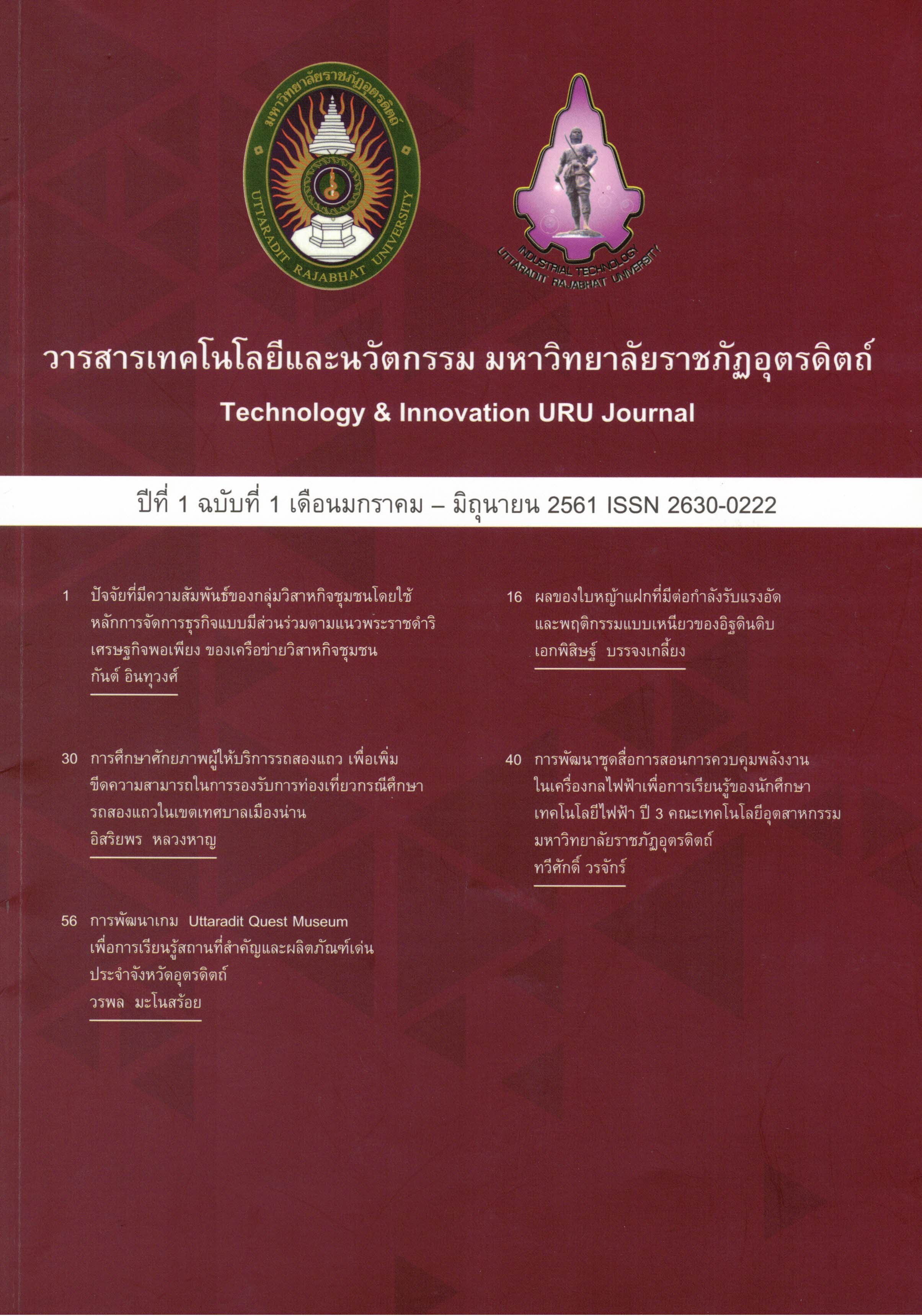
The Effect of Vetiver Grass Leaf on The Compressive Strength and Ductile Behavior of Adobe Bricks
Article Sidebar
Main Article Content
Abstract
With ideas about self-reliance living and environment conservation, return of adobehouse construction once again in Thailand is very interesting. However, adobe stabilization was need to improve its mechanical properties and to extent its service life. The objective of this research is to study the effect of short vetiver grass leaf, which has 2, 4 and 6 cm. fiber length, on the compressive strength and ductile behavior of 10x10x10 cm. adobe bricks. The short vetiver grass leaf content was 0, 0.5, 1 and 1.5 percent by weight of soil and sand. The results showed that adding sand to soil made adobe mixing process be easy and reduced
both shrinkage and cracks in dried adobe bricks. Using Vetiver grass leaf reduced both unit weight and compressive strength of adobe bricks because of the hollow structure of Vetiver grass leaf. However, adding vetiver grass leaf in adobe can obviously improve ductile behavior of adobe bricks.
Article Details

This work is licensed under a Creative Commons Attribution-NonCommercial-NoDerivatives 4.0 International License.
References
Banjongkliang, E., Wattanachai, P., and Parichatprecha, R. (2015). Evaluation of strength and microstructure of adobe stabilized with blended rubber latex and sodium silicate, Kasetsart J. (Natural Science), 49(5), 288-300.
Dethier, J. (1986). Des architectures de terre. Edition de centre Pompidou, Paris.
Moral, J. C., Mesbah, A., Oggero, M., and Walker, P. (2001). Building houses with local materials; means to drastically reduce the environmental impact of construction, Building and Environment, 36(10), 1119-1126.
National geographical Committee. (1984). Document of Thailand geography volume 1: Thailand topography. Bangkok.
Neves, R. D., and Fernandes de Almeida, J.C.O. (2005). Compressive behavior of steel fiber reinforced concrete, Structural Concrete, 6(1), 1-8.
Quagliarini, E., Lenci, S., Iorio, M. (2010). Mechanical properties of adobe walls in a Roman republican domus at Suasa. Journal of Cultural Heritage, 11(2), 130-137.
Sangchaya, W. (1994). Earthen houses found in the Lampao river basin Kalasin. Master’s Thesis, Silpakorn University, Bangkok: Silpakorn University.
Sinlapasai, D. (2003). Earth house: an alternative architecture, case study: Baan Srithan,
Aumphor Pateaw, Yasothorn province. Master’s Thesis, Silpakorn University, Bangkok: Silpakorn University.
Thai Meteorological Department. (2007). Thailand climate (in Thai). Retrieved March 1, 2012, from http://www.tmd.go.th/info/info.php?FileID=22.
United Nations Thailand. (2008). Thailand info. Retrieved December 1, 2012, from http://www.un.or.th/thailand/geography.html.
วงศกร มูลอ้าย, ปิติวัฒน์ วัฒนชัย, และเอกพิสิษฐ์ บรรจงเกลี้ยง. (2557). การศึกษาสัดส่วนผสมแอสฟัลต์อิมัลชัน สำหรับการพัฒนาปูนฉาบผนังบ้านดิน เพื่อให้ทนต่อน้ำ อุณหภูมิและความชื้น. รายงานการประชุมวิชาการวิศวกรรมโยธาแห่งชาติ ครั้งที่ 19, 14-16 พฤษภาคม 2557 ณ โรงแรมพูลแมน ขอนแก่น ราชา ออคิด จังหวัดขอนแก่น. กรุงเทพฯ: วิศวกรรมสถานแห่งประเทศไทย ในพระบรมราชูปถัมภ์.
ศุภสันห์ ชื่นศิริกุลชัย, ปิติวัฒน์ วัฒนชัย และเอกพิสิษฐ์ บรรจงเกลี้ยง. (2556). การประยุกต์ใช้ใบหญ้าแฝกและแอสฟัลต์อิมัลชันเพื่อปรับปรุงคุณสมบัติทางกลของอิฐดินดิบ. รายงานการประชุมวิศวกรรมโยธาแห่งชาติ ครั้งที่ 18, 8-10 พฤษภาคม 2556 ณ โรงแรมดิเอ็มเพลส จังหวัดเชียงใหม่. กรุงเทพฯ: วิศวกรรมสถานแห่งประเทศไทย ในพระบรมราชูปถัมภ์.