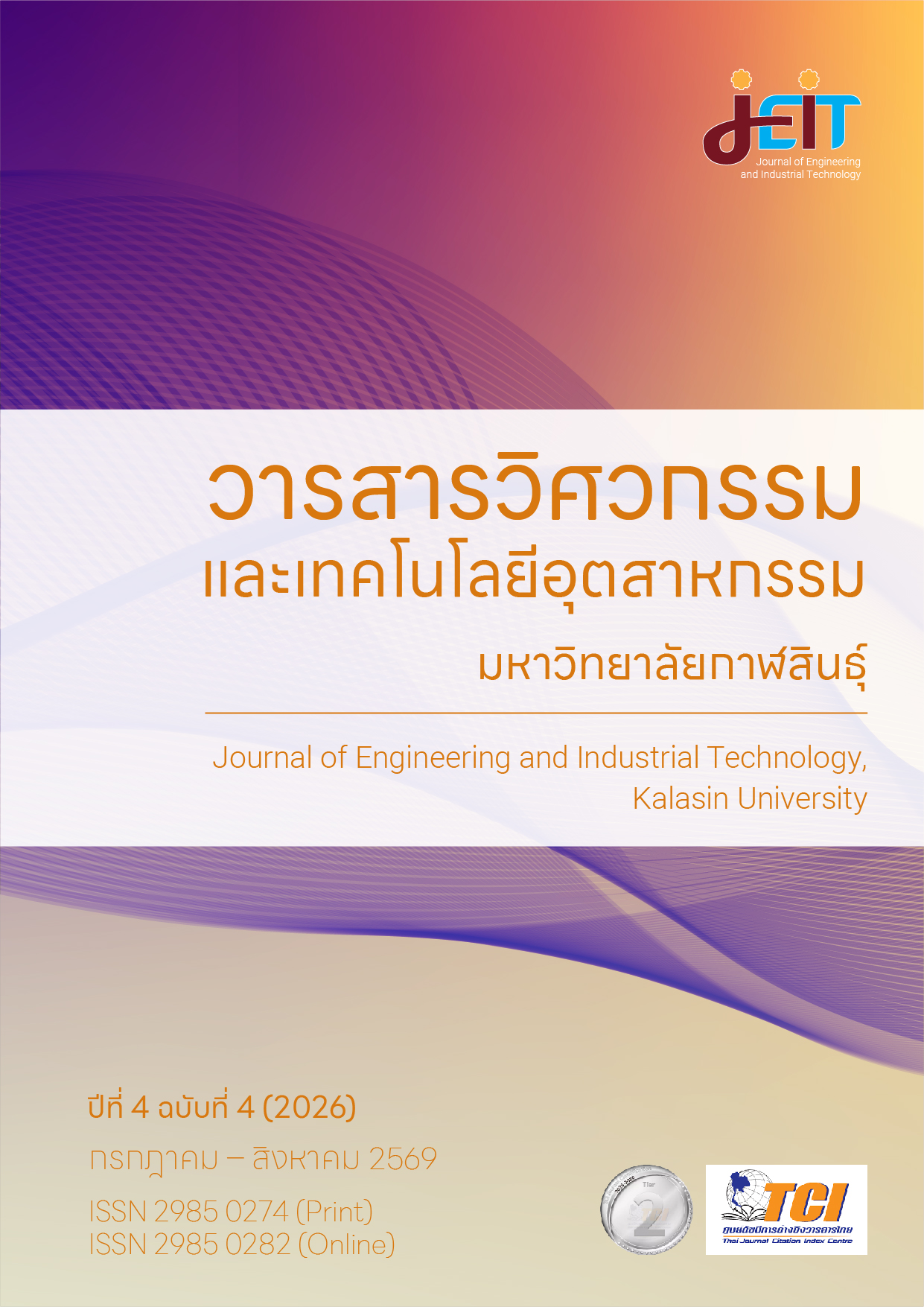
Effects of Rotational Speed and Feed Rate on the Performance of a Dual-Blade Herbal Chopper for Cassumunar Ginger and Turmeric
DOI:
https://doi.org/10.14456/jeit.2026.25Keywords:
Cassumunar Ginger, Turmeric, Double Blade Chopping, Herbal Compresses, Chopper MachineAbstract
This study aimed to investigate the effects of cutting blade speed and feed rate on the performance of a dual blade herbal chopping machine optimized for Cassumunar ginger and Turmeric. The machine's performance was evaluated based on throughput capacity, chopping efficiency and chopping loss. The experiments were conducted across three levels of blade rotational speed as 536.25 715.00 and 893.75 rpm. For Cassumunar ginger, the feed rates were varied at three levels as 359.64 617.14 and 872.37 kg/h, while a Turmeric, feed rates were 471.00, 621.76, and 916.81 kg/h. The results showed that, the feed rate for Cassumunar ginger and Turmeric had no statistically significant effect on the chopping efficiency. Conversely, the blade speed was a critical factor that significantly affected both throughput capacity and chopping efficiency at a 95% confidence level, particularly during Cassumunar ginger processing, for turmeric, the blade speed exhibited a similar trend influencing operational performance, with its p-value approaching the threshold of statistical significance at the 95% confidence level. To optimize operational parameters, the recommended settings for during Cassumunar ginger and Turmeric processing are feed rates of 872.37 kg/h and 916.81 kg/h coupled with blade rotational speeds of 715.00 rpm and 536.25 rpm, respectively. These optimal configurations yielded average chopping efficiencies of 97% and 98%, with corresponding chopping losses minimized to 3% and 2%, respectively.
References
[1] R. N. Alolga, F. Wang, X. Zhang, J. Li, L.-S. P. Tran, and X. Yin, “Bioactive compounds from the Zingiberaceae family with known antioxidant activities for possible therapeutic uses,” Antioxidants, vol. 11, no. 7, Art. no. 1281, 2022, doi: 10.3390/antiox11071281.
[2] จิตต์เรขา ทองมณี, “ลูกประคบสมุนไพร,” วารสารกรมวิทยาศาสตร์บริการ, ปีที่ 53, ฉบับที่ 169, หน้า 1–3, 2548.
[3] สมศักดิ์ คำมา, จารุวรรณ สิงห์ม่วง, และ พินัย ทองสวัสดิ์วงศ์, “การออกแบบและพัฒนาเครื่องสับวัสดุพืชเกษตรและเปลือกผลไม้,” วารสารวิชาการเกษตร, ปีที่ 38, ฉบับที่ 1, หน้า 58–67, 2563, doi: 10.14456/thaidoa-agres.2020.5.
[4] สมศักดิ์ คำมา, “การออกแบบและสร้างเครื่องสับย่อยเศษพืชผักในครัวเรือน,” วารสารวิชาการคณะเทคโนโลยีอุตสาหกรรม มหาวิทยาลัยราชภัฏลำปาง, ปีที่ 11, ฉบับที่ 1, หน้า 82–95, 2561.
[5] เพลิงฟ้า เฮียงสา, สิริรัตน์ พรมทา, เสาวลักษณ์ ศรีลุนช่าง, และ อาภาภรณ์ จอมหล้าพีรติกุล, “การพัฒนาเครื่องหั่นใบสมุนไพร,” วารสารวิทยาศาสตร์เกษตร, ปีที่ 48, ฉบับที่ 3 (พิเศษ), หน้า 35–38, 2560.
[6] อัศวิน สืบนุการณ์, ภูเมศร์ นิยมมาก, วัชรากร จันโสม, และ นันทพัทธ ปัดภัย, “การทดสอบประสิทธิภาพเครื่องสับเอนกประสงค์เพื่อการเกษตร,” วารสารเทคโนโลยีอุตสาหกรรม, ปีที่ 6, ฉบับที่ 1, หน้า 1–7, 2564.
[7] สัญญา โพธิ์วงษ์, วิรัตติ อัศวานุวัตร, สมพงษ์ แซ่บ่าง, และ เทพรถ อนันต์สูงเนิน, “การสร้างและหาประสิทธิภาพเครื่องหั่น-ซอยสมุนไพรแบบต่อเนื่อง,” วารสารวิชาการครุศาสตร์อุตสาหกรรม พระจอมเกล้าพระนครเหนือ, ปีที่ 13, ฉบับที่ 1, หน้า 73–82, 2565.
[8] ชนินทร์ อุปถัมภ์, สมโภชน์ สุดาจันทร์, ชัยยันต์ จันทร์ศิริ, กิตติพงษ์ ลาลุน, และ สิงห์รัญ ชารี, “อิทธิพลของจำนวนใบมีดและความเร็วเชิงเส้นของใบมีดสับที่มีผลต่อสมรรถนะของชุดสับลดขนาดลำต้นมันสำปะหลังสำหรับผลิตเป็นเชื้อเพลิงอัดเม็ด,” วารสารวิจัย มข. (ฉบับบัณฑิตศึกษา), ปีที่ 21, ฉบับที่ 1, หน้า 88–100, 2564.
[9] เทิดศักดิ์ พรมทา, สหรัฐ ปฏิฐาน, อิสระพงษ์ โพธิ์ดอกไม้, และ วันชาติ สุพรมพิทักษ์, “การออกแบบและพัฒนาเครื่องหั่นสับต้นกล้วย,” ใน การประชุมวิชาการระดับชาติด้านวิทยาศาสตร์ เทคโนโลยี และนวัตกรรม ครั้งที่ 1, คณะวิทยาศาสตร์และเทคโนโลยี มหาวิทยาลัยราชภัฏเลย, 2562, หน้า 173–177.
[10] F. Grau, H. Choo, J. W. Hu, and J. Jung, “Engineering behavior and characteristics of wood ash and sugarcane bagasse ash,” Materials, vol. 8, no. 10, pp. 6962–6977, Oct. 2015, doi: 10.3390/ma8105353.
[11] I. C. C. Iloabachie, A. M. Nwankwo, C. F. Nzoiwu, and V. I. Aneke, “Characterization of powdered pentaclethra macrophylla pod as a friction material,” Int. J. Eng. Res. Technol., vol. 15, no. 5, pp. 296–302, May 2026, doi: 10.5281/zenodo.20522455.
[12] รังสรรค์ พงษ์พัฒนอำไพ, ปพณ สะอาดยวง, และ ณมน วรธนานุวงศ์, “การออกแบบและพัฒนาเครื่องสับหัวมันสำปะหลังแบบกึ่งอัตโนมัติ,” รายงานการวิจัย มหาวิทยาลัยราชภัฏมหาสารคาม, มหาสารคาม, 2561.
[13] ณพล เหลืองพิพัฒน์สร, “การพัฒนาเครื่องย่อยและอัดหญ้าอาหารสัตว์,” วิทยานิพนธ์, คณะวิศวกรรมศาสตร์, มหาวิทยาลัยเทคโนโลยีราชมงคลธัญบุรี, ปทุมธานี, 2561.
[14] O. B. Oduntan, A. I. Bamgboye, O. S. Idogwu, and R. O. Bankole, “Optimization of the efficient shredding process of biogas feedstocks from cassava peels,” Journal of Wastes and Biomass Management, vol. 6, no. 1, pp. 30–36, 2024, doi: 10.26480/jwbm.01.2024.30.36.
[15] W. Huang, J. Xie, S. Cao, J. Tang, and Y. Yang, “Optimization of cutting parameters for cotton stalks using reciprocating bionic cutters based on finite element simulation and experiment,” Agri Engineering, vol. 8, no. 5, Art. no. 164, 2026, doi: 10.3390/agriengineering8050164.
Downloads
Published
How to Cite
Issue
Section
Categories
License
Copyright (c) 2026 Journal of Engineering and Industrial Technology, Kalasin University

This work is licensed under a Creative Commons Attribution-NonCommercial-NoDerivatives 4.0 International License.
ลิขสิทธิ์ของวารสาร
เนื้อหาและข้อมูลในบทความที่ลงตีพิมพ์ในวารสารศูนย์ดัชนีการอ้างอิงวารสารไทย ถือเป็นข้อคิดเห็นและความรับผิดชอบของผู้เขียนบทความโดยตรงซึ่งกองบรรณาธิการวารสาร ไม่จำเป็นต้องเห็นด้วย หรือร่วมรับผิดชอบใด ๆ
บทความ ข้อมูล เนื้อหา รูปภาพ ฯลฯ ที่ได้รับการตีพิมพ์ในวารสารศูนย์ดัชนีการอ้างอิงวารสารไทย ถือเป็นลิขสิทธิ์ของวารสารศูนย์ดัชนีการอ้างอิงวารสารไทย หากบุคคลหรือหน่วยงานใดต้องการนำทั้งหมดหรือส่วนหนึ่งส่วนใดไปเผยแพร่ต่อหรือเพื่อกระทำการใด จะต้องได้รับอนุญาตเป็นลายลักอักษรจากวารสารศูนย์ดัชนีการอ้างอิงวารสารไทยก่อนเท่านั้น