Low-cost toilet-based sit-to-stand device for elderly with lower limb weakness
DOI:
https://doi.org/10.60136/bas.v15.2026.4660Keywords:
Bathroom safety, Elderly, Fall prevention, Sit-to-stand assistive deviceAbstract
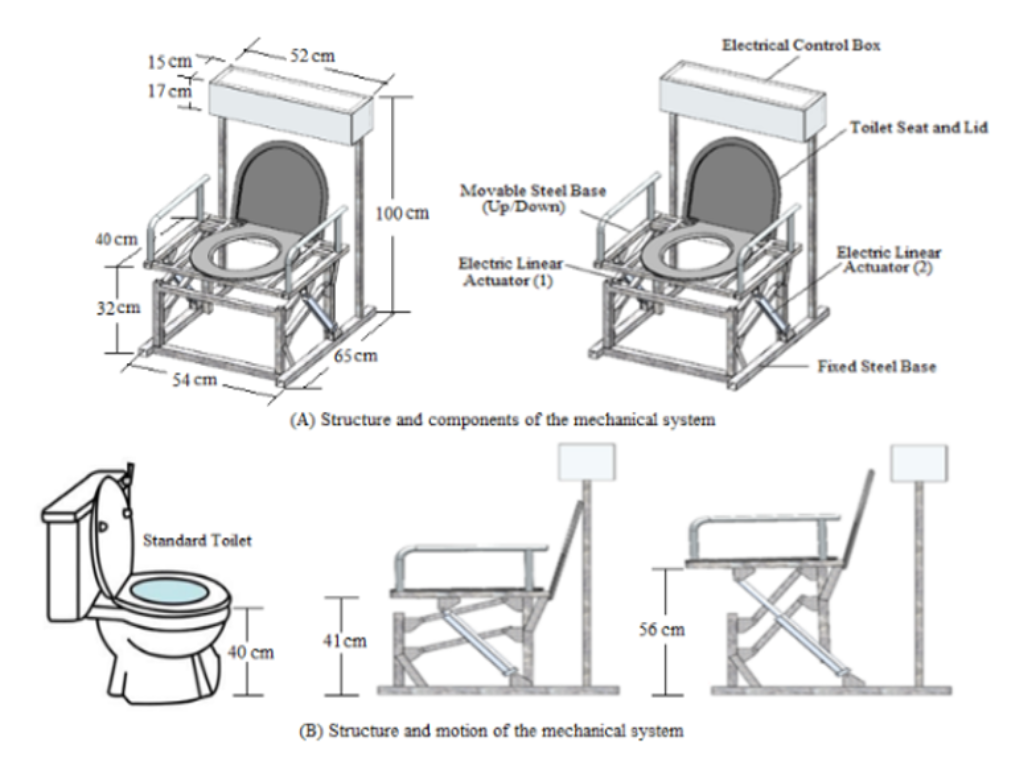
Falls in the bathroom pose a serious risk to older adults, leading to physical and psychological consequences and a reduced quality of life, including fractures, head injuries, fear of movement, and loss of independence. These falls result from both personal factors, such as muscle weakness, impaired balance, chronic conditions, and medication side effects, and environmental factors, including slippery floors, inadequate lighting, insufficient assistive devices, and unsuitable sanitary fixtures. This research aimed to design and develop a low-cost toilet-based sit to stand device for elderly with lower limb weakness that can be used with both standard and multipurpose toilet bowls. The device supports safe and comfortable transitions between sitting and standing and is designed based on biomechanical principles of the sit-to-stand movement. The system comprises a mechanical unit with a linear electric actuator, an electrical control system, a C-based control program, and a battery-powered energy source. Biomedical engineering tests confirmed correct operation and stable performance of the control and safety systems. Biomedical tests confirmed stable control and safety performance. The device safely supported loads of 10–120 kg. Lifting time ranged from 11.73–16.15 s, while lowering time ranged from 11.14–12.93 s. In 30 volunteers (15 males, 15 females), knee flexion angles decreased after device use from 86.07–89.93° to 60.70–72.90° in males and from 78.10–88.13° to 59.10–67.90° in females, indicating reduced knee joint load during sit-to-stand. These results indicate that the device effectively reduces biomechanical load on the knee joint during the sit-to-stand movement.
References
World Health Organization (WHO). WHO global report on falls prevention in older age [Internet]. Geneva: WHO; 2007 [cited 2025 Jun 14]. Available from: https://www.who.int/publications/i/item/9789241563536
World Health Organization (WHO). Falls [Internet]. 2021 [cited 2025 Jun 14]. Available from: https://www.who.int/news-room/fact-sheets/detail/falls
Papa E, Cappozzo A. Sit-to-stand motor strategies investigated in able-bodied young and elderly subjects. Journal of Biomechanics. 2000;33(9):1113-1122. https://doi.org/10.1016/s0021-9290(00)00046-4
Rao C, Liu W, Li Z, Nan X, Yin C, Yang J, et al. The comparison of different acupuncture therapies for post stroke depression: A protocol for a Bayesian network meta-analysis. Medicine. 2020;99(52):e23456. https://doi.org/10.1097/MD.0000000000023456
Pighills AC, Torgerson DJ, Sheldon TA, Drummond AE, Bland JM. Environmental assessment and modification to prevent falls in older people. Journal of the American Geriatrics Society. 2011;59(1):26-33. https://doi.org/10.1111/j.1532-5415.2010.03221.x
Noroozi S, Weyand S, Smart R, Jakobi JM. Impact of seat height and grab bars on postural stability and muscle activity of older females standing from a toilet. Medicine. 2025;104(11):e41856. https://doi.org/10.1097/MD.0000000000041856
Hsieh LC, Chen TH, Lai PC, Huang TM. The engineering design and prototyping of an auxiliary standing toilet chair driven by electric cylinders. Machines. 2025;13(5):402. https://doi.org/10.3390/machines13050402
Li YL, Tu XK, Hu SC, Li X. A design of assistive device for toilet based on sitting-to-stand motion trajectory. Chinese Journal of Rehabilitation Theory and Practice. 2021;27(7):844-851. https://doi.org/10.3969/j.issn.1006-9771.2021.07.018
Campos PI. Biomechanical analysis of the sit-to-stand transition [thesis]. Manchester: The University of Manchester; 2016.
Janssen WGM, Bussmann HBJ, Stam HJ. Determinants of the sit-to-stand movement: A review. Physical Therapy. 2002;82(9):866-879. https://doi.org/10.1093/ptj/82.9.866
Kralj A, Jaeger RJ, Munih M. Analysis of standing up and sitting down in humans: Definitions and normative data presentation. Journal of Biomechanics. 1990;23(11):1123-1138. https://doi.org/10.1016/0021-9290(90)90005-N
Schellenberg M, Inaba K, Chen J, Bardes JM, Crow E, Lam L, et al. Falls in the bathroom: A mechanism of injury for all ages. Journal of Surgical Research. 2019;234:283-286. https://doi.org/10.1016/j.jss.2018.09.044
Zhou B, Xue Q, Yang S, Zhang H, Wang T. Design and control of a sit-to-stand assistive device based on analysis of kinematics and dynamics. Automatika. 2021;62(3-4):353-364. https://doi.org/10.1080/00051144.2021.1967603
Li, Q, Che MR, Faiz YM. Examining emotional factors of smart toilets design for China’s new elderly. International Journal of Management Thinking. 2024;2(1):52-74. https://doi.org/10.56868/ijmt.v2i1.56
Moraru S-A, Moșoi AA, Kristaly DM, Moraru I, Petre VȘ, Ungureanu DE, et al. Using IoT assistive technologies for older people non-intrusive monitoring and living support in their homes. International Journal of Environmental Research and Public Health. 2022;19(10):5890. https://doi.org/10.3390/ijerph19105890
Manríquez-Cisterna RJ, Ravankar AA, Salazar Luces JV, Hatsukari T, Hirata Y. A standing support mobility robot for enhancing independence in elderly daily living [Internet]. 2025 [cited 2025 Jun 28]. Available from: https://doi.org/10.48550/arXiv.2508.19816
Xu Y, Zhang B, Li Y, Guo R, Cao P, Zhu X, et al. Design and evaluation of the sit-to-stand movement assistive device for elderly. Actuators. 2024;13(3):102. https://doi.org/10.3390/act13030102
Zou M, Lu R, Jiang Y, Liu P, Tian B, Liang Y, et al. Association between toileting and falls in older adults admitted to the emergency department and hospitalised: A cross-sectional study. BMJ Open. 2023;13(6):e065544. https://doi.org/10.1136/bmjopen-2022-065544
Wu X, Liu H, Liu Z, Chen M, Wan F, Fu C, et al. Robotic cane as a soft SuperLimb for elderly sit-to-stand assistance. In: 2020 3rd IEEE International Conference on Soft Robotics (RoboSoft); 2020 Jun 15; New Haven (CT), USA. p. 599-606. https://doi.org/10.1109/RoboSoft48309.2020.9116028
Takahashi Y, Nagasawa T, Nakayama H, Hanzawa T, Arai Y, Nagashima T, et al. Robotic assistance for aged people. In: Proceedings of the 37th SICE Annual Conference; 1998 Jul 29-31; Chiba, Japan. p. 869-874. https://doi.org/10.1109/SICE.1998.742928
Ng BP, Lu J, Tiu GF, Thiamwong L, Zhong Y. Bathroom modifications among community-dwelling older adults who experience falls in the United States: A cross-sectional study. Health & Social Care in the Community. 2022;30(1):253-263. https://doi.org/10.1111/hsc.13398
Esmaeilzadeh P. Older adults’ perceptions about using intelligent toilet seats beyond traditional care: Web-based interview survey. JMIR mHealth uHealth. 2023;11:e46430. https://doi.org/10.2196/46430
Sadeh S, Gobert D, Shena K-H, Foroughi F, Hsiao H-Y. Biomechanical and neuromuscular control characteristics of sit-to-stand transfer in young and older adults: A systematic review with implications for balance regulation mechanisms. Clinical Biomechanics. 2023;109:106068. https://doi.org/10.1016/j.clinbiomech.2023.106068
Susilo TE, Putri LD, Syafira K, Rahayu UB, Pristianto A, Irawan DS, et al. Biomechanical analysis of sit-to-stand transitions: Identifying movement strategies in aging populations. Physiotherapy Health Science. 2025;8(1):8-13. https://doi.org/10.22219/physiohs.v8i1.40501
Fu W, Liu Y, Hu W. Characterizing sit-to-stand transition of the elderly considering the effects of seat height and inclination. Computer Methods in Biomechanics and Biomedical Engineering. 2025;1-14. https://doi.org/10.1080/10255842.2025.2574541
Downloads
Published
How to Cite
License
Copyright (c) 2026 Bulletin of Applied Sciences

This work is licensed under a Creative Commons Attribution-NonCommercial-NoDerivatives 4.0 International License.