An innovative of the portable electric tjanting pen
DOI:
https://doi.org/10.60136/bas.v15.2026.3714Keywords:
Innovation, Portable electric tjanting pen, Palm wax sticksAbstract
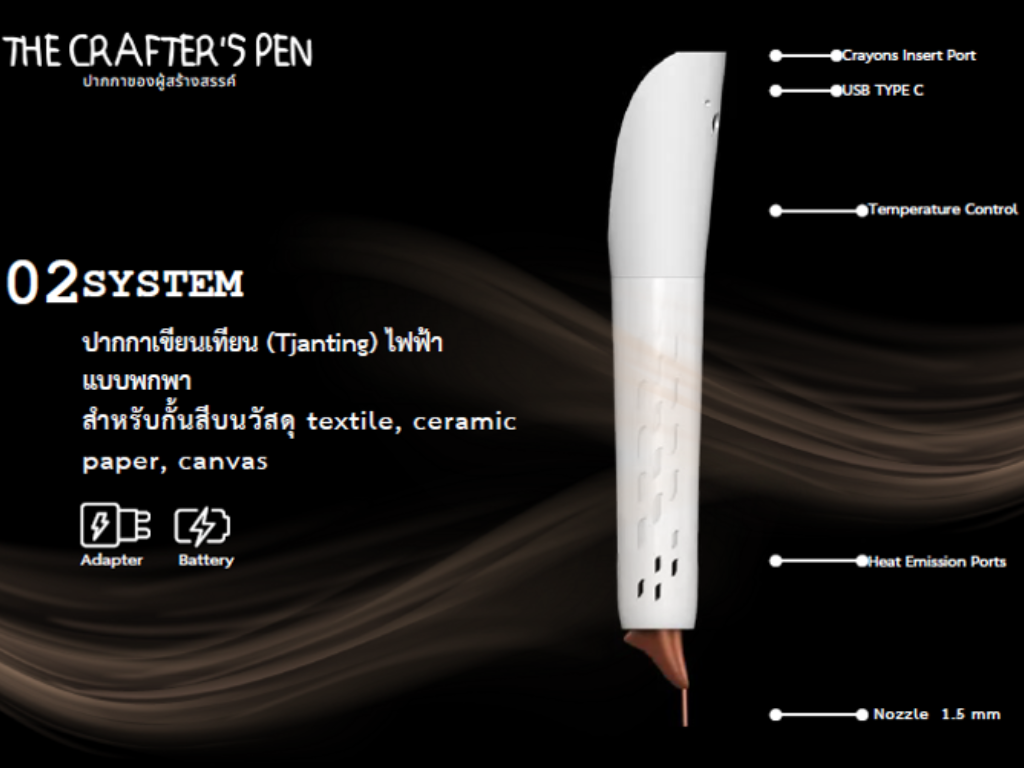
This research aimed to develop a portable electric tjanting pen to replace the traditional tjanting pen, which requires lengthy preparation of melted wax and poses health risks to batik artisans. The study began with a problem analysis, followed by the design of the external structure and internal system, as well as an investigation into alternative materials for batik wax. The process included the construction and development of the portable electric tjanting pen and palm wax sticks, preliminary usability testing, and refinement of the device based on expert recommendations. Additionally, the study assessed the satisfaction of batik artisans using the portable electric tjanting pen. The research results demonstrated that the portable electric tjanting pen could effectively be used to apply wax on batik fabric. When operated at a current of 15 volts in combination with palm wax sticks, the device achieved a maximum continuous writing time of 6 minutes and a maximum writing distance of 1,662 centimeters at a speed of 277 centimeters per minute. The portable electric tjanting pen and palm wax sticks were found to be user-friendly, time-saving by eliminating the need to boil wax, cost-effective in terms of production, and posed no long-term health risks. Moreover, the device is convenient to carry, making it suitable for use by children, youth, and the elderly. The batik artisans who tested the device reported a very high level of satisfaction (x̄ = 4.44, S.D. = 0.69), equivalent to 88.8%.
References
UNESCO. Indonesian batik: UNESCO intangible cultural heritage [Internet]. 2009 [cited 2025 Jan 31]. Available from: https://ich.unesco.org
UNESCO. Indonesian batik: Representative list of the intangible cultural heritage of humanity [Internet]. 2009 [cited 2025 Jan 31]. Available from: https://ich.unesco.org/en/RL/indonesian-batik-00170
UNESCO. Education and training in Indonesian batik intangible cultural heritage for students, in collaboration with the Batik Museum in Pekalongan [Internet]. 2009 [cited 2025 Jan 31]. Available from: https://ich.unesco.org/es/BSP
สำนักงานมาตรฐานผลิตภัณฑ์อุตสาหกรรม (สมอ). มาตรฐานผลิตภัณฑ์ชุมชน ผ้าบาติก. (มผช. 51/2557). กรุงเทพฯ: สมอ.; 2557.
วินัย อุดมทรัพย์. การทำผ้าบาติก. วารสารวิชาการสถาปัตยกรรมและศิลปกรรม สถาบันเทคโนโลยีเจ้าคุณทหารลาดกระบัง. 2547;4(1):45-54.
Kienhuis PGM, Fitz N, Tolosa I, Peschier L. Paraffin wax spill identification by GC-FID and GC-MS. Oil Spill Environmental Forensics Case Studies. 2018:157-186. https://doi.org/10.1016/B978-0-12-804434-6.00008-2
Downloads
Published
How to Cite
Issue
Section
License
Copyright (c) 2025 Bulletin of Applied Sciences

This work is licensed under a Creative Commons Attribution-NonCommercial-NoDerivatives 4.0 International License.