Investigating the collision of objects in liquids using tracker program for teaching in upper secondary school level
Article Sidebar
Main Article Content
Abstract
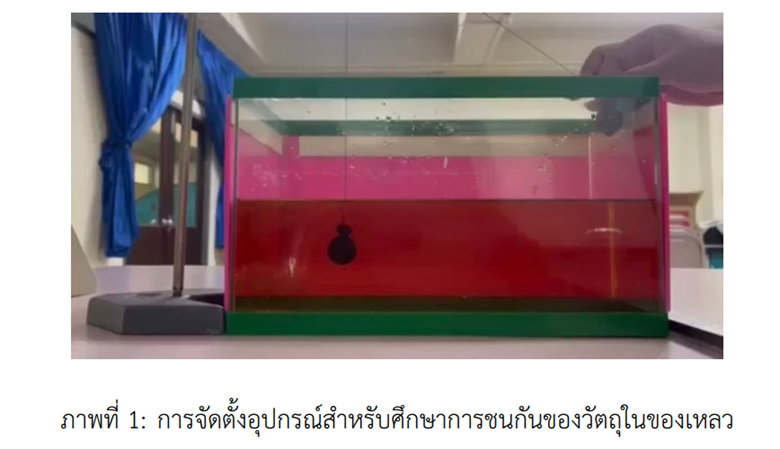
The investigation of the collision of objects in liquids using tracker program for teaching in upper secondary school level is intended to study the movement patterns and movement conditions of objects in liquids at each subsequent period with the tracer program, refer to 2D Cartesian coordinate system, and to find out the effectiveness of the lesson plans and compare the average of the pre-test and post-test scores of the subjects who which using the video tracker program. It teaches physics of collisions of objects in the liquids using the video tracker program. The experimental fluids were water, syrup, and palm oil, which had a viscosity of 20 degrees Celsius, N/A, 2453.37, and 84.53 mPa-s, respectively. The material used as round metal has a radius of 3.17 x10⁻³ m and 1.04 x 10⁻³ kg of mass. The results found that the speed and acceleration of those objects before and after the collision were direct variations to the fluid's viscosity, according to the conservation law of momentum and the conservation law of energy. The results of the educational efficiency of lesson plans of the course on momentum and collision was 85.67/81.98 and which corresponded to the 80/80 standard criteria. The student achievement of the course on momentum and collision score of the pre-test were significantly higher than the post-test which was at the level of 0.05
Article Details

This work is licensed under a Creative Commons Attribution-NoDerivatives 4.0 International License.
บทความที่ได้รับการตีพิมพ์เป็นลิขสิทธิ์ของวารสาร มรภ.กพ. วิทยาศาสตร์ คณิตศาสตร์ และเทคโนโลยี
ข้อคิดเห็นใดๆ ที่ปรากฎในวารสารเป็นวรรณกรรมของผู้เขียนโดยเฉพาะ ซึ่งมหาวิทยาลัยราชภัฏกำแพงเพชรและบรรณาธิการไม่จำเป็นต้องเห็นด้วย
References
สนธิ พลชัยยา. (2557). สะเต็มศึกษากับการคิดขั้นสูง. นิตยสาร สสวท, 42 (189), 7-8.
ปุณภวัฒน์ กาศรุณ, ชนาพร รัตนมาล, อัจฉรา คำหล้า, ธัญญ์วาริน ชูวัฒน์วรกูล และกาญจนา ทองจบ. (2565). การพัฒนาผลสัมฤทธิ์ทางการเรียนและความคิดสร้างสรรค์ในวิชาฟิสิกส์ ของนักเรียนมัธยมศึกษาชั้นปีที่ 4 โดยใช้กิจกรรมการเรียนรู้ตามแนวทาง สะเต็มศึกษา เรื่อง กล่องบรรจุภัณฑ์กันกระแทก. วารสารมหาจุฬานาครทรรศน์, 9 (3), 355-367.
ศิวณัฐ ภูมิโคกรักษ์. (2562). การศึกษาผลการเรียนรู้คณิตศาสตร์และความคิดสร้างสรรค์ของนักเรียนชั้นมัธยมศึกษาปีที่ 3 โดยการจัดการเรียนรู้ตามแนวคิดสะเต็มศึกษา. วารสาร ราชพฤกษ์, 17(2), 73-79.
กรวิทย์ เกื้อคลัง. (2561). ผลสัมฤทธิ์ทางการเรียนโดยการจัดการเรียนรู้ตามแนวทางสะเต็มศึกษาเรื่องสภาพสมดุลและสภาพยืดหยุ่นของนักเรียนชั้นมัธยมศึกษาปีที่ 4. วารสารศึกษาศาสตร์ มหาวิทยาลัยทักษิณ, 18(2), 124-135.
สุรัตน์ กาบทุม. (2562). การเคลื่อนที่ของฟองอากาศภายใต้อิทธิพลของความหนืดของของไหลและการสั่นสะเทือน สำหรับการสอนฟิสิกส์ในระดับมัธยมศึกษาตอนปลาย. (วิทยานิพนธ์ปริญญาวิทยาศาสตรมหาบัณฑิต, มหาวิทยาลัย ราชภัฏเชียงใหม่) [6] อัจฉราวรรณ งามญาณ. (2554). อันเนื่องมาแต่สูตรของยามาเน. วารสารบริหารธุรกิจ, 131, 46-60.
ธัญดร ออกวะลา. (2553). กลศาสตร์ของไหล. ภาควิชาวิศวกรรมชลประทาน. คณะวิศวกรรมศาสตร์กำแพงแสน. มหาวิทยาลัยเกษตรศาสตร์ วิทยาเขตกำแพงแสน, 16.
F.-L. Yang, and M. L. Hunt. (2006). Dynamics of particle-particle collisions in a viscous liquid. Phys. Fluids 18, 121506.
สุภาวรรณ สวนพลอย, วัฒนะ รัมมะเอ็ด และอารยา มุ่งชำนาญกิจ. (2558). การใช้โปรแกรมวิเคราะห์วิดีโอ แทรคเกอร์ช่วยสอนวิชาฟิสิกส์ เรื่องการเคลื่อนที่แบบคาบเพื่อเพิ่มผลการเรียนรู้ของนักเรียนชั้นมัธยมศึกษาปีที่ 4 กรณีศึกษาของโรงเรียนจุฬาภรณราชวิทยาลัย ปทุมธานี. การประชุมวิชาการระดับชาติ มหาวิทยาลัยรังสิต ประจำปี 2558, 1293-1299.
Vera, Francisco., Rivera, Rodrigo and Fuentes, Raúl. (2013). Learning Physics with Video Analysis. Nuevas Ideas en Informática Educativa TISE.
