
The Development of Learning Model Using Robot Project to Enhance Computational Thinking Skill for High School Students
Article Sidebar
Main Article Content
Abstract
This research article presents a novel model of project-based learning with robotics aimed at enhancing computational thinking skills in high school students. The main research objectives were as follows: 1) to develop a project-based learning model with robotics to enhance high school students’ computational thinking skills, and 2) To certify the model operating with research and development process. Resources include 5 experts. There were 2 steps in conducting the research. Step 1 Creating a learning model using robot project to enhance computational thinking skill for high school students. Step 2 Certifying the learning model using robot project to enhance computational thinking skill for high school student. The document for learning research tools were the developed learning model and form certification assessment form. Then the obtained data were analyzed through statistics of mean, S.D.
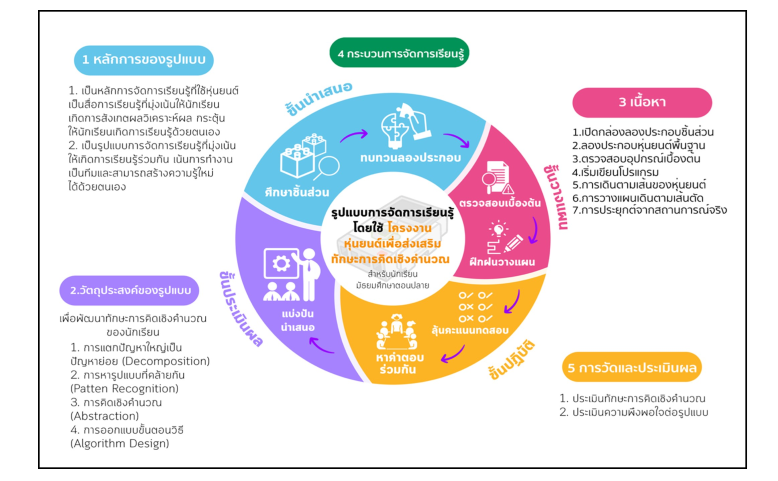
The results reveal the following: 1) The project-based learning model with robotics comprises five aspects, including principles, objectives, content, learning process, and evaluation. The implementation follows a four-step project-based learning management process, involving robotic project issue presentation robotic project development planning, real situation action, and evaluation/review. The assessment result certify that the developed learning model is appropriate at the highest level.
Article Details

This work is licensed under a Creative Commons Attribution-NoDerivatives 4.0 International License.
บทความที่ได้รับการตีพิมพ์เป็นลิขสิทธิ์ของวารสาร มรภ.กพ. วิทยาศาสตร์ คณิตศาสตร์ และเทคโนโลยี
ข้อคิดเห็นใดๆ ที่ปรากฎในวารสารเป็นวรรณกรรมของผู้เขียนโดยเฉพาะ ซึ่งมหาวิทยาลัยราชภัฏกำแพงเพชรและบรรณาธิการไม่จำเป็นต้องเห็นด้วย
References
Gonzalez, M. (2015, July, 6-8). COMPUTATIONAL THINKING:DESIGN GUIDELINES AND CONTENT VALIDATION. In Proceedings of EDULEARN15. Spain: Barcelona.
Wing, J. M. (2006). Computational thinking. Communications of the ACM, 49(3), 33-35.
สำนักงานคณะกรรมการพัฒนาการเศรษฐกิจและสังคมแห่งชาติ. (2559). แผนพัฒนาเศรษฐกิจและสังคมแห่งชาติ ฉบับที่ 11 (พ.ศ. 2555-2559). สืบค้น 20 สิงหาคม 2558 จาก http://www2.oae.go.th/EVA/download/Plan/SummaryPlan11_thai.pdf
รุจโรจน์ แก้วอุไร, สุพรรษา น้อยนคร. (2564). การพัฒนากิจกรรมการเรียนรู้โดยใช้ผังก้างปลาร่วมกับเฟสบุ๊กเพื่อพัฒนาความสามารถในการคิดวิเคราะห์ปัญหาโครงงานของนิสิต.
พิมพันธ์ เดชะคุปต์, พเยาว์ ยินดีสุข, และราเชน มีศรี. (2551). การสอนคิดด้วยโครงงาน: การเรียนการสอน แบบบูรณาการ. กรุงเทพฯ: สำนักพิมพ์แห่งจุฬาลงกรณ์มหาวิทยาลัย.
ศศิโสภิต แพงศรี. (2561). การสอนแบบโครงงานเป็นฐาน: การประยุกต์สู่การปฏิบัติในการจัดการศึกษาพยาบาล. วารสารวิทยาลัยพยาบาลพระปกเกล้าจันทบุรี, 29(1), 215-222.
Chen, G. H. (2017). Assessing elementary students’ computational thinking in everyday reasoning and robotics programming. Journal of Educational Computing Research, 55(7), 924-947.
Bers, M. U. (2010). The TangibleK robotics program: Applied computational thinking for young children. Journal of Educational Technology & Society, 13(3), 203-215.
สุปรีย์ บูรณะกนิษฐ. (2556). ผลการใช้เทคโนโลยีเสริมศักยภาพที่แตกต่างกันในการเรียนรู้แบบโครงงานเป็นฐานที่มีต่อความสามารถในการคิดวิเคราะห์และการแก้ปัญหาในการโปรแกรมหุ่นยนต์ของนักเรียนระดับมัธยมศึกษาตอนต้น (วิทยานิพนธ์ดุษฎีบัณฑิต). กรุงเทพ: จุฬาลงกรณ์มหาวิทยาลัย.
ศศิธร ชูแก้ว. (2560). การพัฒนารูปแบบการสอนแบบบูรณาการโดยใช้หุ่นยนต์เป็นฐานในการพัฒนาทักษะการคิดเชิงประมวลผลของผู้เรียนภายใต้แนวทางการจัดการศึกษาแบบ STEM. (รายงานการวิจัย). กรุงเทพฯ: มหาวิทยาลัยเทคโนโลยีพระจอมเกล้าพระนครเหนือ.
Joyce, B. R., & Weil, M. (1996). Models of teaching (6th ed.). Allyn and Bacon.
Gonzalez, M., & Perez-Munoz, A. (2018). Development of Computational Thinking Skills through Unplugged Activities in Primary School. Education Sciences, 8(1), 17.
Felicia, A. (2017). Computational Thinking and Tinkering: Exploration Study of Primary School Students’ in Robotic and Graphical Programming. International Journal of Assessment and Evaluation in Education, 7, 44-54.
Constantinou, V. (2018). Develop computational thinking skills Through Education Robotics. Andri Ioannou; Published in EC-TEL 2018.
Grover, S. (2011, April 7-11). Robotics for Middle and Hight School Student to Develop Computational Thinking. In Annual Meeting of the American Education Research Association New Orleans. N.P.: n.p.
Swaid, S. (2015). Bringing Computational Thinking to STEM Education. Procedia Manufacturing
Lockwood, J. (2017). A pilot study investigating the introduction of a computer-science course at second level focused on computational thinking. Irish Educational Studies, 36(2), 183-201.
Ling, U. L., Saibin, T. C., Naharu, N., Labadin, J., & Aziz, N. A. (2018). An Evaluation Tool to Measure Computational Thinking Skills: Pilot Investigation. Herald NAMSCA, 1, 606-614.
Wing, J. M. (2012). Computational thinking. Keynote presented at the Microsoft Research Asia Faculty Summit 2012. Retrieved August 30, 2016, from https://www.microsoft.com/en-us/research/wpcontent/uploads/ 2012/08/Jeannette_Wing.pdf
สำนักงานคณะกรรมการการศึกษาแห่งชาติ. (2545). แผนการศึกษาแห่งชาติ (พ.ศ. 2545-2559).กรุงเทพฯ: พริกหวานการพิมพ์.
สุพรรษา น้อยนคร, รุจโรจน์ แก้วอุไร, นฤมล รอดเนียม. (2561). การส่งเสริมการแก้ปัญหาอย่างสร้างสรรค์ด้วยการจัดการเรียนการสอนแบบโครงงานเป็นฐาน บูรณาการกับเฟสบุ๊ก วารสารศึกษาศาสตร์ มหาวิทยาลัยนเรศวร. ปีที่ 21 ฉบับที่ 1 1 มกราคม. – มีนาคม 2562.
อพัชชา ช้างชวัญยืน, รุจโรจน์ แก้วอุไร, วิจัย วงษ์ไทย และ เอื้อมพร หลินเจริญ. (2564). การจัดการเรียนรู้เชิงลึกเพื่อส่งเสริมความเป็นพลเมืองดิจิทัล. วารสารศึกษาศาตร์ มหาวิทยาลัยนเรศวร. ปีที่ 23 ฉบับที่ 3 กรกฎาคม - กันยายน 2564.
ทวีสิน อำนวยพันธ์วิไล, พิชญาภา ยวงสร้อย, รุจโรจน์ แก้วอุไร และ กิตติพงษ์ พุ่มพวง. (2565). การพัฒนารูปแบบการจัดการเรียนรู้บนระบบคลาวด์ด้วยการเรียนรู้แบบร่วมมือรวมพลังร่วมกับการคิดเชิงวิพากษ์เพื่อส่งเสริมการรู้เท่าทันสื่อดิจิทัลสำหรับนักเรียนระดับชั้นมัธยมศึกษาวารสารสักทอง:มนุษศาสตร์สังคมศาสตร์. กรกฎาคม-กันยายน 2565. 81-94.
