
Production and Nutritional Value of Thua Nao Produced Using Traditional Knowledge of Ban Huai Khom Community, Mae Yao Subdistrict, Mueang District, Chiang Rai Province
Article Sidebar
Main Article Content
Abstract
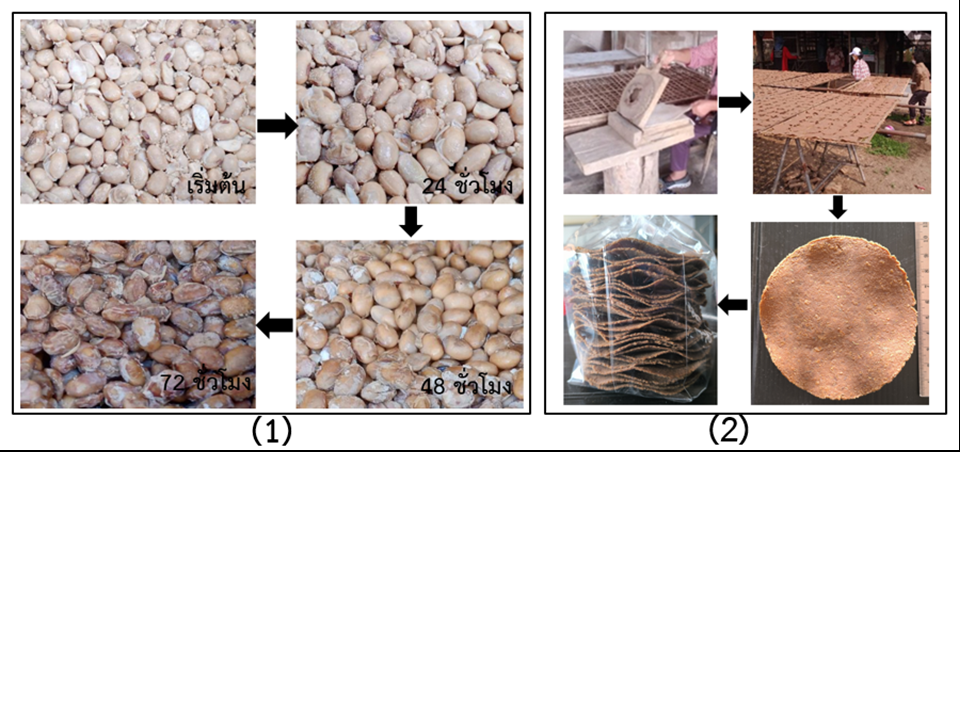
This research aimed to study the traditional production process and nutritional value of Thua Nao (fermented soybeans), a product of indigenous wisdom from the Ban Huai Khom community in Chiang Rai province. It also sought to explore methods for developing production quality using a pure starter culture. The research was conducted through in-depth interviews and participatory observation with three producer households to study the traditional production process, with product samples collected for nutritional analysis. Furthermore, microorganisms were isolated from traditional Thua Nao to produce a starter culture, which was then trialed in the actual production process by the community. The study found that the traditional production process consists of three main steps: soaking, boiling, and fermentation, reflecting inherited wisdom. The hard-type Thua Nao produced using traditional methods had a high average protein content, ranging from 38.52% to 43.39%, although product quality varied among producers. The research successfully isolated bacteria of the Bacillus genus, the primary microorganism in the fermentation, and developed it into a powdered starter culture. The trial of producing Thua Nao with this developed starter culture showed that the fermentation process could be better controlled, resulting in a final product with consistent quality and a high protein content of up to 45.98%. The research indicates that integrating local wisdom with biotechnology through the use of a starter culture is an effective approach to elevate the standard and safety of Thua Nao. This method simultaneously preserves cultural heritage and promotes the community's economy.
Article Details

This work is licensed under a Creative Commons Attribution-NoDerivatives 4.0 International License.
บทความที่ได้รับการตีพิมพ์เป็นลิขสิทธิ์ของวารสาร มรภ.กพ. วิทยาศาสตร์ คณิตศาสตร์ และเทคโนโลยี
ข้อคิดเห็นใดๆ ที่ปรากฎในวารสารเป็นวรรณกรรมของผู้เขียนโดยเฉพาะ ซึ่งมหาวิทยาลัยราชภัฏกำแพงเพชรและบรรณาธิการไม่จำเป็นต้องเห็นด้วย
References
สุกานดา วงศ์กาฬสินธุ์, รัตนาภรณ์ พงษ์ศักดิ์, และสุดารัตน์ พุ่มจันทร์. (2019). คุณภาพทางจุลชีววิทยาและคุณค่าทางโภชนาการของถั่วเน่าในภาคเหนือตอนบนของประเทศไทย. วารสารวิทยาศาสตร์และเทคโนโลยี, 27(1), 105–115.
บุญยงค์ วรเนตร์. (2012). ถั่วเน่า: ภูมิปัญญาพื้นบ้านล้านนา. สำนักพิมพ์มหาวิทยาลัยเชียงใหม่.
AOAC International. (2019). Official methods of analysis of AOAC International (21st ed.). AOAC International.
Sullivan, D. M., & Carpenter, D. E. (1993). Methods of analysis for nutrition labeling. AOAC International.
สุภาวดี อินเขียน. (2011). การศึกษาการผลิตถั่วเน่าแผ่นในพื้นที่ 8 จังหวัดภาคเหนือตอนบน (วิทยานิพนธ์ปริญญามหาบัณฑิต, มหาวิทยาลัยราชภัฏเชียงใหม่). http://cmruir.cmru.ac.th/bitstream/123456789/142/4/C1_382021.pdf
Sangla, K., & Suppadit, T. (2005). A study on production processes and quality of fermented soybean (Thua–Nao) in the upper north of Thailand. Journal of Environmental Management, 2(1), 33–39.
พิมพ์เพ็ญ พรเฉลิมพงศ์, & นิธิยา รัตนาปนนท์. (n.d.). ถั่วเน่า / Thua nao. Food Wiki. https://www.foodnetworksolution.com/wiki/word/2210/ถั่วเน่า-thua-nao
สำนักงานพัฒนาวิทยาศาสตร์และเทคโนโลยีแห่งชาติ. (n.d.). การศึกษาสภาวะที่เหมาะสมในการเกิดเชื้อ Bacillus subtilis เพื่อผลิตถั่วเน่าแข็บ. https://www.nstda.or.th/sci-kids-menu/11545-bacillus-subtilis
Thailand Food Tradition. (2024). ถั่วเน่า อาหารเหนือมากคุณค่าจากภูมิปัญญาพื้นบ้าน. https://thailandfoodtradition.com/th/articles/ถั่วเน่า-อาหารเหนือมากคุณค่าจากภูมิปัญญาพื้นบ้าน
จิรวรรณ เจริญฉลาด, ปริชาติ ราชสุภา, อรทัย บุรีนอก, และศศิธร ศิริสุวรรณ. (2016). องค์ประกอบทางเคมีและคุณสมบัติการต้านอนุมูลอิสระของผลิตภัณฑ์ถั่วเน่า. วารสารวิทยาศาสตร์เกษตร, 47(3, ฉบับพิเศษ), 425–428.
สุนทรี ชัยบุณย์, & ทิพวรรณ เทพปินใจ. (2018). คุณภาพของถั่วเน่าจากแหล่งผลิตต่างกันในจังหวัดพะเยา. ใน การประชุมวิชาการระดับชาติ วิทยาศาสตร์และเทคโนโลยีระหว่างสถาบัน ครั้งที่ 6 (น. 642–648). คณะวิทยาศาสตร์และเทคโนโลยี มหาวิทยาลัยราชภัฏพิบูลสงคราม. https://science.kmutt.ac.th/wp-content/uploads/2021/01/Full-Paper-Proceeding-ASTIC-2018-final.pdf
อัญชนีย์ อุทัยพัฒนาชีพ, มณจันทร์ เมฆธน, และสุวิมล กีรติพิบูล. (2012). การคัดเลือกและพิสูจน์เอกลักษณ์ของเชื้อแบคทีเรียจากถั่วเน่าเพื่อใช้เป็นหัวเชื้อเริ่มต้น. วารสารวิทยาศาสตร์และเทคโนโลยี, 20(4), 315–327.
สถาบันวิจัยวิทยาศาสตร์และเทคโนโลยีแห่งประเทศไทย. (2016). กล้าเชื้อถั่วเน่า. https://www.tistr.or.th/tistrnew/main/page_service.php?id=309
Suppadit, T., Sangla, L., & Pintasean, S. (2008). A study on production processes and quality of fermented soybean (Thua–Nao) in the upper north of Thailand. Journal of Environmental Management and Sustainability, 4(2), 29–38.
เอกชัย ชูเกียรติโรจน์, ศศิธร อินเขียน, เกตุการ ดาจันทา, และอรุณี อภิชาติสรางกูร. (2011). ถั่วเน่า: ผลิตภัณฑ์ถั่วเหลืองหมักพื้นเมืองของประเทศไทย. Science Essence Journal, 27(1), 197–213.
ปิยะวรรณ กาสลัก, & รัชฎาพร อุ่นศิวิไลย์. (2010). การลดกลิ่นไม่พึงประสงค์และเพิ่มคุณค่าทางโภชนาการของผลิตภัณฑ์ถั่วหมัก โดยการใช้ Bacillus subtilis เป็นกล้าเชื้อในการหมัก. สาขาวิชาเทคโนโลยีชีวภาพ สำนักวิชาเทคโนโลยีอาหาร มหาวิทยาลัยเทคโนโลยีสุรนารี.
Dajanta, K., Chukeatirote, E., & Apichartsrangkoon, A. (2012). Nutritional and physicochemical qualities of Thua Nao (Thai traditional fermented soybean). Chiang Mai Journal of Science, 39(1), 76–86..
