The Effects of Learning Activities Using GeoGebra on Fundamental Geometric Constructions for Grade 7 Students at Thepsatri Rajabhat University Demonstration School
Article Sidebar
Main Article Content
Abstract
This study aimed to investigate the learning achievement and satisfaction of Grade 7 students who participated in a learning approach using the GeoGebra program on fundamental geometric constructions. The sample consisted of 49 Grade 7 students from Thepsatri Rajabhat University Demonstration School, who were taught using GeoGebra over a specific period. After the learning process, pre-test and post-test assessments were conducted to measure students' learning achievement, along with a survey to evaluate their satisfaction.
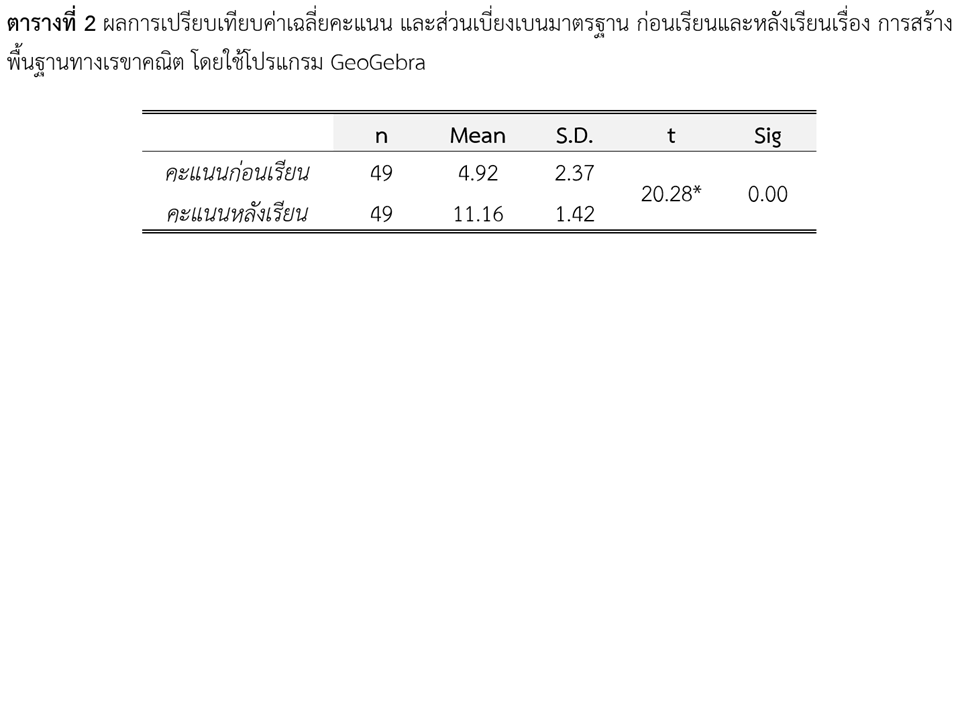
The findings revealed that students' learning achievement significantly improved after using GeoGebra, with the average post-test score increasing from 4.92 to 11.16. Furthermore, students' satisfaction with the GeoGebra-based learning approach was at a very high level (mean = 4.67, S.D. = 0.51). These findings suggest that incorporating the GeoGebra program into geometry instruction can effectively enhance students' understanding and learning outcomes.
Article Details

This work is licensed under a Creative Commons Attribution-NoDerivatives 4.0 International License.
บทความที่ได้รับการตีพิมพ์เป็นลิขสิทธิ์ของวารสาร มรภ.กพ. วิทยาศาสตร์ คณิตศาสตร์ และเทคโนโลยี
ข้อคิดเห็นใดๆ ที่ปรากฎในวารสารเป็นวรรณกรรมของผู้เขียนโดยเฉพาะ ซึ่งมหาวิทยาลัยราชภัฏกำแพงเพชรและบรรณาธิการไม่จำเป็นต้องเห็นด้วย
References
National Council of Teachers of Mathematics. (2000). Principles and standards for school mathematics. Reston, VA: National Council of Teachers of Mathematics.
Shelley, M. W. (1975). Responding to social change. Pennsylvania: Downed Hutchinson & Poss. Stromborg, M. F. (1984). Selecting an instrument to measure quality of life. Oncology Nursing Forum.
กระทรวงศึกษาธิการ. (2551). หลักสูตรแกนกลางการศึกษาขั้นพื้นฐาน พุทธศักราช 2551. กรุงเทพฯ: โรงพิมพ์ ชุมนุมสหกรณ์การเกษตรแห่งประเทศไทย จำกัด.
กระทรวงศึกษาธิการ. (2560). ตัวชี้วัดและสาระการเรียนรู้แกนกลาง กลุ่มสาระการเรียนรู้คณิตศาสตร์ (ฉบับ ปรับปรุง พ.ศ. 2560) ตามหลักสูตรแกนกลางการศึกษาขั้นพื้นฐาน พุทธศักราช 2551. กรุงเทพฯ: โรงพิมพ์ ชุมนุมสหกรณ์การเกษตรแห่งประเทศไทย จำกัด.
กิตติศักดิ์ สังฆะกาโล, เกษรินทร์ เป็งจันทร์, ภูเบศวร์ รัตนมงคล, & ปณิธิ ทองคำ. (2564, 11 เมษายน). การใช้ เทคโนโลยีเพื่อสนับสนุนการจัดการเรียนการสอน. สืบค้นจาก https://www.starfishlabz.com/blog/760
เฉลิมเกียรติ ตุ่นแก้ว. (2553). ความพึงพอใจของผู้ปกครองที่มีต่อการบริหารงานโรงเรียนสาธิตมหาวิทยาลัยราชภัฏ เชียงราย. การศึกษาอิสระปริญญาครุศาสตรมหาบัณฑิต, มหาวิทยาลัยราชภัฏเชียงราย.
เฉลิมวุฒิ คำเมือง. (2562, 14 มิถุนายน). การสร้างสื่อการเรียนการสอน โดยใช้โปรแกรม GeoGebra. สืบค้นจาก http://blog.bru.ac.th/2019/06/14/โปรแกรม-geogebra-v5-0-เบื้องต้น/
ปาริชาต เต็มนา. (2562). ผลการจัดกิจกรรมการเรียนรู้โดยใช้โปรแกรม GeoGebra เรื่อง เวกเตอร์ ที่มีต่อ ผลสัมฤทธิ์ทางการเรียนคณิตศาสตร์และความสามารถในการเชื่อมโยงความรู้ทางคณิตศาสตร์ของนักเรียน มัธยมศึกษาปีที่ 5 โรงเรียนเบญจมราชูทิศ จังหวัดนครศรีธรรมราช. วิทยานิพนธ์ศึกษาศาสตรมหาบัณฑิต, สาขาวิชาศึกษาศาสตร์, มหาวิทยาลัยสุโขทัยธรรมาธิราช.
ปิยะวุฒิ ศรีชนะ. (2556). ชุดการเรียนการสอนเรื่อง กำหนดการเชิงเส้นโดยใช้โปรแกรม GeoGebra สำหรับ นักเรียนชั้นมัธยมศึกษาปีที่ 6. วิทยานิพนธ์วิทยาศาสตรมหาบัณฑิต, สาขาวิชาคณิตศาสตรศึกษา, คณะ วิทยาศาสตร์, มหาวิทยาลัยอุบลราชธานี.
ศิริขวัญ พ่อค้า. (2562). ผลของการจัดกิจกรรมการเรียนรู้ตามทฤษฎีคอนสตรัคติวิสต์ ร่วมกับโปรแกรม GeoGebra เรื่อง เรขาคณิตวิเคราะห์ ที่มีต่อความสามารถในการแก้ปัญหา. วิทยานิพนธ์วิทยาศาสตร มหาบัณฑิต, สาขาวิชาคณิตศาสตรศึกษา, คณะวิทยาศาสตร์, มหาวิทยาลัยอุบลราชธานี.
สถาบันส่งเสริมการสอนวิทยาศาสตร์และเทคโนโลยี. (2561). คู่มือการใช้หลักสูตร กลุ่มสาระการเรียนรู้ คณิตศาสตร์ (ฉบับปรับปรุง พ.ศ. 2560) ตามหลักสูตรแกนกลางการศึกษาขั้นพื้นฐาน พุทธศักราช 2551 ระดับมัธยมศึกษาตอนต้น.
