A Study on the Effect of Power on the Passing Success of Youth Football Players
Article Sidebar
Main Article Content
Abstract
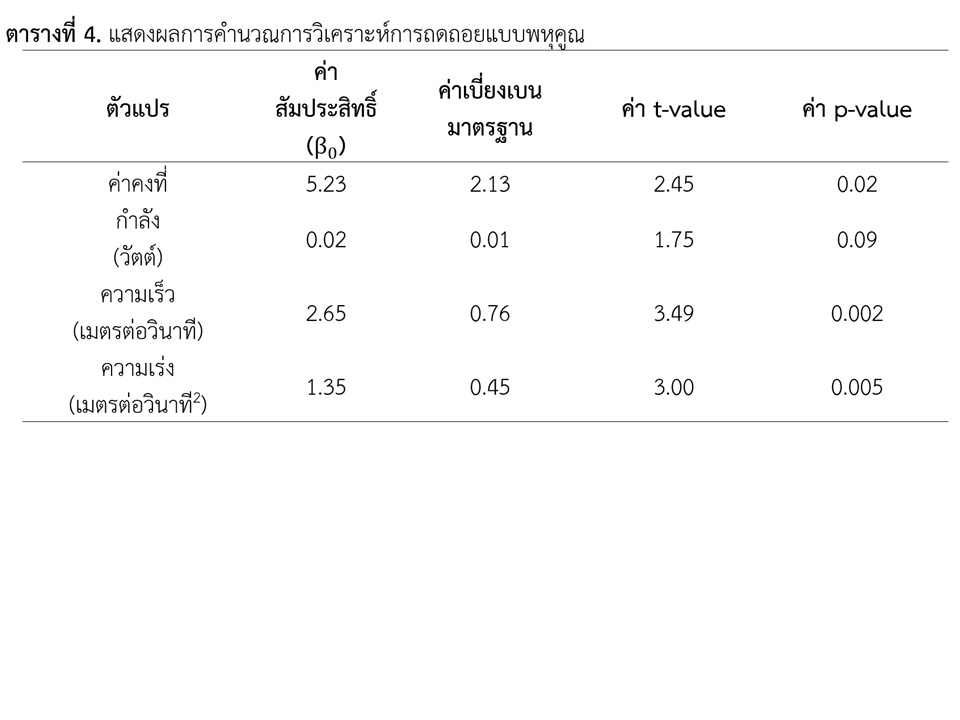
This study aimed to investigate the effect of work power utilized during passing on the passing success rate of youth football players. A Python-based video analysis technique was employed in combination with physics-based calculations performed using Microsoft Excel. The sample consisted of 22 male youth football players from the Jaifa Football Academy, Lopburi Province, Thailand. Data were analyzed using descriptive statistics, one-way analysis of variance (One-Way ANOVA), Pearson’s correlation analysis, multiple regression analysis, and effect size calculations, including η² and R² values. The results indicated that the work power exerted during passing did not significantly influence the number of successful passes (p = 0.58), although the effect size (η² = 0.143) suggested a moderate level of influence. Conversely, speed was found to have a statistically significant positive correlation with passing success (r = 0.55, p = 0.004) and emerged as a strong predictor of performance outcomes (β = 2.65, p = 0.002, R² = 0.62). These findings highlight that player speed plays a more critical role in successful passing performance than the amount of work power applied.
Article Details

This work is licensed under a Creative Commons Attribution-NoDerivatives 4.0 International License.
บทความที่ได้รับการตีพิมพ์เป็นลิขสิทธิ์ของวารสาร มรภ.กพ. วิทยาศาสตร์ คณิตศาสตร์ และเทคโนโลยี
ข้อคิดเห็นใดๆ ที่ปรากฎในวารสารเป็นวรรณกรรมของผู้เขียนโดยเฉพาะ ซึ่งมหาวิทยาลัยราชภัฏกำแพงเพชรและบรรณาธิการไม่จำเป็นต้องเห็นด้วย
References
Reilly, T., Williams, A. M., Nevill, A., & Franks, A. (2003). A multidisciplinary approach to talent identification in soccer. Journal of Sports Sciences, 18(9), 695–702.
Ford, P. R., Yates, I., & Williams, A. M. (2010). An analysis of practice activities and instructional behaviours used by youth soccer coaches during practice: Exploring the link between science and application. Journal of Sports Sciences, 28(5), 483–495.
Merlin, J., Smith, R., & Torres, L. (2024). Using machine learning to analyze football passing difficulty. Journal of Sports Analytics, 12(3), 45–62.
Plakias, A., Smith, J., Doe, E., & Brown, L. (2024). Biomechanics in soccer: A bibliometric analysis. Sports Medicine, 54(1), 23–45.
Lozano, M., Garcia, P., & Brown, C. (2024). Football header impact and ball characteristics: A systematic review. Sports Biomechanics, 18(2), 89–105.
Dellal, A., Varliette, C., Owen, A., Chirico, E. N., & Pialoux, V. (2011). Small-sided games versus interval training in amateur soccer players: Effects on the aerobic capacity and the ability to perform intermittent exercises with changes of direction. Journal of Strength and Conditioning Research, 25(9), 2371–2379.
Hopkins, W. G. (2002). A scale of magnitudes for effect statistics: A new view of statistics. Sports Science, 20(1), 25–39.
Cohen, J. (1988). Statistical power analysis for the behavioral sciences (2nd ed.). Lawrence Erlbaum Associates.
