Development of healthy puffed rice product prototype
Article Sidebar
Main Article Content
Abstract
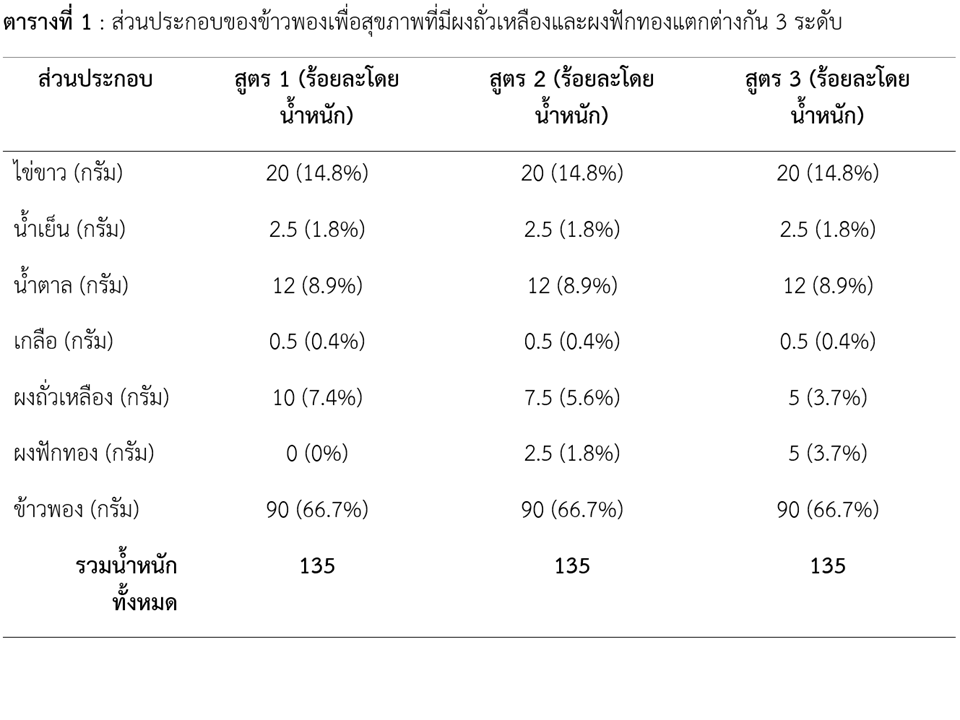
The development of the healthy food product was conducted due to the consumer demand that tends to continuously increase. This research aims to develop the prototype puffed rice product with good nutrition and suitable for healthy food. The effect of rice varieties on the rate of puffing and the appropriate component ratio for a healthy puffed rice development were observed. The result founded that rice varieties were significantly affected by puffing rate (p<0.05). The RD6 Rice had the highest puffing rate at 260.17% w/v, followed by San Pa Tong Rice, Kiaw Ngoo Rice and Purple Rice at 195.84, 175.00 and 150.00% w/v, respectively. The component ratio of puffed rice, soybean powder and pumpkin powder was significantly affected on sensory acceptance and chemical compositions (p<0.05). The optimum ingredients for developed a healthy puffed rice product were puffed rice 66.7%, egg white 14.8%, water 1.8%, sugar 8.9% salt 0.4% and soybean powder 7.5% w/w. Product received overall liking score with 8.24, which is the most like level. The proximate analysis of product was as following; ash 1.78% w/w, protein 10.75% w/w, fat 1.62% w/w, dietary fiber 0.55% w/w, carbohydrate 81.87% w/w, moisture 3.48% and water activity was 0.22. The healthy puffed rice showed good nutritional value. Protein, dietary fiber and mineral content were increased due to the egg white and soybean powder in the formula. The fat content in prototype product was approximately 10 times lower than the puffed rice obtained from frying.
Article Details

This work is licensed under a Creative Commons Attribution-NoDerivatives 4.0 International License.
บทความที่ได้รับการตีพิมพ์เป็นลิขสิทธิ์ของวารสาร มรภ.กพ. วิทยาศาสตร์ คณิตศาสตร์ และเทคโนโลยี
ข้อคิดเห็นใดๆ ที่ปรากฎในวารสารเป็นวรรณกรรมของผู้เขียนโดยเฉพาะ ซึ่งมหาวิทยาลัยราชภัฏกำแพงเพชรและบรรณาธิการไม่จำเป็นต้องเห็นด้วย
References
Silanoi, Thongrawee. (2018). The influence of attitude towards predicting the intention to buy diet supplementary product: A case study in Roi Kaen Sa Ra Sin area. KKU Research Journal of Humanities and Social Sciences (Graduate Study), 6(1), 1-10.
Suchada, M. and Woatthichai, N. (2009). Effects of salt, moisture content and microwave power on puffing qualities of puffed rice. Faculty of Agro Industry, King Mongkut’s Institute of Technology Ladkrabang..
Hetal. K. Bhatt and D.C. Joshi. (2014). Standardization of pretreatments for production of ready-to-puff rice using microwave energy. Journal of Grain Processing and Storage, 1(2), 47-53.
HOKE K., HOUŠOVÁ J. and HOUŠKA M. (2005): Optimum conditions of rice puffing – Review. Journal of Food Science, 23(1), 1–11.
ชลลดา ไรขาม และ อรวรรณ ริ้วทอง. (2561). ผลของอุณหภูมิและเวลาพัฟฟิงต่อคุณภาพของข้าวพองที่ผลิตจากข้าวเหนียวกล้อง กข 6. วารสารวิทยาศาสตร์ลาดกระบัง. 27(1), 42-54
กัญญา สุจริตวงศานนท์, สมจิต อ่อนเหม, ช่อลัดดา เที่ยงพุก และยุวดี พีรพรไพศาล. (2553). การพัฒนาผลิตภัณฑ์ข้าวแต๋นสาหร่ายไก.วารสารอาหาร, 40(1), 73-81
AOAC. (2020). Official methods of analysis of AOAC International. 20th edn. AOAC International, Maryland.
บัณฑิต ไพรีขยาด และปิยวัฒน์ กิจจานนท์. (2559). การพัฒนาผลิตภัณฑ์ข้าวแต๋นแบบไม่ทอดจาก ข้าวเหนียว. วิจัยวิทยาศาสตร์บัณฑิต.มหาวิทยาลัยเทคโนโลยีราชมงคลพระนคร.
Murugesan, G., Bhattacharya, K.R. (1 9 8 6). Studies on puffed rice. I. Effect of processing conditions. Journal of Food Science and Technology, 3(4), 197-202.
กองวิจัยและพัฒนาข้าว กรมการข้าว. (กุมภาพันธ์, 2567). องค์ความรู้เรื่องข้าว:ข้าวเหนียว กข6. Active leaning for All. https://webold.ricethailand.go.th/rkb3/Varieties.htm
Chardraekhar, P.R. and Chattopadhyay P.K. (1991). Rice puffing in relation to its varietal characteristics and processing conditions. Journal of Food Process Engineering. 14(4), 261-277
นรินทร์ เจริญพันธ. (2563) การใช้ประโยชน์จากปลายข้าวเพื่อผลิตข้าวแตน. วารสารวิทยาศาสตร์และเทคโนโลยี. 28(12), 2150-2163
Gomes, R.S., de Almeida C.F., Chagas, R.R., Fara, J.S., and da Silva, D.J.H. (2020). Winter squash (CucurbitamoschataD.) displays promising nutritional aspects in fruits, seeds and in the seed oil. Journal of PlantBiochemistry & Physiology, 8(2), 248-253
Adelakun, O.E., Duodu, K.G., Buys, E. and Olanipekun, B.F. (2013). Potential use of soybean flour (glycinemax) in food fortification. Editor, Rijeka, InTech.
สำนักงาน มาตรฐาน ผลิตภัณฑ์ อุตสาหกรรม. (2562). มาตรฐานผลิตภัณฑ์ชุมชน เรื่อง ข้าวพอง มผช. 743/2562. กระทรวงอุตสาหกรรม
