การประเมินดัชนีความเสี่ยงของนิวไคลด์กัมมันตรังสีในตัวอย่างดินจากสวนกาแฟ จังหวัดชุมพร ประเทศไทย
คำสำคัญ:
ดัชนีความเสี่ยงของนิวไคลด์กัมมันตรังสี, หัววัดเจอร์มาเนียมบริสิทธิ์สูง, ดินปลูกกาแฟบทคัดย่อ
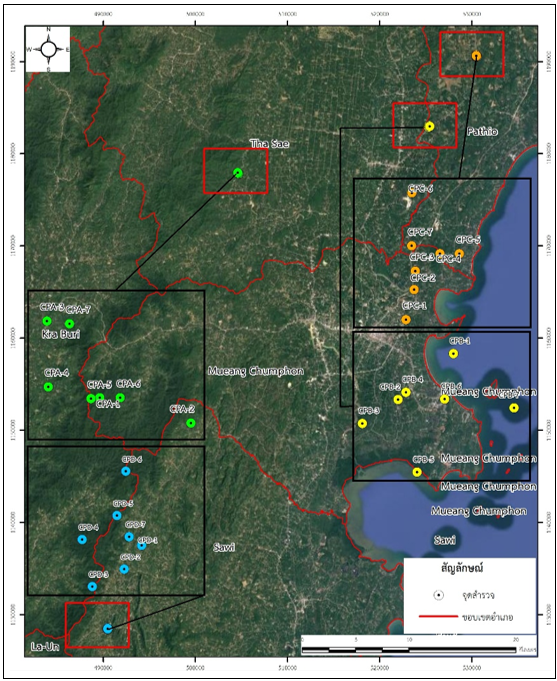
วัตถุประสงค์ของการวิจัยครั้งนี้เพื่อประเมินดัชนีความเสี่ยงของนิวไคลด์กัมมันตรังสีธรรมชาติในตัวอย่างดิน จากสวนกาแฟ อำเภอท่าแซะ อำเภอปะทิว และอำเภอสวี จังหวัดชุมพร 28 สถานี แต่ละสถานีแบ่งเป็น 6 ระดับ คือ 0-30 cm รวม 168 ตัวอย่าง วิเคราะห์โดยใช้ระบบแกมมาสเปกโตรมิตรี หัววัดเจอร์มาเนียมบริสิทธิ์สูง พบว่าค่ากัมมันตรังสีสมมูลเรเดียม (Raeq) ค่าอัตราปริมาณรังสีดูดกลืนในอากาศ (D) ค่าปริมาณรังสีที่ได้รับภายนอกร่างกายประจำปี (E) ค่าดัชนีความเสี่ยงจากการได้รับรังสีภายนอกร่างกาย (Hex) และค่าความเสี่ยงในการก่อให้เกิดมะเร็งตลอดช่วงชีวิต (ELCR) มีค่าเฉลี่ยเป็น 153.76 ± 0.19 Bq/kg, 72.97 ± 0.13 nGy/h, 0.089 ± 0.004 mSv/y, 0.42 ± 0.01 และ 0.31 ± 0.01 mSv/y ตามลำดับ โดยค่ากัมมันตรังสีสมมูลเรเดียม ค่าปริมาณรังสีที่ได้รับภายนอกร่างกายประจำปี ค่าดัชนีความเสี่ยงจากการได้รับรังสีภายนอกร่างกาย และค่าความเสี่ยงในการก่อให้เกิดมะเร็งตลอดช่วงชีวิต มีค่าต่ำกว่าเกณฑ์ UNSCEAR ที่ 370 Bq/kg, 0.48 mSv/y, 1 และ 0.29 mSv/y ตามลำดับ ส่วนค่าอัตราปริมาณรังสีดูดกลืนในอากาศอยู่ในเกณฑ์ที่ยอมรับได้ในระดับสากลที่ 57 nGy/h ผลการวิจัยสรุปได้ว่าปริมาณสารกัมมันตรังสีที่ปนเปื้อนในดิน สวนกาแฟ อำเภอท่าแซะ อำเภอปะทิว และอำเภอสวี จังหวัดชุมพร อยู่ในเกฑณ์ที่ปลอดภัย
เอกสารอ้างอิง
กรมทรัพยากรธรณี. (2550). การจำแนกเขตเพื่อการจัดการด้านธรณีวิทยาและทรัพยากรธรณีจังหวัดชุมพร. ห้างหุ้นส่วนจำกัด ไอเดีย สแควร์.
กรมวิชาการเกษตร. (ม.ป.ป.). ยกระดับอัตลักษณ์กาแฟไทยด้วยนวัตกรรมกาแฟ สู่ตลาดสากล. สำนักพิมพ์การันตี.
คณะกรรมการความปลอดภัยทางรังสี ศูนย์ความปลอดภัยอาชีวอนามัยและสิ่งแวดล้อม จุฬาลงกรณ์มหาวิทยาลัย. (2564). คู่มือความปลอดภัยในการทำงานด้านรังสี. https://www.shecu.chula.ac.th/data/boards/120/manual-radiation-safety.pdf
ชุษณา เมฆโหรา. (2558). กาแฟเพื่อสุขภาพ. วารสารอาหาร, 45(4), 15–18.
สะเราะ นิยมเดชา, รุ่งศักดิ์ สุวรรณกลาง, และพรธิภา ตั้งตระกูล. (2567). การวิเคราะห์นิวไคลด์กัมมันตรังสีในตัวอย่างสิ่งแวดล้อมด้วยระบบวัดแกมมาสเปกโตรเมตรี. https://www.oap.go.th/wp-content/uploads/2024/04/3-คู่มือการวิเคราะห์นิวไคลด์รังสีในตัวอย่างสิ่งแวดล้อม.pdf
สำนักงานเกษตรและสหกรณ์จังหวัดชุมพร. (2567). ข้อมูลเพื่อการวางแผนพัฒนาการเกษตรรายสินค้า ปี 2567.สำนักงานปลัดกระทรวงเกษตรและสหกรณ์. https://www.opsmoac.go.th/chumphon-performance-preview-461591791830
Agbalagba, E. O., & Onoja, R. A. (2011). Evaluation of natural radioactivity in soil, sediment and water samples of Niger Delta (Biseni) flood plain lakes, Nigeria. Journal of Environmental Radioactivity, 102(7), 667–671. https://doi.org/10.1016/j.jenvrad.2011.03.002
Ahmad, A. Y., Al-Ghouti, M. A., AlSadig, I., & Dieyeh, M. A. (2019). Vertical distribution and radiological risk assessment of Cs-137 and natural radionuclides in soil samples. Scientific Reports, 9, Article 12481. https://doi.org/10.1038/s41598-019-48500-x
Ahmed, N. K., & El-Aradi, A. G. M. (2005). Natural radioactivity in farm soil and phosphate fertilizer and its environmental implications in Qena governorate, Upper Egypt. Journal of Environmental Radioactivity, 84(1), 51–64. https://doi.org/10.1016/j.jenvrad.2005.04.007
Alharbi, W. R., & Alamoudi, Z. M. (2017). Radiological hazard of coffee to humans: A comparative study of Arabian and Turkish coffees. African Journal of Agricultural Research, 12(5), 327–341. https://doi.org/10.5897/AJAR2016.12031
Asaduzzaman, K., Khandaker, M. U., Amin, Y. M., & Mahat, R. (2014). Soil-to-root vegetable transfer factors for 226Ra, 232Th, 40K, and 88Y in Malaysia. Journal of Environmental Radioactivity, 135, 120–127. https://doi.org/10.1016/j.jenvrad.2014.04.009
Asaduzzaman, K., Khandaker, M. U., Amin, Y. M., & Mahat, R. (2015). Uptake and distribution of natural radioactivity in rice from soil in north and west part of peninsular Malaysia for the estimation of ingestion dose to man. Annals of Nuclear Energy, 76, 85–93. https://doi.org/10.1016/j.anucene.2014.09.036
Ashebir, N. C., Goshu, B. S., & Mengistu, E. (2021). Assessment of Natural Radioactivity in Soil Samples and Tea Leaves at Gumero Tea Farm, Ethiopia. Romanian Journal of Biophysics. 32(2), 103-119.
Chauymanee, G., Kessaratikoon, P., Boonkrongcheep, R., Benjakul, S. & Youngchauy, U. (2013). Specific Activity and Radioactive Contour Map of Anthropogenic Radionuclide (Cs-137) in Surface Soil Samples from Chumphon Province, Thailand. Advanced Materials Research. 770, 108-111. https://doi.org/10.4028/www.scientific.net/AMR.770.108
Eke, B.C., Akomolafe, I.R., Ukewuik, U.M. & Onyenegecha, C.P. (2024). Assesment of Radiation Hazard Indices Due to Natural Radionuclides in Soil Samples from Imo State University, Owerri, Nigeria. Environmental Health Insight, 18(1), 1-11. https://doi.org/10.1177/11786302231224581
Environmental Protection Agency (EPA). (1999). National Emission Standard for Hazardous Air Pollutants; National Emission Standards for Radon Emissions from Phosphogypsum Stacks. Federal Register, 64(20), 5574-5580.
Feng, W., Zhang, Y., Li, Y., Wang, P., Zhu, C., Shi, L., Hou, X., & Qie, X. (2020). Spatial distribution, risk assessment and influence factors of terrestrial gamma radiation dose in China. Journal of Environmental Radioactivity. 222, 106325. https://doi.org/10.1016/j.jenvrad.2020.106325
Goshu, B. S. & Ashebir, N. C. (2024). Estimation of annual effective radiation dose and cancer risk due to tea consumption. Romanian Journal of Biophysics, 34(2), 73-85. https://www.doi.org/10.59277/RJB.2024.2.02
Hameed, P. S., Pillai, G. S., & Mathiyarasu, R. (2014). A study on the impact of phosphate fertilizers on the radioactivity profile of cultivated soils in Srirangam (Tamil Nadu, India). Journal of Radiation Research and Applied Sciences. 7(4), 463-471. https://doi.org/10.1016/j.jrras.2014.08.011
International Agency for Research on Cancer. (2012). IARC monographs on evaluation of carcinogenic risks to humans: Volume 100D, Radiation (ISBN 978-92-832-1321-5). International Agency for Research on Cancer. https://publications.iarc.who.int/Book-And-Report-Series/Iarc-Monographs-On-The-Identification-Of-Carcinogenic-Hazards-To-Humans/Radiation-2012
International Commission on Radiological Protection (ICRP). (2007). The 2007 recommendations of the International Commission on Radiological Protection (ICPR Publication 103). Annals of the ICPR, 37(2-4), 1-332. https://doi.org/10.1016/j.icrp.2007.10.003
Júnior, J. A. dos S., Araújo, E. E. de. N., Fernández, Z. H., Amaral, R. dos S., Nascimento, J. M. do S. & Milán, M. O. (2021). Measurement of natural radioactivity and radium equivalent activity for pottery making clay samples in Paraíba and Rio Grande do Norte – Brazil. Environmental Advances, 6, 100121. https://doi.org/10.1016/j.envadv.2021.100121
Keser, R., Görür, F. K., Akcay, N., & Okumuşoglu, N. T. (2011). Radionuclide concentration in tea, cabbage, orange, kiwi and soil and lifetime cancer risk due to gamma radioactivity in Rize, Turkey. Journal of the Science of Food and Agriculture. 91(6), 987-991. https://doi.org/10.1002/jsfa.4259
Kritsananuwat, R., Sahoo, S. K., Fukushi, M., & Chanyotha, S. (2015). Distribution of rare earth elements, thorium and uranium in Gulf of Thailand’s sediments. Environmental Earth Sciences. 73, 3361-3374. https://doi.org/10.1007/s12665-014-3624-8
Lolila, F. & Mazunga, M. S. (2023). Measurements of natural radioactivity and evaluation of radiation hazard indices in soils around the Manyoni uranium deposit in Tanzania. Journal of Radiation Research and Applied Sciences, 16(1), 100524. https://doi.org/10.1016/j.jrras.2023.100524
Nieder, R., Bendi, D. K., & Reich, F. X. (2018). Health Risks Associated with Radionuclides in Soil Materials. Soil Component and Human Health, 451-501. Springer Dordrecht. https://doi.org/10.1007/978-94-024-1222-2
Office of Atoms for Peace. (2002). OAP 1994-2002 annual reports. Office of Atoms for Peace.
Owoade, L. R., Oyeyemi, S. M., Lawal, F. A., Adeyemo, A. J., Adamoh, N. O., & Adebowale, F. M. (2019). Assessing naturally occurring radionuclides in soil of Egbeda Local Government for a baseline data of Oyo State, Nigeria. Radiation Protection and Environment. 42(3), 90-95. https://doi.org/10.4103/rpe.RPE_14_19
Singh, S., Rani, A. & Mahajan, R. K. (2005). Ra-226, Th-232 and K-40 analysis in soil samples from some areas of Punjab and Himachal Pradesh, India using gamma ray spectrometry. Radiation Measurements, 39, 431-439. https://doi.org/10.1016/j.radmeas.2004.09.003
Taskin, H., Karavus, M., Ay, P., Topuzoglu, A., Hidiroglu, S. & Karahan, G. (2009). Radionuclide concentrations in soil and lifetime cancer risk due to gamma radioactivity in Kirklareli, Turkey. Journal of Environmental Radioactivity, 100(1), 49–53. https://doi.org/10.1016/j.jenvrad.2008.10.012
United Nations Scientific Committee on the Effects of Atomic Radiation. (1988). Sources and effects of Radiation, Report to General Assembly with Scientific Annexes, United Nations Scientific Committee on the Effects of Atomic Radiation, New York, USA.
United Nations Scientific Committee on the Effects of Atomic Radiation. (1993). Sources and effects of Radiation, Report to General Assembly with Scientific Annexes, United Nations Scientific Committee on the Effects of Atomic Radiation, New York, USA.
United Nations Scientific Committee on the Effects of Atomic Radiation. (2000). Sources and effects of ionizing radiation: United Nations Scientific Committee on the Effects of Atomic Radiation 2000 report to the General Assembly, with scientific annexes. Retrieved from https://www.unscear.org/unscear/uploads/documents/unscear-reports/UNSCEAR_2000_Report_Vol.I.pdf
United Nations Scientific Committee on the Effects of Atomic Radiation. (2010). Sources and effects of ionizing radiation: UNSCEAR 2008 report to the General Assembly with scientific annexes. Volume I: sources (Corrigendum). Retrieved from https://www.unscear.org/unscear/uploads/documents/unscear-reports/UNSCEAR_2008_Report_Vol.I-CORR.pdf
ดาวน์โหลด
เผยแพร่แล้ว
รูปแบบการอ้างอิง
ฉบับ
ประเภทบทความ
สัญญาอนุญาต
ลิขสิทธิ์ (c) 2026 มหาวิทยาลัยราชภัฏจันทรเกษม

อนุญาตภายใต้เงื่อนไข Creative Commons Attribution-NonCommercial-NoDerivatives 4.0 International License.
บทความที่ได้รับการตีพิมพ์เป็นลิขสิทธิ์ของมหาวิทยาลัยราชภัฏจันทรเกษม
ข้อความที่ปรากฎในบทความแต่ละเรื่องในวารสารวิชาการเล่มนี้เป็นความคิดเห็นส่วนตัวของผู้เขียนแต่ละท่าน ไม่เกี่ยวข้องกับมหาวิทยาลัยราชภัฏจันทรเกษม และคณาจารย์ท่านอื่นในมหาวิทยาลัยแต่อย่างใด ความรับผิดชอบองค์ประกอบทั้งหมดของบทความแต่ละเรื่องเป็นของผู้เขียนแต่ละท่าน หากมีความผิดพลาดใดๆ ผู้เขียนแต่ละท่านจะรับผิดชอบบทความของตัวเองแต่เพียงผู้เดียว
 สำหรับผู้แต่ง (Author)