การนำวิทยาศาสตร์การกีฬาไปใช้ในกีฬาเพาะกายและฟิตเนส
คำสำคัญ:
วิทยาศาสตร์การกีฬา, เพาะกายและฟิตเนสบทคัดย่อ
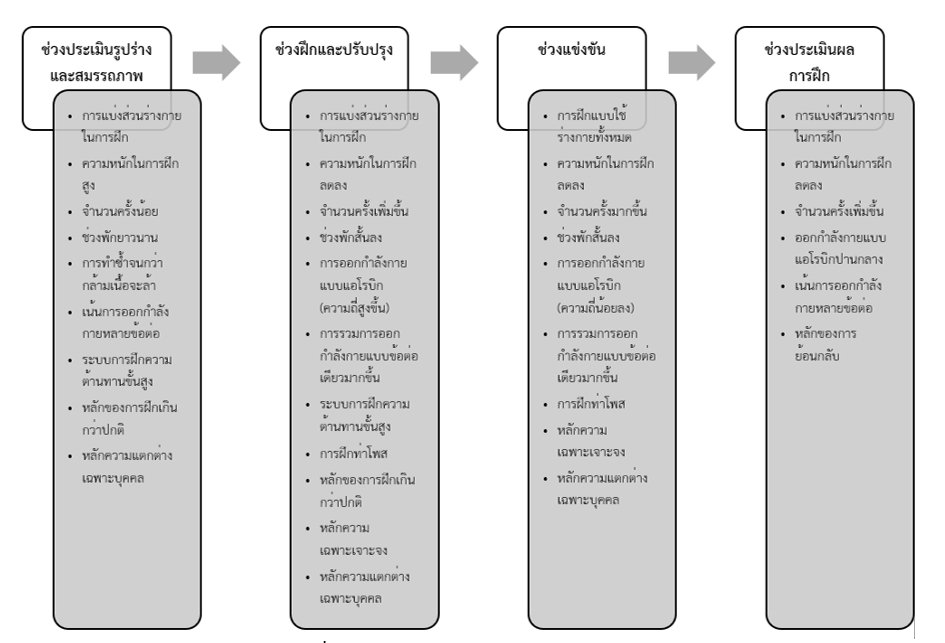
บทความวิชาการนี้มีวัตถุประสงค์เพื่อนำเสนอการวิเคราะห์การนำวิทยาศาสตร์การกีฬาไปใช้ในกีฬาเพาะกายและฟิตเนส ขอบเขตวิทยาศาสตร์การกีฬาที่สามารถนำมาใช้ประโยชน์ในการฝึกซ้อมและพัฒนารูปร่างกล้ามเนื้อในกีฬาเพาะกายและฟิตเนสที่สำคัญ ได้แก่ กายวิภาคศาสตร์ สรีรวิทยา ชีวกลศาสตร์ จิตวิทยา โภชนาการ และเวชศาสตร์การกีฬา โดยอาจแบ่งการฝึกเป็น 4 ช่วง ได้แก่ช่วงประเมินรูปร่างและสมรรถภาพ ช่วงฝึกและปรับปรุง ช่วงการแข่งขัน และช่วงประเมินผลการฝึก อีกทั้งหลักการฝึกซ้อมทั่วไปจะเป็นการนำองค์ความรู้วิทยาศาสตร์การกีฬาด้านสรีรวิทยามาใช้ในการกำหนดรูปแบบและรายละเอียดของการออกกำลังกาย
ซึ่งประกอบด้วย 4 หลักการ ได้แก่ หลักการฝึกหนักเกินปกติ หลักความเฉพาะเจาะจง หลักการความแตกต่างเฉพาะบุคคล และหลักการย้อนกลับ บทความนี้เป็นเครื่องมือที่สำคัญสำหรับนักกีฬาและโค้ชในการปรับปรุงประสิทธิภาพและลดการบาดเจ็บในกีฬาเพาะกายและฟิตเนส
เอกสารอ้างอิง
ดิฏฐชัย จันทร์คุณา. (2561). การวิเคราะห์ปัจจัยเชิงยืนยันของฟิตเนสเซ็นเตอร์ที่มีประสิทธิผลในกรุงเทพมหานครและปริมณฑล. วารสารวิชาการสถาบันการพลศึกษา, 10(1), 65-76.
ดิฏฐชัย จันทร์คุณา. (2563). รูปแบบสมการเชิงโครงสร้างของฟิตเนสเซ็นเตอร์ที่มีประสิทธิผลในกรุงเทพมหานครและปริมณฑล. วารสารวิชาการมหาวิทยาลัยการกีฬาแห่งชาติ, 12(1), 85-96.
ดิฏฐชัย จันทร์คุณา และธเนษฐ์พงษ์ สุขวงศ์. (2561). กลยุทธ์ส่วนประสมทางการตลาด 8 พี ในธุรกิจฟิตเนส. วารสารวิชาการวิทยาศาสตร์ มหาวิทยาลัยราชภัฏจันทรเกษม, 28(3), 37-44.
ดิฏฐชัย จันทร์คุณา และธเนษฐ์พงษ์ สุขวงศ์. (2562). ปัจจัยของประสิทธิผลองค์กรในฟิตเนสเซ็นเตอร์: กรณีศึกษาฟิตเนสเซ็นเตอร์ มหาวิทยาลัยราชภัฏจันทรเกษม. วารสารวิชาการวิทยาศาสตร์ มหาวิทยาลัยราชภัฏจันทรเกษม, 29(1), 56-62.
ธเนษฐ์พงษ์ สุขวงศ์, พชร ชินสีห์, วรเมธ ประจงใจ, นงนภัส เจริญพานิช, และ ชำนาญ ชินสีห์. (2564). คุณลักษณะของคลื่นไฟฟ้ากล้ามเนื้อขณะโพส 7 ท่าบังคับมาตรฐานของนักกีฬาเพาะกายทีมชาติไทย. วารสารวิทยาศาสตร์การกีฬาและสุขภาพ, 22(3), 291-302.
ธเนษฐ์พงษ์ สุขวงศ์, วรเมธ ประจงใจ, พชร ชินสีห์, นงนภัส เจริญพานิช และ ชำนาญ ชินสีห์. (2564). การวิเคราะห์ทางชีวกลศาสตร์ของ 7 ท่าโพสบังคับมาตรฐานในนักกีฬาเพาะกายชายทีมชาติไทย. ใน การประชุมวิชาการนำเสนอผลงานวิจัยระดับชาติด้านวิทยาศาสตร์และเทคโนโลยี มหาวิทยาลัยราชภัฏจันทรเกษม ครั้งที่ 4. มหาวิทยาลัยราชภัฏจันทรเกษม.
สนธยา สีละมาด และดุจเดือน สีละมาด. (2551). การฝึกด้วยน้ำหนัก การประยุกต์วิภาคศาสตร์และสรีรวิทยาสู่เทคนิคการปฏิบัติ (พิมพ์ครั้งที่ 2). สำนักพิมพ์แห่งจุฬาลงกรณ์มหาวิทยาลัย.
สมาคมกีฬาเพาะกายและฟิตเนสแห่งประเทศไทย. (10 เมษายน 2563). About us. สมาคมกีฬาเพาะกายและฟิตเนสแห่งประเทศไทย. http://tbpa.or.th/about-us/.
สมาคมกีฬาเพาะกายและฟิตเนสแห่งประเทศไทย. (10 เมษายน 2563). Committee. สมาคมกีฬาเพาะกายและฟิตเนสแห่งประเทศไทย. http://tbpa.or.th/committee/.
สมาคมกีฬาเพาะกายและฟิตเนสแห่งประเทศไทย. (10 เมษายน 2567). Recent Updates. สมาคมกีฬาเพาะกายและฟิตเนส
แห่งประเทศไทย. http://tbpa.or.th/committee/.
Alves, R. C., Prestes, J., Enes, A., de Moraes, W. M. A., Trindade, T. B., de Salles, B. F., Aragon, A. A., and Souza-Junior, T. P. (2020). Training programs designed for muscle hypertrophy in bodybuilders: A narrative review. Sports, 8(11), 149. https://doi.org/10.3390/sports8110149.
Bagchi, D., Nair, S., and Sen, C. K. (2013). Nutrition and Enhanced Sports Performance: Muscle Building, Endurance, and Strength. Elsevier.
Bartlett, R. (2014). Introduction to Sports Biomechanics: Analysing Human Movement Patterns (3rd ed.). Taylor & Francis.
Bauer, A. (2018). WBPF Rules Book Bodybuilding, Fitness Physique, Athletic Physique, Sport Physique, Model Physique and Mixed Pairs: World Bodybuilding & Physique Sport Federation.
Bompa, T. O., and Buzzichelli, C. (2019). Periodization-: theory and methodology of training. Human kinetics. https://doi.org/10.5040/9781718225435.
Bushman, B., and Battista, R. (eds.). (2014). ACSM’s Resource for the Personal Trainer (4th ed.). Lippincott William & Wilkins.
Coratella, G., Tornatore, G., Caccavale, F., Longo, S., Esposito, F., and Cè, E. (2021). The activation of gluteal, thigh, and lower back muscles in different squat variations performed by competitive bodybuilders: implications for resistance training. International journal of environmental research and public health, 18(2), 772. https://doi.org/10.3390/ijerph18020772.
France, R. C. (2019). Introduction to Sports Medicine and Athletic Training (3rd ed.). Cengage.
Hackett, D. A., Johnson, N. A., and Chow, C. M. (2013). Training practices and ergogenic aids used by male bodybuilders. The Journal of Strength & Conditioning Research, 27(6), 1609-1617.
Haff, G. G. (2010). Sport Science. Strength and Conditioning Journal, 32(2), 33-45.
Haff, G. G., and Triplett, N. T. (eds.). (2016). Essentials of Strength Training and Conditioning (4th ed.). Champaign, IL: Human Kinetics.
Helms, E. R., Fitschen, P. J., Aragon, A. A., Cronin, J., and Schoenfeld, B. J. (2015). Recommendations for natural bodybuilding contest preparation: resistance and cardiovascular training. J Sports Med Phys Fitness, 55(3), 164-78. ttps://doi.org/10.1519/JSC.0b013e318271272a.
Iljinaitė, V., Šiupšinskas, L., and Berškienė, K. (2024). The Quality of Functional Movements and the Back Squat in Amateur and Professional Bodybuilders. International Journal of Sports Physical Therapy, 19(11), 1455. https://doi.org/10.26603/001c.124998.
Iraki, J., Fitschen, P., Espinar, S., and Helms, E. (2019). Nutrition recommendations for bodybuilders in the off-season: A narrative review. Sports, 7(7), 154. https://doi.org/10.3390/sports7070154.
Israetel, M. I. K. E., Hoffman, J., and Smith, C. W. (2015). Scientific principles of strength training. Np (in Eng.).
Keogh, J. W., and Winwood, P. W. (2017). The epidemiology of injuries across the weight-training sports. Sports medicine, 47(3), 479-501. https://doi.org/10.1007/s40279-016-0575-0.
McArdle, W. D., Katch, F. I., and Katch, V. I. (eds.). (2014). Exercise Physiology: Energy, Nutrition, and Human Performance (8th ed.). Philadelphia: Lippincott William & Wilkins.
McGinnis, P. M. (2021). Biomechanics of Sport and Exercise (4th ed.). Human Kinetics.
Peters, M. A., and Phelps, L. (2001). Body image dissatisfaction and distortion, steroid use, and sex differences in college age bodybuilders. Psychology in the Schools, 38(3), 283-289. https://doi.org/10.1002/pits.1018.
Piatkowski, T. M., Obst, P. L., White, K. M., and Hides, L. (2022). The relationship between psychosocial variables and drive for muscularity among male bodybuilding supplement users. Australian Psychologist, 57(2), 148-159. https://doi.org/10.1080/00050067.2021.2020074.
Riebe, D., Ehrman, J. K., Ligouri, G., & Magal, M. (eds.). (2018). ACSM’s Guidelines for Exercise Testing and Prescription (10th ed.). Wolters Kluwer.
Rossow, L. M., Fukuda, D. H., Fahs, C. A., Loenneke, J. P., and Stout, J. R. (2013). Natural bodybuilding competition preparation and recovery: a 12-month case study. International journal of sports physiology and performance, 8(5), 582-592. https://doi.org/10.1123/ijspp.8.5.582.
Santonja., R. (2019). IFBB rules section 2: men’s bodybuilding: International federation of bodybuilding & fitness (IFBB).
Schoenfeld, B. J. (2010). The mechanisms of muscle hypertrophy and their application to resistance training. The Journal of Strength & Conditioning Research, 24(10), 2857-2872.
https://doi.org/10.1519/JSC.0b013e3181e840f3.
Schoenfeld, B. J. (2020). Science and development of muscle hypertrophy. Human Kinetics.
Schoenfeld, B. J., Ogborn, D., & Krieger, J. W. (2017). Dose-response relationship between weekly resistance training volume and increases in muscle mass: A systematic review and meta-analysis. Journal of sports sciences, 35(11), 1073-1082. https://doi.org/10.1080/02640414.2016.1210197.
Siewe, J., Marx, G., Knöll, P., Eysel, P., Zarghooni, K., Graf, M., Herren, C., Sobottke, R., & Michael, J. (2014). Injuries and overuse syndromes in competitive and elite bodybuilding. International journal of sports medicine, 35(11), 943-948. https://doi.org/10.1055/s-0034-1367049.
Steele, I. H., Pope Jr, H. G., & Kanayama, G. (2019). Competitive bodybuilding: fitness, pathology, or both?. Harvard review of psychiatry, 27(4), 233-240. https://doi.org/10.1097/HRP.0000000000000211.
Weinberg, R., & Gould, D. (2018). Foundations of Sport and Exercise Psychology (7th ed.). Human Kinetics.
ดาวน์โหลด
เผยแพร่แล้ว
รูปแบบการอ้างอิง
ฉบับ
ประเภทบทความ
สัญญาอนุญาต
ลิขสิทธิ์ (c) 2025 มหาวิทยาลัยราชภัฏจันทรเกษม

อนุญาตภายใต้เงื่อนไข Creative Commons Attribution-NonCommercial-NoDerivatives 4.0 International License.
บทความที่ได้รับการตีพิมพ์เป็นลิขสิทธิ์ของมหาวิทยาลัยราชภัฏจันทรเกษม
ข้อความที่ปรากฎในบทความแต่ละเรื่องในวารสารวิชาการเล่มนี้เป็นความคิดเห็นส่วนตัวของผู้เขียนแต่ละท่าน ไม่เกี่ยวข้องกับมหาวิทยาลัยราชภัฏจันทรเกษม และคณาจารย์ท่านอื่นในมหาวิทยาลัยแต่อย่างใด ความรับผิดชอบองค์ประกอบทั้งหมดของบทความแต่ละเรื่องเป็นของผู้เขียนแต่ละท่าน หากมีความผิดพลาดใดๆ ผู้เขียนแต่ละท่านจะรับผิดชอบบทความของตัวเองแต่เพียงผู้เดียว
 สำหรับผู้แต่ง (Author)