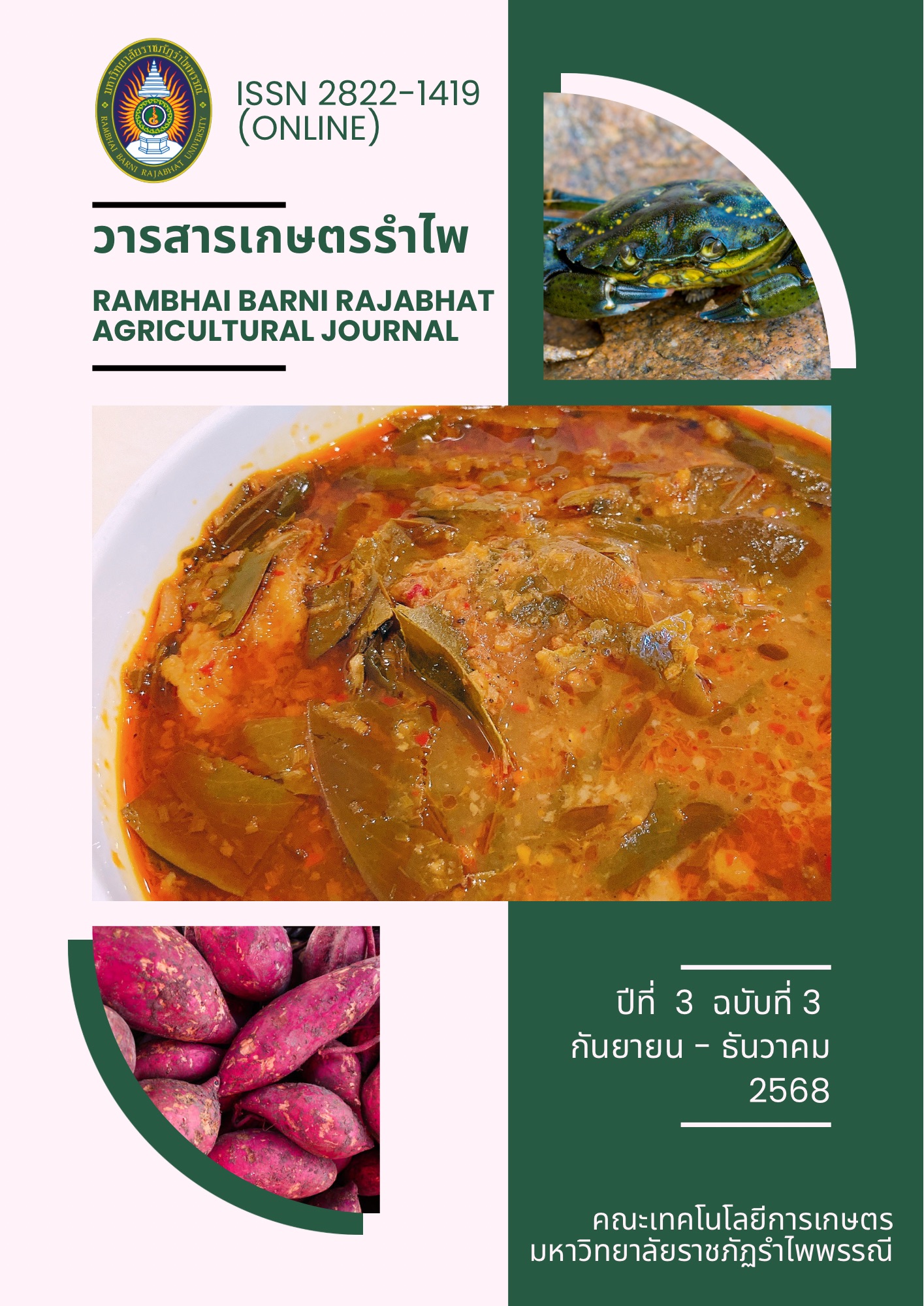
Vegan Yogurt Production Using Soy Milk Supplemented with Purple Sweet Potato Powder
Article Sidebar
Main Article Content
Abstract
This study aimed to investigate the production of vegan yogurt from soy milk supplemented with purple sweet potato. The optimal formulation was determined by varying the ratios of purple sweet potato powder to soy milk at 1:5, 1:8, and 1:10 (w/v). The mixtures were incubated at 45 °C for 10 hours and stored at 4°C for 15 days. Samples were analyzed every 5 days to determine physiochemical and microbiological properties. The vegan yogurt supplemented with purple sweet potato at a 1:10 ratio received the highest scores in all sensory attributes, including appearance, texture, color, flavor, and overall acceptability at 6.70±2.27, 5.70±2.00, 7.40±1.05, 5.25±1.48 and 5.55±1.76 respectively. During refrigerated storage, the total soluble solids tended to increase, reaching 13.23 °Brix on day 15. The yogurt exhibited a purple coloration and retained anthocyanin content at 104.98±4.54mg/L on day 15. Microbiological analysis revealed that although the viable counts of lactic acid bacteria fluctuated during storage, they consistently remained above the minimum level required by the Thai Ministry of Public Health Notification No. 353 (2013) throughout 15 days, while yeast, mold, and coliform counts remained within the permissible limits. These results confirm the microbiological safety of the product. The purple sweet potato–supplemented vegan yogurt not only retained its nutritional value but also provided antioxidant compounds, particularly anthocyanins, representing a potential functional food product that supports sustainable utilization of purple sweet potato.
Article Details

This work is licensed under a Creative Commons Attribution-NonCommercial-NoDerivatives 4.0 International License.
References
กรมส่งเสริมอุตสาหกรรม. (2564). Plant-based Food อาหารแห่งโลกอนาคต. วารสารกรมส่งเสริมอุตสาหกรรม, 63 : 1-44.
กระทรวงสาธารณสุข. (2556). ประกาศกระทรวงสาธารณสุข (ฉบับที่ 353) พ.ศ. 2556 เรื่อง นมเปรี้ยว. 19 สิงหาคม 2568, เข้าถึงได้จาก : https://food.fda.moph.go.th/food-law/announ-moph-353.
จีระศักดิ์ คำสุริย์, ดุจเดือน บุญสม และเมธาวี ชุณหวุฒิยานนท์. (2562). โครงการศึกษาตลาดอาหารวีแกน (Vegan) เพื่อรองรับการพัฒนาอุตสาหกรรมอาหารไทย. ในรายงานวิจัยฉบับสมบูรณ์ สถาบันอาหาร (หน้า 1-124): กระทรวงอุตสาหกรรม.
นรินทร์ เจริญพันธ์. (2559). การพัฒนาผลิตภัณฑ์อาหารจากมันเทศเพื่อสร้างมูลค่าเพิ่มให้กับผลิตผลเกษตรท้องถิ่นของจังหวัดสระแก้ว. ใน รายงานวิจัยฉบับสมบูรณ์ คณะเทคโนโลยีการเกษตร (หน้า 1-88). ชลบุรี : มหาวิทยาลัยบูรพา.
ไพโรจน์ วิริยจารี. (2561). การประเมินทางประสาทสัมผัส (sensory evaluation). พิมพ์ครั้งที่ 2. เชียงใหม่ : คณะอุตสาหกรรมเกษตร มหาวิทยาลัยเชียงใหม่.
ประจงเวท สาตมาลี. (2567). มันเทศ : แหล่งแป้งทางเลือกสำหรับผู้รักสุขภาพ. วารสารวิจัยและพัฒนาผลิตภัณฑ์อาหาร, 54(1) : 83-87.
วรรณภา ทาบโลกา. (2560). การผลิตโยเกิร์ตถั่วเหลืองคุณภาพจากโพรไบโอติกที่คัดเลือก. รายงานวิจัย สาขาวิทยาศาสตร์และเทคโนโลยีการอาหาร คณะวิทยาศาสตร์และเทคโนโลยี : มหาวิทยาลัยเทคโนโลยีราชมงคลตะวันออก.
ศูนย์สารสนเทศวิทยาศาสตร์และเทคโนโลยี สํานักหอสมุดและศูนย์สารสนเทศวิทยาศาสตร์และเทคโนโลยี. (2553).แอนโทไซยานิน (Anthocyanin). 1 เมษายน 2566, เข้าถึงได้จาก : http://siweb.dss.go.th/index.php/th/ information-repacking/5624-anthocyanin.
สถาบันวิจัยพืชสวน. (2559). เทคโนโลยีการผลิตมันเทศ. กรุงเทพฯ : สถาบันวิจัยพืชสวน กรมวิชาการเกษตร.
สุภาพร ฟักเงิน และศิรประภา. (2560). การสกัดแยกหาปริมาณแอนโทไซยานินจากลูกมะม่วงหาว มะนาวโห่. รายงานสืบเนื่องจากการประชุมวิชาการระดับชาติ ครั้งที่ 4 สถาบันวิจัย. (หน้า 1002-1011), กำแพงเพชร : มหาวิทยาลัยราชภัฏกำแพงเพชร.
สุวิชา ดีหะสิงห์. (2550). การสกัดและการทําให้สารแอนโธไซยานินในลูกหว้าบริสุทธิ์. วิทยานิพนธ์ ปริญญาวิทยาศาสตรบัณฑิต, คณะศิลปศาสตร์และวิทยาศาสตร์, มหาวิทยาลัยเกษตรศาสตร์.
อัญชนา จันทร์ประทิว, ยุพา มิตรมังกร และนาตยา มนตรี. (2560). ผลของความร้อนและการเก็บรักษาในผักสีม่วงบางชนิด. วารสารแก่นเกษตร, 45(1) : 1278-1282.
อำพรรณ ชัยกุลเสรีวัฒน์, วิญญู ช่วยแก้ว และเนตรนภา สกุลซ้ง. (2557). การผลิตโยเกิร์ตข้าวกล้องพันธุ์หอมนิล. วารสารวิทยาศาสตร์เกษตร, 45(2) (พิเศษ) : 273-276.
Afiati, F., Priadi, G. and Setiyoningrum, F. (2018). The improvement of functional food in yogurt enriched with purple sweet potato (Ipomea batatas var. Ayamurasaki). Indonesian Tropical Animal Agriculture, 43(2) :159-168.
Alonso-Miravalles, L., Grasso, N. and O’ Mahony, JA. (2020). Composition, physicochemical and sensorial properties of commercial plant-based yogurts. Food 2020, 9(252) : 1-11. DOI:10.3390/foods9030252.
Amirina, Q. S., Anindyah, D. S., Huda, A. N., Indrianingrum, W., Lestari, L. A., Nisa, A., Nurliyani. and Prasetyastuti. (2020). Characteristics of purple sweet potato yogurt and its effect on lipid profiles of sprague dawley rats fed with high fat diet. Journal of food and pharmaceutical sciences, 8(2) : 240-251.
AOAC. (2000). Official Method of Analysis of AOAC International. 17th ed. Verginia, USA, Association of Official Analysis Chemists.
Bolten, J. C., Muller, J., Tangyu, M. and Wittmann, C. (2019). Fermentation of plant-based milk alternatives for improved flavour and nutritional value. Applied Microbiology and Biotechnology, 103 : 9263-9275. DOI: 10.1007/s00253-019-10175-9.
Chan, C. F., Huang, C. L., Lai, Y. C., Liao, W. C., and Lien, C.Y. (2013). Studies of sugar composition and starch morphology of baked sweet potatoes (Ipomoea batatas (L.) Lam). J Food Sci Technol, 50(6) : 1193-1199. DOI: 10.1007/s13197-011-0453-6.
Corke, H., Wheatley, C. C., and Zhang, Z. (2002). Biochemical changes during storage of sweet potato roots differing in dry matter content.Postharvest biology and technology, 24(3): 317-325.DOI: 10.1016/S0925-5214(01)00149-1.
Dhakal, D., Younas, T., Bhusal., R.P., Devkota, L., Henry, C.J., and Dhital, S. (2023). Design rules of plant-based yoghurt-mimic : Formulation, functionality, sensory profile and nutritional value. Food Hydrocolloid, 142 : 1-21. DOI: 10.1016/j.foodhyd.2023.108786.
Enaru, B., Dretcanu, G., Pop, T.D., Stanila, A., and Diaconeasa, Z. (2021). Anthocyanins : factors affecting their stability and degradation. Antioxidants, 10(12). DOI: 10.3390/antiox 10121967.
Lambertus, E., Srianta, I., Liem, D., Wanapruta, F., Nugerahani, I., Kuswardhani, I., and Tewfik, I. (2022). Enhancement of lactic acid bacteria population, chemical and organoleptic properties of soygurt with nutraceunicals from purple sweet potato (lpomoea batatas L) paste. E3S web of conferences, 344(02004), DOI: 10.1051/e3sconf/202234402004.
Mende, S., Rohm, H., and Jaros, D. (2026). Influence of exopolysaccharides on the structure, texture, stability and sensory properties of yogurt and related products. International Dairy Journal, 52 : 57-71.
US Food and Drug Administration. (2001). Biological analytical manual (BAM). Washington DC, USA : New Hampshire Avenue, Department of Health and Human Services.
