
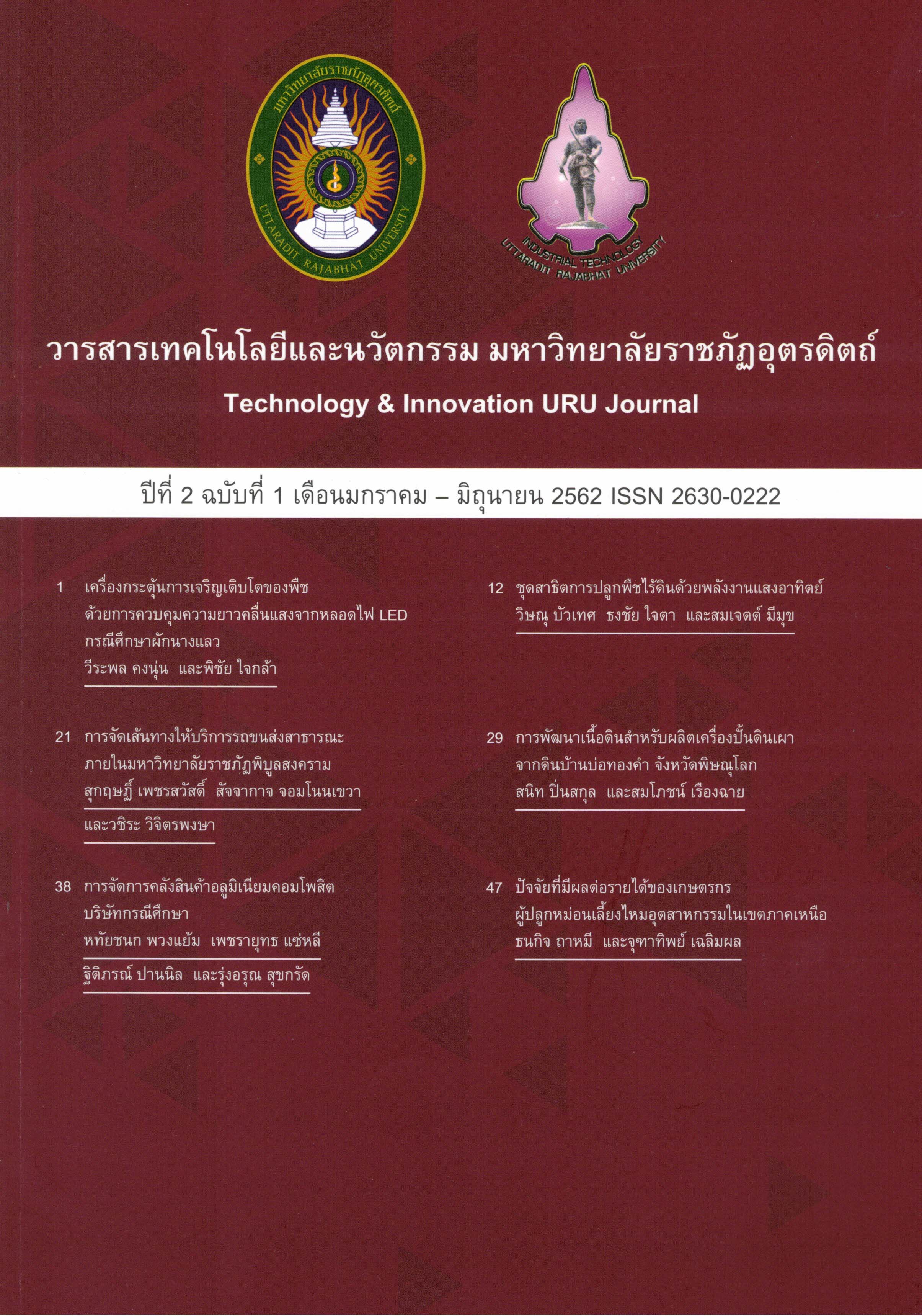
Factors Relating to Income on Farmer of Industrial Sericulture in Northern Thailand
Article Sidebar
Main Article Content
Abstract
The objectives of this research were to study factor related to income of sericulture. The sample group of this research was sericulture farmer in northern of Thailand. The instruments used for data collection were interview and questionnaire. Data analyses were used descriptive statistic such as percentage, mean, standard deviation, maximum, minimum
and multiple regression analysis.
The results showed that most of the sericulture farmers were male with average age of 50.06 years and graduated from primary school, the experiment of sericulture was 12.76 years in average. The average areas of mulberry cultivations were 8.85 rai. The average mulberry cultivation cost was 3581.94 baht per rai. The average silk rearing cost was 1839.52 baht per box. The average cocoon sales were 102,589.35 baht per year. The average silk production was 7.08 tons per year and the average number box of silk for rearing 14.3 boxes per year. The farmer had score of good agriculture for silk cocoon production was 12.70 in the medium level. Farmers receive information in less level. From studying factor relation to success of sericulture, it was found that the significant factors were to Age of mulberry tree, Size of the mulberry area, Number of labors in rearing silk worm, Cost of mulberry filed,
Number of rearing silk worm in year, Score of good practice for silk cocoon that had positive relationship. The problems of sericulture were drought in high level. Secondly, found that factors of production were high cost and insect pests in mulberry field. For farmers' suggestions were need the government to take care of them, high quality of product, high selling price and area has enough water.
Article Details

This work is licensed under a Creative Commons Attribution-NonCommercial-NoDerivatives 4.0 International License.
References
กรมศุลกากร. (2561). รายงานสถิตินําเข้า-ส่งออก. สืบค้นจาก http://www.customs.go.th/statistic_report.php?show_search=1
กรมหม่อนไหม. (2560). รายงานประจําปี 2560 กรมหม่อนไหม. กรุงเทพฯ: กระทรวงเกษตรและสหกรณ์, กรมฯ.
จิราพร ตยุติวุฒิกุล. (2544). การผลิตหม่อนไหม. เชียงใหม่: มหาวิทยาลัยเชียงใหม่.
ชญานิศวร์มาไพศาลสิน. (2556). การจัดการการผลิตและการตลาดรังไหมอุตสาหกรรม: กรณีศึกษากลุ่มเกษตรกรบ้านนาแพง ตําบลเขาน้อย อําเภอเวียงเก่า จังหวัดขอนแก่น. วิทยานิพนธ์ปริญญามหาบัณฑิต, มหาวิทยาลัยขอนแก่น.
ธานินทร์ศิลป์จารุ. (2553). การวิจัยและวิเคราะห์ข้อมูลทางสถิติด้วย SPSS. (พิมพ์ครั้งที่ 11). กรุงเทพฯ: เอส อาร์พริ้นติ้ง แมสโปรดักส์.
นิชานันท์คงทวีและประภัสสร เกียรติสุรนนท์. (2559). ปัจจัยที่มีผลต่อการตัดสินใจเลี้ยงไหมของเกษตรกรในจังหวัดขอนแก่น. แก่นเกษตร, 44(4). 631-638.
พุทธพร วิวาจารย์, สิทธิชัย บุญมั่น, ศุภกฤต จันทรวิชญ์, ชลธิรา แสงศิริและธนพร ขจรผล. (2558). อิทธิพลของลักษณะทางเศรษฐกิจต่อผลผลิตใบหม่อนของหม่อนเลี้ยงไหม (silkworm mulberry; Morus spp.) จากประเทศจีน. แก่นเกษตร, 43(ฉบับพิเศษ 1). 780-783.
บุญก์ณิสา มาคง และพงศ์พันธุ์เธียรหิรัญ. (2556). การจัดการการผลิตไหมของเกษตรกรเพื่อพัฒนาการผลิตไหม. ใน การประชุมเสนอผลงานวิจัยระดับบัณฑิตศึกษา มหาวิทยาลัยสุโขทัยธรรมาธิราช ครั้งที่ 3 (O-ST 090). นนทบุรี: มหาวิทยาลัยสุโขทัยธรรมาธิราช.
บุญสม วราเอกศิริ. (2535). ส่งเสริมการเกษตร : หลักและวิธีการ. (พิมพ์ครั้งที่ 3). เชียงใหม่: มหาวิทยาลัยแม่โจ้.
ศูนย์หม่อนไหมเฉลิมพระเกียรติสมเด็จพระนางเจ้าสิริกิติ์พระบรมราชินีนาถ. (2560). รายงานประจําปี 2560 ศูนย์หม่อนไหมเฉลิมพระเกียรติสมเด็จพระนางเจ้าสิริกิติ์พระบรมราชินีนาถ เขต 1 จังหวัดแพร่. แพร่: กรมหม่อนไหม.
สุชาติประสิทธิ์รัฐสินธุ์. (2548). เทคนิคการวิเคราะห์ตัวแปรหลายตัว สําหรับการวิจัยทางสังคมศาสตร์และพฤติกรรมศาสตร์. (พิมพ์ครั้งที่ 6). กรุงเทพฯ: หจก. สามลดา.
Ghafoor, A., Hussain, M., Naseer, K., Ishaque, M., and Baloch, M. H. (2010). Factors Affecting Income and Saving of Small Farming Households in Sargodha District of The Punjab, Pakistan. Pak. J. Agri., Agril. Engg., Vet. Sci., 26(2), 27-35.
Ibekwe, U. C. (2010). Determinants of Income Among Farm Households in Orlu Agricultural Zone of Imo State, Nigeria. Report and opinion, 2(8), 32-35. Retrieved from http://www.sciencepub.net/report/report0208/06_3606report0208_32_35.pdf
Peris, N. W., Gacheri, K. M., Theophillus, M. M., and Lucas, N. (2014). Morphological characterization of Mulberry (Morus spp.) accessions grown in Kenya. Sustainable Agriculture Research. 3(1), 10-17.
Prakash, B. G., Halaswamy K. M., and Guled, M. B. (2004). Performance of mulberry varieties and correlation among leaf yield and its components under dryland situation at Bijapur. Karnataka J. Agri. Sci., 17(3), 562-565.
Vijayan, K., Doss, S. G., Chackraborti, S. P., Ghosh, P. D., and Saratchandra, B. (2010). Character association in mulberry under different magnitude of salinity stress. Emir. J. Food Agric, 22(4), 318-325.
