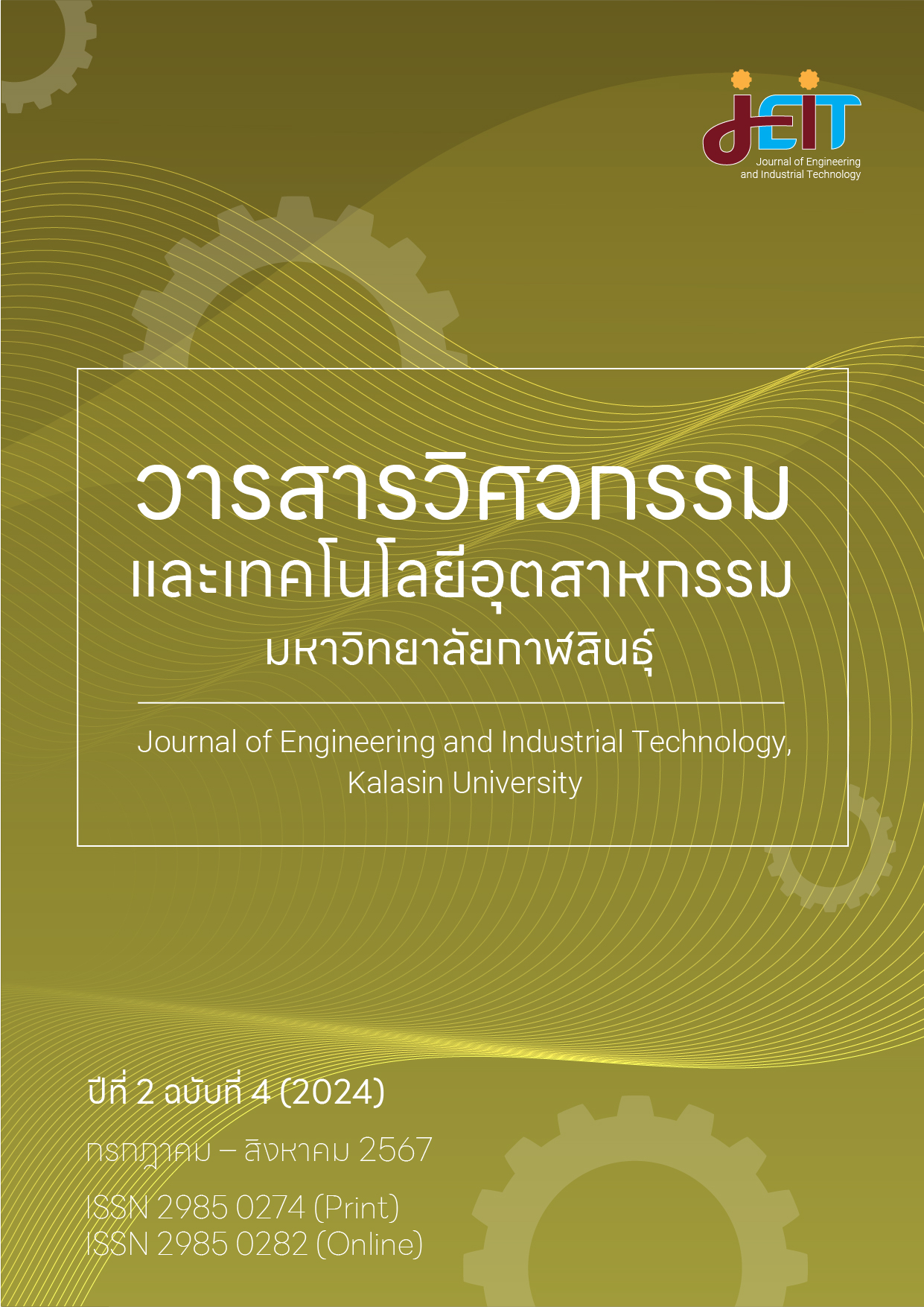
Application of the TOPSIS Method for Solving Multi-Response Optimization Problem
DOI:
https://doi.org/10.14456/jeit.2024.16Keywords:
TOPSIS, Multi-Response Optimization, Multi-Attribute Decision Making, Optimal Parameters, Taguchi Experimental DesignAbstract
This study aims to apply the Technique for Order Preference by Similarity to Ideal Solution (TOPSIS) method to solve multi-response optimization (MRO) problems, which are inherently complex due to the potential conflicts among response variables. The research employs TOPSIS to aggregate multiple responses into a single response, which is then used to determine the optimal parameters using Minitab Version 19. The aggregation of the two responses using TOPSIS yielded a maximum closeness coefficient (CC) of 0.8007 and a minimum of 0.2150, indicating the efficiency of each parameter setting. These coefficients were subsequently input into Minitab Version 19 to identify the optimal parameters, which were found to be a cutting speed of 140 m/min, a feed rate of 0.071 mm/rev, and a depth of cut of 0.6 mm. The TOPSIS method proved to be an effective tool for solving MRO problems. When compared with other methods, such as MOORA and WASPAS, TOPSIS demonstrated comparable performance in determining optimal parameter settings. The TOPSIS approach can be applied in various fields requiring multi-criteria decision-making, such as optimizing parameters in manufacturing processes, experimental design, or data analysis involving multiple response variables to achieve the best possible outcomes. Additionally, applying this method can effectively reduce time and costs in the search for optimal values across various processes.
References
[1] A. Sriburum, W. Khanthirat, W. Warorot, A. Lawong, N. Wichapa, T. Sudsuansee, S. Sergsiri, K. Charoenjit, A. Rotjanakorn Wangchamhan, M. Tongsupon, and A. Choompol, “Data Envelopment Analysis-Taguchi Method for Determining Optimal Parameters of a Fish Scaling Machine,” The Journal of Industrial Technology, vol. 19, no. 1, pp. 63-76, Apr. 2023, doi: 10.14416/j.ind.tech.2023.04.001.
[2] Y. Kumar and H. Singh, “Multi-response Optimization in Dry Turning Process Using Taguchi's Approach and Utility Concept,” Procedia Materials Science, vol. 5, pp. 2142-2151, 2014, doi: 10.1016/j.mspro.2014.07.417.
[3] P. To-On, N. Wichapa, and W. Khanthirat, "A novel TOPSIS linear programming model based on response surface methodology for determining optimal mixture proportions of lightweight concrete blocks containing sugarcane bagasse ash," Heliyon, vol. 9, no. 7, p. e17755, 2023.
[4] A. Sriburum, N. Wichapa, and W. Khanthirat, "A novel TOPSIS linear programming model based on the Taguchi method for solving the multi-response optimization problems: A case study of a fish scale scraping machine," Engineered Science, vol. 23, p. 882, 2023, doi: https://dx.doi.org/10.30919/es882.
[5] P. A. Sylajakumari, R. Ramakrishnasamy, and G. Palaniappan, "Taguchi grey relational analysis for multi-response optimization of wear in Co-continuous composite," Materials, vol. 11, no. 9, p. 1743, 2018.
[6] N. Yuvaraj and M. P. Kumar, "Multiresponse optimization of abrasive water jet cutting process parameters using TOPSIS approach," Materials and Manufacturing Processes, pp. 882-889, 2015.
[7] A. M. Ghaleb, H. Kaid, A. Alsamhan, S. H. Mian, and L. Hidri, "Assessment and comparison of various MCDM approaches in the selection of manufacturing process," Advances in Materials Science and Engineering, Article ID 4039253, 2020.
[8] H. Taherdoost and M. Madanchian, "Multi-criteria decision making (MCDM) methods and concepts," Encyclopedia, vol. 3, no. 1, pp. 77-87, 2023.
[9] M. Ramezani, M. Bashiri, and A. C. Atkinson, "A goal programming-TOPSIS approach to multiple response optimization using the concepts of non-dominated solutions and prediction intervals," Expert Systems with Applications, vol. 38, no. 8, pp. 9557-9563, 2011.
[10] S. Kamalizadeh, S. A. Niknam, M. Balazinski, and S. Turenne, "The use of TOPSIS method for multi-objective optimization in milling Ti-MMC," Metals, vol. 12, no. 11, p. 1796, 2022.
[11] B. Şimşek and T. Uygunoğlu, "Multi-response optimization of polymer blended concrete: A TOPSIS based Taguchi application," Construction and Building Materials, vol. 117, pp. 251-262, 2017.
[12] A. T. Abbas, N. Sharma, S. Anwar, M. Luqman, I. Tomaz, and H. Hegab, "Multi-response optimization in high-speed machining of Ti-6Al-4V using TOPSIS-fuzzy integrated approach," Materials, vol. 13, no. 5, p. 1104, 2020.
[13] R. Thirumalai, M. Seenivasan, and K. Panneerselvam, "Experimental investigation and multi-response optimization of turning process parameters for Inconel 718 using TOPSIS approach," Materials Today: Proceedings, vol. 45, pp. 467-472, 2021.
[14] P. Chokkalingam, H. El-Hassan, A. El-Dieb, and A. El-Mir, "Multi-response optimization of ceramic waste geopolymer concrete using BWM and TOPSIS-based Taguchi methods," Journal of Materials Research and Technology, vol. 21, pp. 4824-4845, 2022.
[15] E. K. Zavadskas, Z. Turskis, J. Antucheviciene, and A. Zakarevicius, "Optimization of Weighted Aggregated Sum Product Assessment," Electronics and Electrical Engineering, no. 6(122), pp. 3-6,2012. DOI:10.5755/j01.eee.122.6.1810.
[16] E. K. Zavadskas, A. Kaklauskas, and V. Šarka, "The new method of multicriteria complex proportional assessment of projects," Technological and Economic Development of Economy, vol. 1, no. 3, pp. 131-139, 1994.
[17] F. Zhujani, G. Todorov, K. Kamberov, and F. Abdullahu, "Mathematical modeling and optimization of machining parameters in CNC turning process of Inconel 718 using the Taguchi method," Journal of Engineering Research, 2023. DOI: 10.1016/j.jer.2023.10.029.
Downloads
Published
How to Cite
Issue
Section
Categories
License
Copyright (c) 2024 Journal of Engineering and Industrial Technology, Kalasin University

This work is licensed under a Creative Commons Attribution-NonCommercial-NoDerivatives 4.0 International License.
ลิขสิทธิ์ของวารสาร
เนื้อหาและข้อมูลในบทความที่ลงตีพิมพ์ในวารสารศูนย์ดัชนีการอ้างอิงวารสารไทย ถือเป็นข้อคิดเห็นและความรับผิดชอบของผู้เขียนบทความโดยตรงซึ่งกองบรรณาธิการวารสาร ไม่จำเป็นต้องเห็นด้วย หรือร่วมรับผิดชอบใด ๆ
บทความ ข้อมูล เนื้อหา รูปภาพ ฯลฯ ที่ได้รับการตีพิมพ์ในวารสารศูนย์ดัชนีการอ้างอิงวารสารไทย ถือเป็นลิขสิทธิ์ของวารสารศูนย์ดัชนีการอ้างอิงวารสารไทย หากบุคคลหรือหน่วยงานใดต้องการนำทั้งหมดหรือส่วนหนึ่งส่วนใดไปเผยแพร่ต่อหรือเพื่อกระทำการใด จะต้องได้รับอนุญาตเป็นลายลักอักษรจากวารสารศูนย์ดัชนีการอ้างอิงวารสารไทยก่อนเท่านั้น