
การศึกษาสัดส่วนที่เหมาะสมของมะเฟืองในกระบวนการผลิตคราฟต์โซดามะเฟือง
Article Sidebar
Main Article Content
บทคัดย่อ
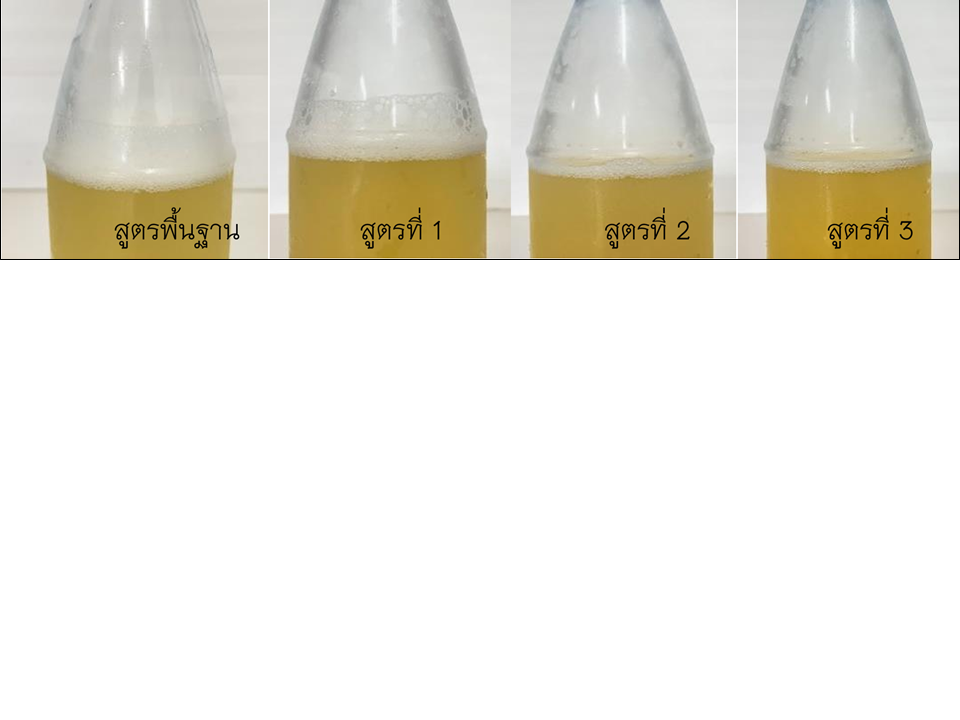
งานวิจัยนี้มีวัตถุประสงค์เพื่อศึกษากระบวนการผลิตคราฟต์โซดาจากมะเฟืองและวิเคราะห์คุณภาพผลิตภัณฑ์คราฟต์โซดาจากมะเฟือง ผลการวิเคราะห์คุณลักษณะทาง กายภาพ ทางเคมีของคราฟต์โซดาผลไม้ในท้องตลาด 3 ยี่ห้อ และทำการทดสอบชิมเพื่อหาความชอบ พบว่าคราฟต์โซดาในท้องตลาดตัวอย่าง Bมีความชอบรวมสูงที่สุด โดยมีปริมาณกรดทั้งหมดสูงสุด 1.54 % และปริมาณของแข็งที่ละลายได้สูงสุด 8.70 oBrix และการศึกษาสัดส่วนที่เหมาะสมของมะเฟืองในกระบวนการผลิต และตรวจสอบคุณลักษณะของคราฟต์โซดามะเฟือง พบว่าคราฟต์โซดาที่ใช้น้ำมะเฟืองในสัดส่วนต่อน้ำตาลมากที่สุด คือ 125 : 175 กรัม ได้รับคะแนนความชอบรวมสูงที่สุด 7.13 โดยมีปริมาณกรดทั้งหมดน้อยที่สุด 0.8 % แต่มีปริมาณของแข็งที่ละลายได้สูงที่สุด 15.4 oBrix เมื่อเปรียบเทียบกับคราฟต์โซดาตัวอย่าง B มีความใกล้เคียงกันในค่า pH และ ค่าสี L*, a*, b* คราฟต์โซดาทุกตัวอย่างผ่านตามมาตรฐานผลิตภัณฑ์ชุมชน (มผช. 2/2546)
Article Details

อนุญาตภายใต้เงื่อนไข Creative Commons Attribution-NoDerivatives 4.0 International License.
บทความที่ได้รับการตีพิมพ์เป็นลิขสิทธิ์ของวารสาร มรภ.กพ. วิทยาศาสตร์ คณิตศาสตร์ และเทคโนโลยี
ข้อคิดเห็นใดๆ ที่ปรากฎในวารสารเป็นวรรณกรรมของผู้เขียนโดยเฉพาะ ซึ่งมหาวิทยาลัยราชภัฏกำแพงเพชรและบรรณาธิการไม่จำเป็นต้องเห็นด้วย
เอกสารอ้างอิง
Future Market Insights. (2025). Craft soda market outlook (2023 to 2033). https://www.futuremarketinsights.com/reports/craft-soda-market
Domnick Thailand. (2025). Get to know craft soda. https://www.domnickthailand.com/th/get-to-know-craft-soda/
Lusk, J. L., & McCluskey, J. J. (2018). Understanding the implications of consumer preference for “natural” and “organic” products. Agribusiness, 34(1), 27–43. https://doi.org/10.1002/agr.21661
Food Intelligence Center. (2023, September 1). Craft soda: A market trend to watch in the health-conscious era. https://fic.nfi.or.th/technologyandinnovation_detail.php?smid=1833
The Momentum. (2022, August 9). The Chair: The Craft Bangsakao – A soda made from farmers’ spirit. https://themomentum.co/thechair-thecraft-bangsakao/
Haruki, B. (2021, September 23). Raspberry Craft soda: The next generation of beverages | Hillary Baron | TEDxSeattleU [Video]. YouTube. https://www.youtube.com/watch?v=iCBwJS2Y1Qk
Hanumant, P. (2018). Plant-based probiotic beverages: A healthy drink alternative. Journal of Industrial Education, 17(1), 1–10.
AOAC International. (2023). Official methods of analysis of AOAC International (22nd ed.) [Online version]. https://www.aoac.org/
U.S. Food and Drug Administration. (2025). Bacteriological analytical manual (BAM) online. Center for Food Safety and Applied Nutrition. https://www.fda.gov/food/laboratory-methods-food/bacteriological-analytical-manual-bam
Ashurst, P. R. (Ed.). (2016). Chemistry and technology of soft drinks and fruit juices (3rd ed.). John Wiley & Sons.
Ashurst, P. R., Hargitt, R., & Palmer, F. (2017). Soft drink and fruit juice problems solved (2nd ed.). Woodhead Publishing. https://doi.org/10.1016/B978-0-08-100918-5.00001-1
Verma, S. (2018). Fruit based carbonated soft drinks for nutritional security and value chain development – A review. International Journal of Current Microbiology and Applied Sciences, 7(11), 3084–3095. https://doi.org/10.20546/ijcmas.2018.711.354
Abdullahi, I. D., Zakiyya, M. Y., Yepshak, N. B., Umar, D., Abbas, A. H., Ben-Musa, A. S., & Aisha, A. M. (2021). Physicochemical and sensory properties of fruit drink produced from African fan palm (Borassus aethiopum) in Kano metropolis. Direct Research Journal of Agriculture and Food Science, 9, 290–296. https://doi.org/10.26765/DRJAFS10855563
Wanla, S., et al. (2023). A semi-automatic kraft soda beverage production machine. Northern Vocational Education Institute Region 2, Phrae Technical College. (Supported by the Office of the Permanent Secretary, Ministry of Higher Education, Science, Research and Innovation.)
Pan-uthai, W., Pornpakdeewatana, S., Adam, M., Romrattapan, R., & Yodbamrung, C. (2023). Kefir: A fermented beverage product for health. Journal of Food Research and Product Development, 53(2), 43–55. https://kuojs.lib.ku.ac.th/index.php/JFRPD
Joshita, L., G., Sangeeta, & Saxena, S. K. (2019). Study the lactic acid bacteria content in traditional fermented Indian drink: Kanji. International Journal of Gastronomy and Food Science, 19(16), 100–143.
Nanuch, T., Foithongsuk, K., & Niyomwong, N. (2021). Consumer acceptance of pineapple soda beverage. In Proceedings of the 3rd National Conference on Science, Technology and Innovation: Creative Science and Technology for Communities (pp. 128–136). Faculty of Science and Technology, Loei Rajabhat University.
National Electronics and Computer Technology Center. (n.d.). Thai OTOP product standards: TCPS 2/46 Fruit Wine [PDF]. https://www.nkw.ac.th/courseware/www.nectec.or.th/courseware/siamculture/otop-tis/tcps2_46.pdf
National Electronics and Computer Technology Center. (n.d.). Thai OTOP product standards: TCPS 481/47 fermented beverage from plants products [PDF]. https://www.nkw.ac.th/courseware/www.nectec.or.th/courseware/siamculture/otop-tis/tcps481_47.pdf
