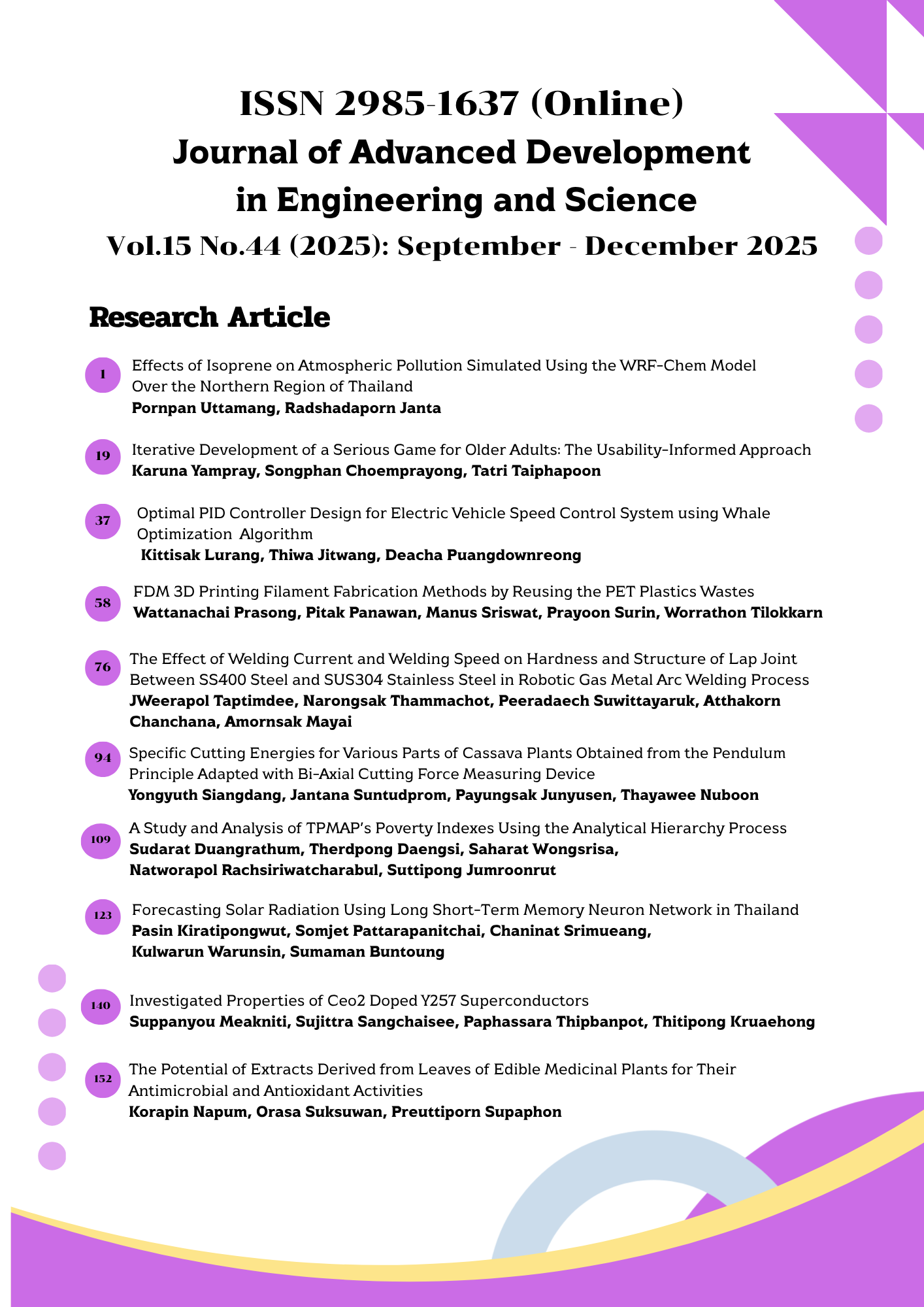
ศักยภาพของสารสกัดจากใบของพืชสมุนไพรที่รับประทานได้ในการต้านจุลินทรีย์และต้านอนุมูลอิสระ
Article Sidebar
Main Article Content
บทคัดย่อ
งานวิจัยนี้มีวัตถุประสงค์เพื่อประเมินฤทธิ์ต้านจุลินทรีย์และฤทธิ์ต้านอนุมูลอิสระของสารสกัดจากใบของพืชสมุนไพรที่รับประทานได้จำนวน 4 ชนิด ได้แก่ Clerodendrum disparifolium (ข่อยดำ), Ehretia acuminate (พญาล้างไต), Blumea balsamifera (หนาดใหญ่) และ Strobilanthes crispa (หินฟ้าแลบ) เตรียมตัวอย่างสารสกัดจากส่วนใบของพืชทั้ง 4 ชนิด ด้วยการแช่สกัดด้วยตัวทำละลายเอทานอล จากนั้นนำสารสกัดมาทดสอบประสิทธิภาพในการยับยั้งจุลินทรีย์ก่อโรค 8 สายพันธุ์ ได้แก่ Staphylococcus aureus ATCC25923, Methicillin-Resistant Staphylococcus aureus (MRSA) SK1, Staphylococcus epidermidis, Escherichia coli ATCC25922, Pseudomonas aeruginosa ATCC27853, Acinetobacter baumannii, Candida albicans NCPF3153 และ Cryptococcus neoformans ATCC90112 โดยใช้วิธี Colorimetric broth microdilution จากนั้นประเมินฤทธิ์ต้านอนุมูลอิสระและปริมาณสารฟีนอลิกทั้งหมดของสารสกัดโดยใช้วิธี DPPH radical scavenging และวิธี Folin-Ciocalteuตามลำดับ นอกจากนี้วิเคราะห์ส่วนประกอบของสาระสำคัญที่พบด้วยเทคนิค Gas Chromatography-Mass Spectrometry จากการทดสอบฤทธิ์ยับยั้งจุลินทรีย์ของสารสกัดพบว่าสารสกัดจากใบของ B. balsamifera มีประสิทธิภาพสูงสุดในการยับยั้งการเจริญของ S. aureus, S. epidermidis และ MRSA (MIC เท่ากับ1.024 มิลลิกรัมต่อมิลลิลิตร) นอกจากนี้สารสกัดจากใบของ B. balsamifera ยังแสดงประสิทธิภาพสูงสุดในการยับยั้งอนุมูลอิสระ DPPH ให้ค่า IC50 เท่ากับ 0.178 ± 0.10 มิลลิกรัมต่อมิลลิลิตร และตรวจพบมีปริมาณสารประกอบฟีนอลิกรวมสูงที่สุดเท่ากับ 88.769 ± 10.33 มิลลิกรัมสมมูลของกรดแกลลิกต่อกรัมสารสกัดจากการศึกษาส่วนประกอบของสารสำคัญในสารสกัดโดยใช้เทคนิค Gas Chromatography-Mass Spectrometry (GC-MS) ตรวจพบไฟทอล (phytol) มีปริมาณสูงที่สุด จากผลการศึกษานี้ชี้ให้เห็นว่าสารสกัดจากสมุนไพรเป็นแหล่งของสารออกฤทธิ์ที่น่าสนใจ และสามารถยืนยันประสิทธิภาพของพืชสมุนไพรเหล่านี้ อีกทั้งยังสามารถใช้เป็นข้อมูลพื้นฐานในการศึกษาฤทธิ์ทางชีวภาพอื่นๆในอนาคต
Article Details

อนุญาตภายใต้เงื่อนไข Creative Commons Attribution-NonCommercial-NoDerivatives 4.0 International License.
เนื้อหาและข้อมูลในบทความที่ลงตีพิมพ์ใน Journal of Advanced Development in Engineering and Science ถือเป็นข้อคิดเห็นและความรับผิดชอบของผู้เขียนบทความโดยตรง ซึ่งกองบรรณาธิการวารสารไม่จำเป็นต้องเห็นด้วยหรือร่วมรับผิดชอบใดๆ
บทความ ข้อมูล เนื้อหา ฯลฯ ที่ได้รับการตีพิมพ์ในJournal of Advanced Development in Engineering and Science ถือเป็นลิขสิทธิ์ของ Journal of Advanced Development in Engineering and Science หากบุคคลหรือหน่วยงานใดต้องการนำทั้งหมดหรือส่วนหนึ่งส่วนใดไปเผยแพร่ต่อหรือเพื่อกระทำการใดๆ จะต้องได้รับอนุญาตเป็นลายลักษณ์อักษรจาก Journal of Advanced Development in Engineering and Scienceก่อนเท่านั้น
เอกสารอ้างอิง
Thun, M.J., et al., (2009). The global burden of cancer: priorities for prevention. Carcinogenesis. 31(1): 100-110.
Khan, M.S.A. and Ahmad, I. Herbal medicine: current trends and future prospects. In: Ahmad Khan, M.S., Ahmad, I. and Chattopadhyay, D., Eds., New Look to Phytomedicine, Academic Press, Cambridge, 3-13. https://doi.org/10.1016/B978-0-12-814619-4.00001-X
Salmeron-Manzano, E., et al., (2020). Worldwide research trends on medicinal plants. International Journal of Environmental Research and Public Health. 2020; 17(10): 3376. https://doi.org/10.3390/ijerph17103376.
Cero, M.D., et al., (2023). Trends of medicinal plant use over the last 2000 Years in central Europe. Plants. 12(1): 13. https://doi.org/10.3390/plants12010135.
Ahmad K, M.S. and Ahmad, I. (2018). Herbal medicine: current trends and prospects. In: New Look to Phytomedicine: Advancements in Herbal Products as Novel Drug Leads, pp. 3–13. https://doi.org/10.1016/B978-0-12-814619-4.00001-X.
Phumthum, M., et al., (2019). Important medicinal plant families in Thailand.
Frontiers in Pharmacology. 10: 1-14.
Guo, Y., et al., (2020). Prevalence and therapies of antibiotic-resistance in Staphylococcus aureus. Frontiers in Cellular and Infection Microbiology. 10:107. doi: 10.3389/fcimb.2020.00107.
Hazam, K., et al., (2019). Global mortality associated with 33 bacterial pathogens in 2019: a systematic analysis for the Global Burden of Disease Study. The Lancet. 400(10369): 2221 – 2248.
Baker, R.E., et al., (2021). Infectious disease in an era of global change. Nature Review Microbiology. 20: 193–205.
Huang, J., et al., (2023). Global Infectious diseases in August 2023: A Monthly Analysis. Zoonoses. 3(1): https://doi.org/ 10.15212/ZOONOSES-2023-1009.
Brey, F., et al., (2024). Global cancer statistics 2022: GLOBOCAN estimates of incidence and mortality worldwide for 36 cancers in 185 countries. A cancer journal for clinicians. 2024; 74(3): 229-263.
Ghasemzadeh, A., et al., (2015). Phytochemical constituents and biological
activities of different extracts of Strobilanthes crispus (L.) Bremek leaves grown in different locations of Malaysia. BMC Complementary and Alternative Medicine. 15: 422. https://doi.org/10.1186/s12906-015-0873-3
Phosrithong, N. and Nuchtavorn, N. (2016). Antioxidant and anti-inflammatory activites of Clerodendrum leaf extracts collected in Thailand. European Journal of Integrative Medicine. 8(3): 281-285.
Jan, H.U., et al., (2023). Pharmacognostic study of Ehretia acuminata R.Br. life and environmental sciences. Pakistan Academy of Sciences. 60(2): 267-272.
Wang, J., et al., (2023). Chemical constituents and bioactivities of Blumea balsamifera (Sembung): a systematic review. Food science and technology, Campinas, 2023; 43.e132322.
Chee-Shien, C., et al., (2023). Traditional uses, phytochemistry and pharmacological properties of Strobilanthes crispa (L.) Blume. Records of Natural Products. 17(5): 743 – 792.
Clinical and Laboratory Standards Institute (CLSI). 2022a. Reference method for broth dilution antimicrobial susceptibility tests for bacteria that grow aerobically. Approved standard M7-A4. Clinical and Laboratory Standards Institute, Wayne, Pa.
Clinical and Laboratory Standards Institute (CLSI). 2002b. Reference method for
broth dilution antimicrobial susceptibility testing of yeasts. Approved standard M27- A2. Clinical and Laboratory Standards Institute, Wayne, Pa.
Sarker, S. D., et al., (2007). Microtiterplate-based antibacterial assay incorporating resazurin as an indicator of cell growth, and its application in the in vitro antibacterial screening of phytochemicals. Methods, 42: 321e324. https://doi.org/10.1016/j.ymeth.2007.01.006.
Ghafar, M.F.A., et al., (2010). Flavonoid, hesperidine, total phenolic contents and
antioxidant activities from citrus species. African Journal of Biotechnology. 9(3): 326-330.
Supaphon, P., et al., (2018). Isolation and antimicrobial activities of fungi derived from Nymphaea lotus and Nymphaea stella. Mycoscience. 59(5): 415-423.
Nurul, A.I., et al., (2022). Antimicrobial activities and phytochemical properties of Blumea balsamifera against pathogenic microorganisms, Journal of Medicine and Life. 15(8): 951 – 954.
Sakee U, et al., (2011). Antimicrobial activity of Blumea balsamifera (Lin.) DC. extracts and essential Oil, Natural Product Research. 25(19): 1478 - 6427.
Yuan-Hui Wang and Xiao-Yu Yu. (2018). Biological activities and chemical compositions of volatile oil and essential oil from the leaves of Blumea balsamifera, Journal of Essential Oil Bearing Plants. 21(6): 1511 – 1531.
Hui, Y., et al., (2021). Antibacterial effect of Blumea balsamifera (L.) DC. Essential oil against Staphylococcus aureus, Archives of Microbiology. 203: 3981 - 3988.
Chow, Y. C. (2018). In Vitro Antimicrobial Activities of Strobilanthes Crispus and Clinacanthus nutans on Urinary Tract Infection (UTI) Causing Bacteria. Final Year Project (Bachelor), Tunku Abdul Rahman University College. 2018.
Hanafiah, R.M., et al., (2023). Green synthesis, characterization and antibacterial activities of Strobilanthes crispa-mediated silver nanoparticles (SC-AGNPS) against selected bacteria, Artificial Cells, Nanomedicine, and Biotechnology. 51: 549 – 559.
Ting, H.T. (2024). Phytochemical study of Strobilanthes crispa leaves and Its antioxidant and antibacterial properties, Final Year Project (Bachelor), Tunku Abdul Rahman University of Management and Technology.
Jirakitticharoen, S., et al., (2022). Phenolics, antioxidant and antibacterial activities of immature and mature Blumea balsamifera leaf extracts eluted with different solvents, The Journal of Tropical Medicine and Parasitology. 7794227 https://doi.org/10.1155/2022/7794227
Thach, B. D., et al., (2017). Antioxidant and antityrosinase activities of flavonoid from Blumea balsamifera (L.) DC. leaves extract, European Journal of Research in Medical Sciences. 2017; 5(1): 2056 - 2061.
Sari, N.M., et al., (2023). Phytochemical and antioxidant activities of Blumea balsamifera and Cordyline fruticosa based on Ethnopharmacology Knowledge of Muara Tae Tribe, East Kalimantan. Biology, Medicine, & Natural Product Chemistry. 12: 273 – 280
Septi D.P.R. and Ridho A. (2020). Antioxidant Activities of Sembung Leaves (Blumea balsamifera (L.) DC), EAS Journal of Pharmacy and Pharmacology. 2(5): 166–172.
Silva, R.O., et al., (2020). Fundamental and Clinical Pharmacology. 28(4), 455-46435. Islam, M.T., Rahman, M.A., Saeed, M., Ul-Haq, Z., Alam, M.J., Mondal, M., Hossain, R., Mubarak, M.S., Salehi, B., Setzer, W.N., Razis, A.F.A. and Sharifi-Rad, J. Anti-diarrheal activities of Phytol and its possible mechanism of action through in-vivo and in-silico models. Cellular and Molecular Biology. (4): 243-249.
Ghaneian, M.T., et al., (2015). Antimicrobial activity, toxicity and stability of Phytol as a novel surface disinfectant. Environmental Health Engineering and Management Journal. 2(1): 13-16.
Islam, M.T., et al., (2018). Phytol: A review of biomedical activities. Food and Chemical Toxicology. 121: 82-94.
