α–Glucosidase Inhibitory Activities of Crude Extract from Mitragyna speciosa Korth. Leaves
DOI:
https://doi.org/10.55164/jgrdi.v1i1.613Keywords:
Mitragyna speciosa, Diabetes Mellitus, Crude Extract, Acarbose, α-glucosidaseAbstract
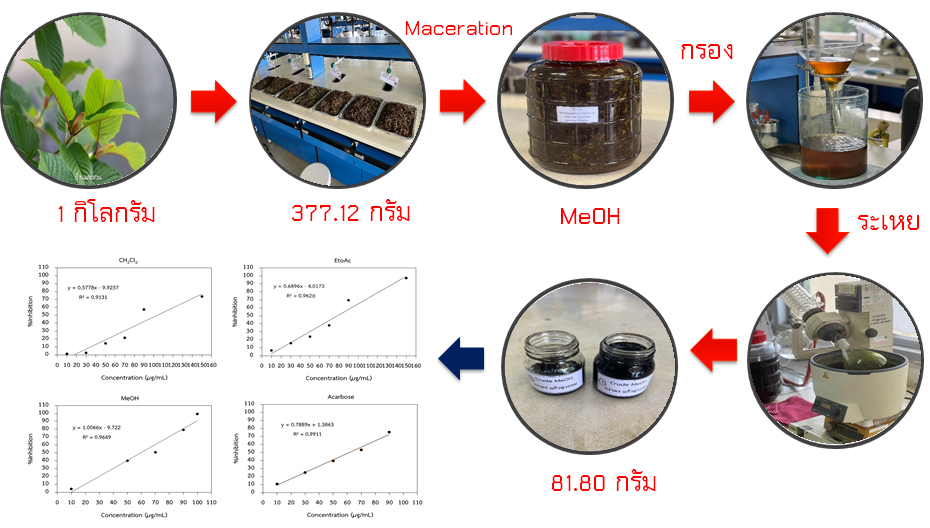
Mitragyna speciosa Korth., commonly known as Kratom, is a herbaceous plant found in southern regions and is known for its high content of alkaloids, mainly mitragynine. To study the potential of crude extract from Mitragyna speciosa Korth. leaves on a–glucosidase inhibitory activities is the aim of this study. The leaves were extracted using dichloromethane, ethyl acetate, and methanol as the solvents with the maceration technique. The extraction results showed the crude yields of chloroform, ethyl acetate, and methanol were 2.37, 0.95 and 8.18%, respectively. The a–glucosidase inhibitory activities of the crude extracts found that the crude dichloromethane, ethyl acetate and methanol extracts had inhibitory activities with IC50 values of 103.71, 78.33 and 66.72 µg/mL, respectively. The crude extract of methanol is close to the IC50 value of the standard substance acarbose, which is 61.62 µg/mL. Therefore, the research can be concluded that the crude methanol extracts from Mitragyna speciosa Korth. leaves have the potential to be further developed as a diabetes drug.
References
Purintrapiban, J., Keawpradub, N., Kansenalak, S., Chittrakarn, S., Janchawee, B., & Sawangjaroen, K. (2011). Study on glucose transport in muscle cells by extracts from Mitragyna speciosa (Korth) and mitragynine. Natural Product Research, 25(15), 1379-1387.
Meesakul, P., Pyne, S. G., & Laphookhieo, S. (2020). Potent -glucosidase inhibitory activity of compounds isolated from the leaf extracts of Uvaria hamiltonii. Natural Product Research, 34(17), 2495-2499.
Suthiphasilp, V., Maneerat, W., Andersen, R. J., Phukhatmuen, P., Pyne, S. G., & Laphookhieo, S. (2019). Dasymaschalolactams A-E, aristolactams from a twig extract of Dasymaschalon dasymaschalum. Journal of Natural Products, 82(11), 3176-3180.
Chear, N. J., Leon, F., Sharma, A., Kanumuri, S. R. R., Zwolinski, G., Abboud, K. A., Singh, D., Restrepo, L. F., Patel, A., Hiranita. T., Ramanathan, S., Hampson, A. J., McCurdy, L. R., & McCurdy, C. R. (2021). Exploring the Chemistry of alkaloids from Malaysian Mitragyna speciosa (Kratom) and the role of oxindoles on human opioid receptors. Journal of Natural Products, 84(4), 1034-1043.
Phillipson, J. D., & Hemingway, S. R., Bisset, N. G., Houghton, P. J. & Shellard, E. J. (1974). Angustine and related alkaloids from species of Mitragyna, nauclea, uncarza, and Strychnos. Phytochemistry, 13, 973-978.
Carpenter, J. M., Criddle, C. A., Craig, H. K., Ali, Z., Zhang, Z., Khan, I. A., & Sufka, K. J. (2016). Comparative effects of Mitragyna speciosa extract, mitragynine, and opioid agonists on thermal nociception in rats. Fitoterapia, 109, 87-90.
Qurrat-ul-Ain, Ashiq, U., Jamal, R.A., Saleem, M., Mahroof-Tahir, M. (2017). Alpha-glucosidase and carbonic anhydrase inhibition studies of Pd(II)-hydrazide complexes. Arabian Journal of Chemistry, 10(4), 488–499.
Downloads
Published
How to Cite
Issue
Section
License
Copyright (c) 2023 Graduate School Thaksin University

This work is licensed under a Creative Commons Attribution-NonCommercial-NoDerivatives 4.0 International License.


