
การประเมินคาร์บอนฟุตพริ้นท์องค์กรและการวิเคราะห์แหล่งปล่อยก๊าซเรือนกระจกที่สำคัญของมหาวิทยาลัยราชภัฏนครศรีธรรมราช
Article Sidebar
Main Article Content
บทคัดย่อ
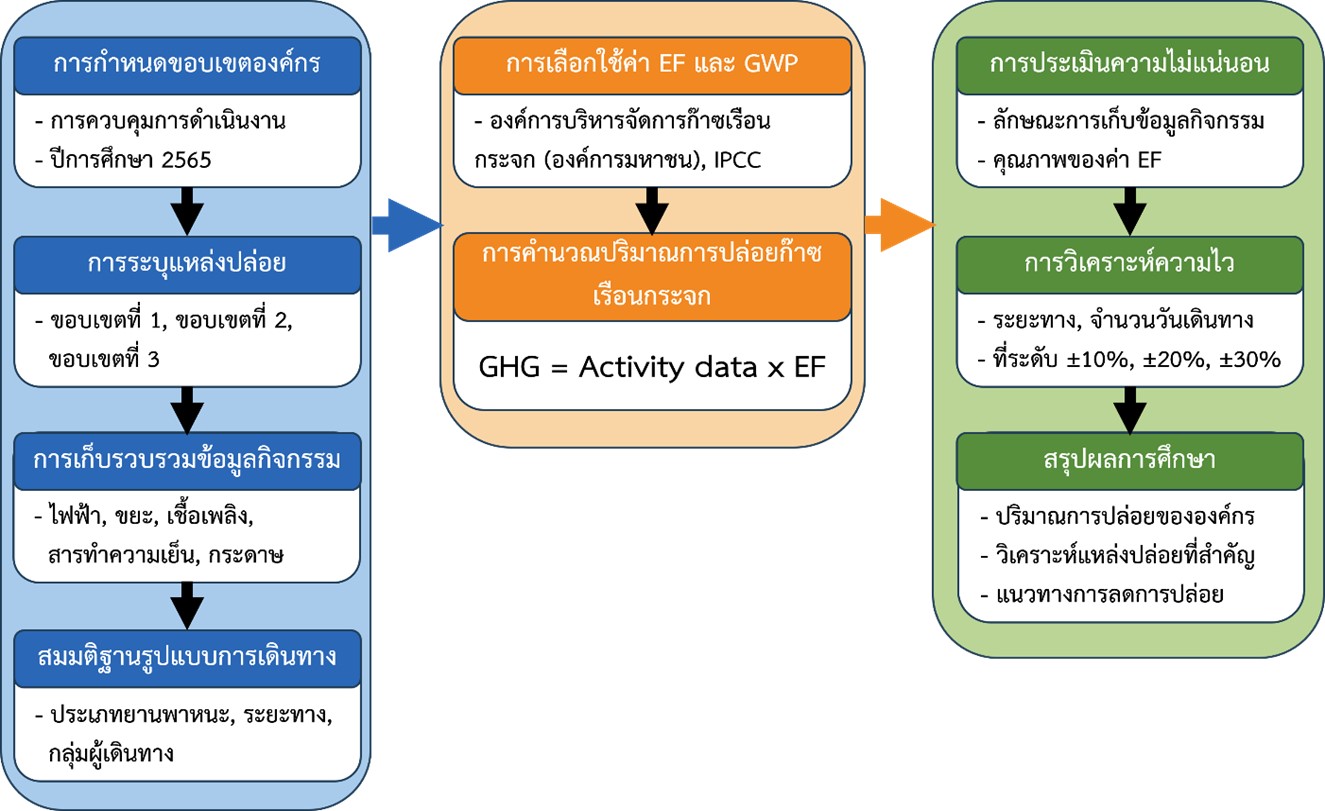
การวิจัยนี้มีวัตถุประสงค์เพื่อ 1) ประเมินปริมาณการปล่อยก๊าซเรือนกระจกของมหาวิทยาลัยราชภัฏนครศรีธรรมราชตามมาตรฐาน ISO 14064-1 และแนวทางขององค์การบริหารจัดการก๊าซเรือนกระจก (องค์การมหาชน) 2) จำแนกและวิเคราะห์แหล่งปล่อยก๊าซเรือนกระจกที่มีนัยสำคัญในแต่ละขอบเขต และ 3) จัดทำฐานข้อมูลคาร์บอนฟุตพริ้นท์องค์กรเพื่อใช้เป็นแนวทางในการวางแผนมาตรการลดการปล่อยก๊าซเรือนกระจกของมหาวิทยาลัย การศึกษานี้ใช้ข้อมูลกิจกรรมของปีการศึกษา 2565 ร่วมกับค่าสัมประสิทธิ์การปล่อยก๊าซเรือนกระจก โดยการปล่อยจากกิจกรรมการเดินทางไป-กลับของบุคลากรและนักศึกษาในขอบเขตที่ 3 ได้ประเมินจากสมมติฐานรูปแบบการเดินทางร่วมกับข้อมูลประชากรจริงของมหาวิทยาลัย ผลการวิจัยพบว่า มหาวิทยาลัยมีปริมาณการปล่อยก๊าซเรือนกระจกสุทธิรวมทั้งสิ้น 8,669.85 ตันคาร์บอนไดออกไซด์เทียบเท่า (tCO2eq) ต่อปี คิดเป็นอัตราการปล่อยเฉลี่ย 0.94 tCO2eq ต่อคนต่อปี โดยขอบเขตที่ 3 มีสัดส่วนสูงสุดร้อยละ 62.38 รองลงมาคือ ขอบเขตที่ 2 ร้อยละ 27.70 และขอบเขตที่ 1 ร้อยละ 9.92 ตามลำดับ เมื่อวิเคราะห์แหล่งปล่อยก๊าซเรือนกระจกที่สำคัญ พบว่า การเดินทางไป-กลับของบุคลากรและนักศึกษาด้วยยานพาหนะส่วนตัวเป็นแหล่งปล่อยสูงสุด คิดเป็น 3,629.61 tCO2eq ต่อปี รองลงมาคือการใช้พลังงานไฟฟ้าในระบบอาคารและส่วนกลาง คิดเป็น 2,401.54 tCO2eq ต่อปี และการกำจัดขยะมูลฝอย 1,294.39 tCO2eq ต่อปี ผลการศึกษาสะท้อนให้เห็นถึงลักษณะเฉพาะของมหาวิทยาลัยในพื้นที่ภูมิภาคที่มีข้อจำกัดด้านระบบขนส่งสาธารณะ ส่งผลให้กิจกรรมการเดินทางเป็นแหล่งปล่อยก๊าซเรือนกระจกที่มีนัยสำคัญ ฐานข้อมูลที่ได้จากการศึกษานี้สามารถใช้สนับสนุนการกำหนดนโยบายและมาตรการลดการปล่อยก๊าซเรือนกระจกของมหาวิทยาลัย ทั้งในด้านการจัดการการเดินทาง การเพิ่มประสิทธิภาพการใช้พลังงาน และการจัดการของเสีย เพื่อขับเคลื่อนมหาวิทยาลัยสู่การเป็นองค์กรคาร์บอนต่ำอย่างยั่งยืน
Article Details

อนุญาตภายใต้เงื่อนไข Creative Commons Attribution-NonCommercial-NoDerivatives 4.0 International License.
บทความที่ได้รับตีพิมพ์ในวารสารนี้เป็นลิขสิทธิ์ของคณะเทคโนโลยีอุตสาหกรรม มหาวิทยาลัยราชภัฏนครศรีธรรมราช
อนึ่งผลงานวิจัยและผลงานทางวิชาการที่ปรากฏเผยแพร่ในวารสารฯ เป็นความคิดเห็นอิสระของผู้แต่ง โดยผู้แต่งเป็นผู้รับผิดชอบต่อผลทางกฎหมายใด ๆ ที่อาจจะเกิดขึ้นจากบทความเผยแพร่นั้น ซึ่งกองบรรณาธิการและคณะผู้จัดทำวารสารฯ ไม่จำเป็นต้องเห็นด้วยเสมอไป
เอกสารอ้างอิง
Department of Climate Change and Environment. 2024. NDC Action Plan on Mitigation 2021–2030. [Online]. Available: https://www.dcce.go.th/datacenter/653/ (in Thai)
Intergovernmental Panel on Climate Change (IPCC). 2023. Climate Change 2023: Synthesis Report. Contribution of Working Groups I, II and III to the Sixth Assessment Report of the Intergovernmental Panel on Climate Change. Geneva, Switzerland: Intergovernmental Panel on Climate Change. [Online]. Available: https://doi.org/10.59327/IPCC/AR6-9789291691647
Suksatit, P. and et al. 2025. "Assessing carbon footprint for organization (CFO): Case study of the Faculty of Environment, Kasetsart University," EnvironmentAsia, 18(Special Issue): pp. 143-154. [Online]. Available: https://doi.org/10.14456/ea.2025.30
Usubharatana, P. and Phungrussami, H. 2014. "Carbon footprint of organization: Case study for Thammasat University," Thai Science and Technology Journal, 22(1): pp. 1-12. [Online]. Available: https://li01.tci-thaijo.org/index.php/tstj/article/view/15101/13845 (in Thai)
Choenthanomwong, F. and Sumpuntamas, T. 2024. "Carbon footprint assessment of Walailak University," Science, Technology, and Social Sciences Procedia, 2024(1): p. NCR2R19. [Online]. Available: https://wjst.wu.ac.th/index.php/stssp/article/view/25831 (in Thai)
Thanatrakolsri, P. and Sirithian, D. 2024. "Evaluation of greenhouse gas emissions and mitigation measures at Thammasat University’s Lampang campus in Thailand," Environmental Health Insights, 18: pp. 1-9. [Online]. Available: https://doi.org/10.1177/ 11786302241253589
Maimun, T. and et al. 2018. "Organization carbon footprint assessment of Eastern Asia University," EAU Heritage Journal: Science and Technology, 12(2): pp. 195-209. [Online]. Available: https://he01.tci-thaijo.org/index.php/EAUHJSci/article/view/134724/105650 (in Thai)
Sudha, S. and Hirun, D. 2019. "Carbon footprint of an organization: Case study of Chaiyaphum Rajabhat University," Engineering Journal Chiang Mai University, 26(1): pp. 227-233. [Online]. Available: https://www.thaiscience.info/Journals/Article/EJCM/10990888.pdf (in Thai)
Samara, F. and et al. 2022. "Carbon footprint at a United Arab Emirates university: GHG protocol," Sustainability, 14(5): p. 2522. [Online]. Available: https://doi.org/10.3390/su14052522
International Organization for Standardization. 2018. Greenhouse gases—Part 1: Specification with guidance at the organization level for quantification and reporting of greenhouse gas emissions and removals (ISO 14064-1:2018). Geneva, Switzerland: ISO.
Thailand Greenhouse Gas Management Organization. 2022. Requirements for the calculation and reporting of carbon footprint for organization, 8th ed. [Online]. Available: https://thaicarbonlabel.tgo.or.th/tools/files.php?mod=YjNKbllXNXBlbUYwYVc5dVgyUnZkMjVzYjJGaw&type=WDBaSlRFVlQ&files=TkRFPQ (in Thai)
Greenhouse Gas Protocol. 2011. Corporate Value Chain (Scope 3) Accounting and Reporting Standard. World Resources Institute and World Business Council for Sustainable Development. [Online]. Available: https://ghgprotocol.org/sites/default/files/standards/Corporate-Value-Chain-Accounting-Reporing-Standard_041613_2.pdf
Thailand Greenhouse Gas Management Organization. 2022. Carbon footprint for organization: Emission factor (CFO). [Online]. Available: https://thaicarbonlabel.tgo.or.th/index.php?lang=TH&mod=YjNKbllXNXBlbUYwYVc5dVgyVnRhWE56YVc5dQ (in Thai)
Intergovernmental Panel on Climate Change (IPCC). 2006. "Chapter 6: Wastewater treatment and discharge," in 2006 IPCC Guidelines for National Greenhouse Gas Inventories, Volume 5: Waste. [Online]. Available: https://www.ipcc-nggip.iges.or.jp/public/2006gl/pdf/5_Volume5/V5_6_Ch6_Wastewater.pdf
Thailand Greenhouse Gas Management Organization. 2022. Carbon footprint of product: Emission factor (CFP). [Online]. Available: https://thaicarbonlabel.tgo.or.th/index.php?lang=TH&mod=Y0hKdlpIVmpkSE5mWlcxcGMzTnBiMjQ9 (in Thai)
Mangkang, R. 2013. "Organizational carbon footprint of Kasetsart University to promote a green university," Research report. Bangkok, Thailand: Kasetsart University. (in Thai)
