
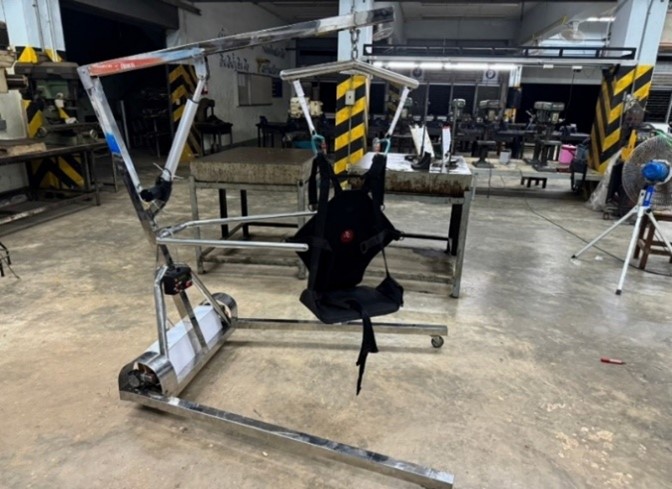
การประเมินประสิทธิภาพและความพึงพอใจต่อการใช้งานเครื่องช่วยพยุงเดินและยกผู้ป่วยกึ่งอัตโนมัติแบบทูอินวันสำหรับงานกายภาพบำบัด
Article Sidebar
Main Article Content
บทคัดย่อ
งานวิจัยนี้มีวัตถุประสงค์เพื่อ 1) ประเมินประสิทธิภาพเชิงเวลาและภารกิจ (Task performance & eficiency) ของเครื่องช่วยพยุงเดินและยกผู้ป่วยกึ่งอัตโนมัติแบบทูอินวันในการเคลื่อนย้ายและพยุงเดินสำหรับงานกายภาพบำบัด 2) ศึกษาความพึงพอใจของผู้ใช้งานทั่วไปและนักกายภาพบำบัดที่มีต่อการใช้งานเครื่องช่วยพยุงเดินและยกผู้ป่วยกึ่งอัตโนมัติแบบทูอินวัน กลุ่มตัวอย่างที่ใช้ในการศึกษาครั้งนี้ ได้แก่ ผู้ใช้งานทั่วไปและนักกายภาพบำบัด จำนวน 10 คน ซึ่งได้มาจากการสุ่มตัวอย่างแบบง่าย (Simple random sampling) เครื่องมือที่ใช้ในการเก็บรวบรวมข้อมูลคือแบบบันทึกผลการทดสอบประสิทธิภาพเชิงเวลาและภารกิจ และแบบสอบถามความพึงพอใจ สถิติที่ใช้ในการวิเคราะห์ข้อมูล ได้แก่ ค่าความถี่ ร้อยละ ค่าเฉลี่ย () และส่วนเบี่ยงเบนมาตรฐาน (S.D.) ผลการวิจัยพบว่า 1) ด้านการประเมินประสิทธิภาพเชิงภารกิจ เครื่องช่วย พยุงเดินและยกผู้ป่วยกึ่งอัตโนมัติสามารถช่วยลดภาระด้านบุคลากรลงได้ร้อยละ 50 โดยใช้ผู้ดูแลเพียง 1 คน ในการปฏิบัติงานเมื่อเทียบกับวิธีปกติที่ใช้ 2 คน ในขณะที่กลุ่มตัวอย่างสามารถปฏิบัติภารกิจลุล่วงในสถานการณ์จำลองได้ตามภารกิจที่ออกแบบไว้ โดยใช้เวลายกตัวผู้ป่วยจำลองเฉลี่ย 46.45 วินาที และเวลาในการจัดท่าพยุงเดินเฉลี่ย 53.50 วินาที 2) ผลการประเมินความพึงพอใจที่มีต่อเครื่องช่วยพยุงเดินและยกผู้ป่วยกึ่งอัตโนมัติสำหรับงานกายภาพบำบัด พบว่า ในภาพรวมมีความพึงพอใจอยู่ในระดับมาก (
= 4.48, S.D. = 0.17) เมื่อพิจารณาเป็นรายด้าน พบว่า ด้านการออกแบบมีความพึงพอใจเฉลี่ยสูงสุดอยู่ในระดับมากที่สุด (
= 4.57, S.D. = 0.31) รองลงมาคือ ด้านโครงสร้างมีความพึงพอใจอยู่ในระดับมาก (
= 4.44, S.D. = 0.29) และด้านการใช้งานมีความพึงพอใจอยู่ในระดับมาก (
= 4.44, S.D. = 0.26) ตามลำดับ จากการวิจัยจึงสรุปได้ว่า เครื่องช่วยพยุงเดินและยกผู้ป่วยกึ่งอัตโนมัติแบบทูอินวันมีความเหมาะสมทั้งในด้านโครงสร้าง การออกแบบ และการใช้งาน สามารถนำไปใช้เป็นอุปกรณ์ทางเลือกเพื่อสนับสนุนการปฏิบัติงานของนักกายภาพบำบัดและเพิ่มความสะดวกในการดูแลผู้ป่วยได้อย่างมีประสิทธิภาพ
Article Details

อนุญาตภายใต้เงื่อนไข Creative Commons Attribution-NonCommercial-NoDerivatives 4.0 International License.
บทความที่ได้รับตีพิมพ์ในวารสารนี้เป็นลิขสิทธิ์ของคณะเทคโนโลยีอุตสาหกรรม มหาวิทยาลัยราชภัฏนครศรีธรรมราช
อนึ่งผลงานวิจัยและผลงานทางวิชาการที่ปรากฏเผยแพร่ในวารสารฯ เป็นความคิดเห็นอิสระของผู้แต่ง โดยผู้แต่งเป็นผู้รับผิดชอบต่อผลทางกฎหมายใด ๆ ที่อาจจะเกิดขึ้นจากบทความเผยแพร่นั้น ซึ่งกองบรรณาธิการและคณะผู้จัดทำวารสารฯ ไม่จำเป็นต้องเห็นด้วยเสมอไป
เอกสารอ้างอิง
Chan-Ubol, R. and et al. 2012. "Gait training in subacute stroke using a robotic-assisted gait trainer: a randomized controlled trial compared with conventional physical therapy," Journal of Rehabilitation Medicine, 22(2): pp. 40-48. [Online]. Available: https://doi.org/10.14456/jrm.2012.5 (in Thai)
Cho, J. E. and et al. 2018. "Systematic review of appropriate robotic intervention for gait function in subacute stroke patients," BioMed Research International, 2018: pp. 1-13. [Online]. Available: https://doi.org/10.1155/2018/3521369
Fusakul, Y. 2017. "Walking device," Vajira Medical Journal: Journal of Urban Medicine, 61(2): pp. 139-153. [Online]. Available: https://doi.org/10.14456/vj.2017.15 (in Thai)
Thabklam, S., Nilkon, S. and Chaloodprasert, S. 2021. "A pilot study on improving lateral patient transfer devices to reduce back pain risks for hospital personnel," The Journal of the Royal Thai Army Nurses, 22(1): pp. 154-163. [Online]. Available: https://doi.org/10.14456/jrtan.2021.16 (in Thai)
Nelson, A. and Baptiste, A. S. 2006. "Evidence-based interventions for safe patient handling and movement," Online Journal of Issues in Nursing, 11(3). [Online]. Available: https://doi.org/10.3912/OJIN.Vol11No03Man03
Khruanonrat, P. 2017. "Study and development of assist devices for the elderly," M.S. thesis, King Mongkut's Institute of Technology Ladkrabang. [Online]. Available: https://doi.org/10.14456/kmitl.2017.1 (in Thai)
Sitlaothaworn, W. and Roongruangduayboon, B. 2018. "Design of a walking assist device with partial body weight support system for people with gait movement problems, version 2.0," Kasetsart Engineering Journal, 31(105): pp. 1-10. [Online]. Available: https://doi.org/10.14456/kuengj.2018.10 (in Thai)
Konstantinovic, L. M., Veg, A. and Schwirtlich, L. B. 2014. "Gait training of poststroke patients assisted by the Walkaround (body postural support)," International Journal of Rehabilitation Research, 37(1): pp. 22-28. [Online]. Available: https://doi.org/10.1097/MRR.0000000000000035
Khanthaballang, Y., Suwanthen, W. and Chaichana, N. 2022. "Development and efficiency of innovative patient transfer equipment," Journal of Health and Nursing Education, 28(1): pp. 1-15. [Online]. Available: https://doi.org/10.14456/jhen.2022.1 (in Thai)
