
ORGANIZATION CARBON FOOTPRINT ASSESSMENT AND HOTSPOT ANALYSIS OF GREENHOUSE GAS EMISSIONS AT NAKHON SI THAMMARAT RAJABHAT UNIVERSITY
Article Sidebar
Main Article Content
Abstract
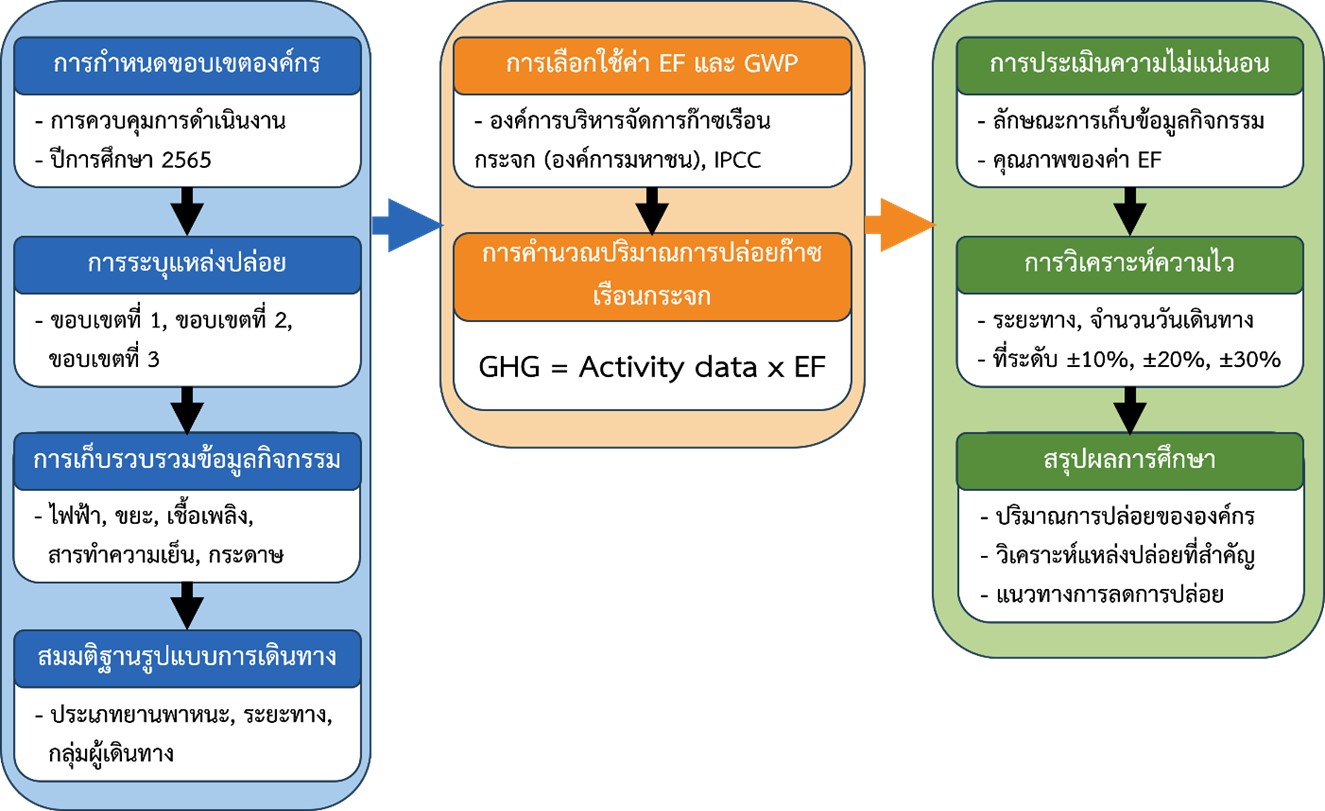
This research aimed to 1) assess the greenhouse gas emissions of Nakhon Si Thammarat Rajabhat University in accordance with ISO 14064-1 and the guidelines of the Thailand Greenhouse Gas Management Organization (Public Organization), 2) classify and analyze significant greenhouse gas emission sources within each scope, and 3) develop an organizational carbon footprint database to support greenhouse gas mitigation planning for the university. The study used activity data from the 2022 academic year together with greenhouse gas emission factors. Emissions from commuting by university personnel and students under Scope 3 were estimated using commuting pattern assumptions in combination with the university’s actual population data. The results showed that the university’s total net greenhouse gas emissions were 8,669.85 tCO2eq per year, with an average emission intensity of 0.94 tCO2eq per person per year. Scope 3 contributed the largest share of total emissions at 62.38%, followed by Scope 2 at 27.70% and Scope 1 at 9.92%. Hotspot analysis revealed that commuting by private vehicles was the largest emission source, accounting for 3,629.61 tCO2eq per year, followed by electricity consumption in buildings and central facilities at 2,401.54 tCO2eq per year, and solid waste disposal at 1,294.39 tCO2eq per year. These findings reflect the characteristics of a regional university where limitations in public transportation make commuting a significant source of greenhouse gas emissions. The database developed from this study can support the formulation of greenhouse gas reduction policies and measures for the university, particularly in transport management, energy efficiency improvement, and waste management, in order to drive the university toward becoming a sustainable low-carbon organization.
Article Details

This work is licensed under a Creative Commons Attribution-NonCommercial-NoDerivatives 4.0 International License.
Articles published in this journal are copyrighted by the Faculty of Industrial Technology. Nakhon Si Thammarat Rajabhat University
In addition, research results and academic works published in the journal It is the independent opinion of the author. The author is responsible for any legal consequences that may arise from the published article. The editorial team and the journal's production team, we don't always have to agree.
References
Department of Climate Change and Environment. 2024. NDC Action Plan on Mitigation 2021–2030. [Online]. Available: https://www.dcce.go.th/datacenter/653/ (in Thai)
Intergovernmental Panel on Climate Change (IPCC). 2023. Climate Change 2023: Synthesis Report. Contribution of Working Groups I, II and III to the Sixth Assessment Report of the Intergovernmental Panel on Climate Change. Geneva, Switzerland: Intergovernmental Panel on Climate Change. [Online]. Available: https://doi.org/10.59327/IPCC/AR6-9789291691647
Suksatit, P. and et al. 2025. "Assessing carbon footprint for organization (CFO): Case study of the Faculty of Environment, Kasetsart University," EnvironmentAsia, 18(Special Issue): pp. 143-154. [Online]. Available: https://doi.org/10.14456/ea.2025.30
Usubharatana, P. and Phungrussami, H. 2014. "Carbon footprint of organization: Case study for Thammasat University," Thai Science and Technology Journal, 22(1): pp. 1-12. [Online]. Available: https://li01.tci-thaijo.org/index.php/tstj/article/view/15101/13845 (in Thai)
Choenthanomwong, F. and Sumpuntamas, T. 2024. "Carbon footprint assessment of Walailak University," Science, Technology, and Social Sciences Procedia, 2024(1): p. NCR2R19. [Online]. Available: https://wjst.wu.ac.th/index.php/stssp/article/view/25831 (in Thai)
Thanatrakolsri, P. and Sirithian, D. 2024. "Evaluation of greenhouse gas emissions and mitigation measures at Thammasat University’s Lampang campus in Thailand," Environmental Health Insights, 18: pp. 1-9. [Online]. Available: https://doi.org/10.1177/ 11786302241253589
Maimun, T. and et al. 2018. "Organization carbon footprint assessment of Eastern Asia University," EAU Heritage Journal: Science and Technology, 12(2): pp. 195-209. [Online]. Available: https://he01.tci-thaijo.org/index.php/EAUHJSci/article/view/134724/105650 (in Thai)
Sudha, S. and Hirun, D. 2019. "Carbon footprint of an organization: Case study of Chaiyaphum Rajabhat University," Engineering Journal Chiang Mai University, 26(1): pp. 227-233. [Online]. Available: https://www.thaiscience.info/Journals/Article/EJCM/10990888.pdf (in Thai)
Samara, F. and et al. 2022. "Carbon footprint at a United Arab Emirates university: GHG protocol," Sustainability, 14(5): p. 2522. [Online]. Available: https://doi.org/10.3390/su14052522
International Organization for Standardization. 2018. Greenhouse gases—Part 1: Specification with guidance at the organization level for quantification and reporting of greenhouse gas emissions and removals (ISO 14064-1:2018). Geneva, Switzerland: ISO.
Thailand Greenhouse Gas Management Organization. 2022. Requirements for the calculation and reporting of carbon footprint for organization, 8th ed. [Online]. Available: https://thaicarbonlabel.tgo.or.th/tools/files.php?mod=YjNKbllXNXBlbUYwYVc5dVgyUnZkMjVzYjJGaw&type=WDBaSlRFVlQ&files=TkRFPQ (in Thai)
Greenhouse Gas Protocol. 2011. Corporate Value Chain (Scope 3) Accounting and Reporting Standard. World Resources Institute and World Business Council for Sustainable Development. [Online]. Available: https://ghgprotocol.org/sites/default/files/standards/Corporate-Value-Chain-Accounting-Reporing-Standard_041613_2.pdf
Thailand Greenhouse Gas Management Organization. 2022. Carbon footprint for organization: Emission factor (CFO). [Online]. Available: https://thaicarbonlabel.tgo.or.th/index.php?lang=TH&mod=YjNKbllXNXBlbUYwYVc5dVgyVnRhWE56YVc5dQ (in Thai)
Intergovernmental Panel on Climate Change (IPCC). 2006. "Chapter 6: Wastewater treatment and discharge," in 2006 IPCC Guidelines for National Greenhouse Gas Inventories, Volume 5: Waste. [Online]. Available: https://www.ipcc-nggip.iges.or.jp/public/2006gl/pdf/5_Volume5/V5_6_Ch6_Wastewater.pdf
Thailand Greenhouse Gas Management Organization. 2022. Carbon footprint of product: Emission factor (CFP). [Online]. Available: https://thaicarbonlabel.tgo.or.th/index.php?lang=TH&mod=Y0hKdlpIVmpkSE5mWlcxcGMzTnBiMjQ9 (in Thai)
Mangkang, R. 2013. "Organizational carbon footprint of Kasetsart University to promote a green university," Research report. Bangkok, Thailand: Kasetsart University. (in Thai)
