
BASE DERIVED FROM RAP AND LATERITIC SOIL MIXED WITH CEMENT
Article Sidebar
Main Article Content
Abstract
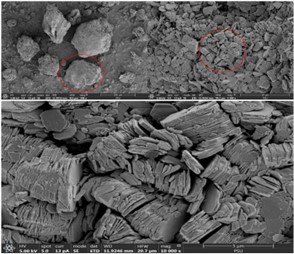
This research aims to: 1) study the development of compressive strength and durability performance of composite mixtures consisting of lateritic soil, Recycled Asphalt Pavement (RAP), and Portland cement type 1 for application as an innovative material in pavement base course construction; 2) analyze the engineering influence of controlled variables, including RAP content, optimum moisture content, cement content, and curing period, on the development of mechanical properties; 3) evaluate the compliance of the mixture properties compared to the pavement standards of the Department of Rural Roads; and 4) synthesize engineering and microstructural supporting data for the practical implementation of recycled materials in the construction industry. The research methodology utilized laboratory engineering tests by preparing mixture samples with RAP to lateritic soil weight ratios of 100:0, 0:100, 90:10, 80:20, 70:30, 60:40, and 50:50, and stabilized with cement at 0%, 1.5%, 3%, and 4.5% by weight. The testing process included modified compaction to determine maximum dry density and optimum moisture content, California Bearing Ratio (CBR) testing, and microstructural analysis using X-ray Diffraction (XRD) and Scanning Electron Microscopy (SEM) to explain chemical bonding mechanisms. The research results revealed that the mixtures of Sample Set C (90:10 RAP to lateritic soil) and Sample Set D (80:20 RAP to lateritic soil), when stabilized with 3% cement, achieved CBR values of 152.52% and 148.87%, respectively, which significantly exceed the criteria specified by pavement base standards. This study demonstrates that integrating recycled pavement waste with cement enhances load-bearing efficiency and serves as an innovative alternative that adds value to waste materials for optimal resource management in the road construction industry.
Article Details

This work is licensed under a Creative Commons Attribution-NonCommercial-NoDerivatives 4.0 International License.
Articles published in this journal are copyrighted by the Faculty of Industrial Technology. Nakhon Si Thammarat Rajabhat University
In addition, research results and academic works published in the journal It is the independent opinion of the author. The author is responsible for any legal consequences that may arise from the published article. The editorial team and the journal's production team, we don't always have to agree.
References
Chotikakrai, J. 2014. Highway Engineering, 5th ed. Bangkok: Kasetsart University Press. (in Thai)
Aydogmus, T. 2004. "Investigation of interaction behaviour of cement-stabilized cohesive soil and PVA geogrids," in Proceedings of the 3rd European Geosynthetics Conference, pp. 559-564. [Online]. Available: https://www.geosyntheticssociety.org/
Department of Rural Roads. 2014. Standard No. 242-2557 In-Place Recycling of Existing Pavement Materials. Bangkok: Department of Rural Roads. (in Thai)
Lambe, T. W. 1959. "Physico-chemical properties of soils: Role of soil technology," Journal of the Soil Mechanics and Foundation Division, 85(2): pp. 1-55. [Online]. Available: https://doi.org/10.1061/JSFE.1959.014
Sukprasert, S. 2017. "Application of natural rubber and soil-cement for road construction," Master's thesis, Suranaree University of Technology, Nakhon Ratchasima, Thailand. [Online]. Available: https://ir.sut.ac.th/ (in Thai)
Ayoola, A. and Philip, A. 2023. "Stabilization of lateritic soil for road application using lime and cow bone ash," Journal of Engineering Research and Reports, 25(6): pp. 109-121. [Online]. Available: https://doi.org/10.9734/jerr/2023/v25i6929
Montepara, A. and et al. 2012. "Effect on pavement performance of a subbase layer composed by natural aggregate and RAP," Procedia - Social and Behavioral Sciences, 53: pp. 981-990. [Online]. Available: https://doi.org/10.1016/j.sbspro.2012.09.947
Chattanajai, P. and et al. 2023. "Effect of temperature on recycled asphalt concrete pavement mixed with lateritic soil," Journal of Science and Technology, Rajamangala University of Technology Rattanakosin, 5(3): pp. 55-63. [Online]. Available: https://li01.tci-thaijo.org/index.php/rmutr/ (in Thai)
Wangno, P. 2017. "Improvement of recycled asphalt concrete pavement using calcium carbide residue and fly ash," Master’s thesis, Suranaree University of Technology, Nakhon Ratchasima, Thailand. [Online]. Available: https://ir.sut.ac.th/ (in Thai)
Suebsuk, J. and et al. 2016. "Unconfined compressive strength and microstructure of marginal lateritic soil improved with recycled asphalt pavement and cement," KMITL Engineering Journal, 33(2): pp. 112-116. [Online]. Available: https://li01.tci-thaijo.org/index.php/kmitlj/ (in Thai)
Rungreang, T. 2013. "Improvement of cement-treated crushed rock base mixed with reclaimed asphalt concrete using portland cement," Master’s thesis, Suranaree University of Technology, Nakhon Ratchasima, Thailand. [Online]. Available: https://ir.sut.ac.th/ (in Thai)
Charitngam, S. 2014. "Use of lateritic soil-cement for road rehabilitation after flooding," Research report. Nakhon Si Thammarat, Thailand: Nakhon Si Thammarat Rajabhat University. (in Thai)
Kaewma, P. and et al. 2022. "Effect of temperature on the performance of subbase materials containing reclaimed asphalt pavement," in Proceedings of the 27th National Convention on Civil Engineering (NCCE 27), paper No. GTE51, pp. 1-8. (in Thai)
Htet, O. K. and Nyam, M. K. 2025. "Stabilization of lateritic soil using cement and lime for road construction," Innovation in Engineering, 2(1): pp. 31-43. [Online]. Available: https://doi.org/10.3785/innovation.2025.1
Mills, W. H. 1936. "Stabilizing soils with Portland cement, experiments by South Carolina Highway Department," Highway Research Board Proceedings, 16: pp. 322-347.
Ngernphrom, N. 2010. "Study on the properties of pavement base materials mixed with lateritic soil, Portland cement, and steel slag," Journal of Research, Rajamangala University of Technology Phra Nakhon. [Online]. Available: https://li01.tci-thaijo.org/index.php/rmutp/ (in Thai)
Agus, S. M. and et al. 2013. "Engineering properties of silty soil stabilized with lime and rice husk ash and reinforced with waste plastic fiber," Journal of Materials in Civil Engineering, 25(9). [Online]. Available: https://doi.org/10.1061/(ASCE)MT.1943-5533.0000659
Wahab, N. A. and et al. 2015. "Effects of cement on the compaction properties of lateritic soil," IOP Conference Series: Materials Science and Engineering, 1153. [Online]. Available: https://doi.org/10.1088/1757-899X/1153/1/012015
Amadi, A. A. and et al. 2025. "Stabilization characteristics of cement soil produced with selected cement types," Cement, 19: pp. 1-15. [Online]. Available: https://doi.org/ 10.1016/j.cement.2025.100019
Boonthifong, B. and et al. 2016. "Improvement of subbase materials below standard using Portland cement and FGD gypsum," Engineering Journal Chiang Mai University: pp. 139-151. [Online]. Available: https://li01.tci-thaijo.org/index.php/engcmu/ (in Thai)
Khirirat, C., Keesawatkorn, P. and Rungsakthaweekul, T. 2021. "Improvement of lateritic soil using bottom ash geopolymer for pavement applications," Research report. (in Thai)
Joseph, E. E., Adrian, O. E. and Onah, A. 2012. "Lateritic soil stabilization of reclaimed asphalt pavement as flexible highway pavement materials," Advanced Materials Research, 367: pp. 3-11. [Online]. Available: https://doi.org/10.4028/ www.scientific.net/AMR.367.3
American Society for Testing and Materials. 2007. ASTM D422-63 Standard Test Method for Particle-Size Analysis of Soils. West Conshohocken, PA: ASTM International, pp. 1-3. [Online]. Available: https://doi.org/10.1520/D0422-63R07E02
American Society for Testing and Materials. 2016. ASTM D421-85 Standard Practice for Dry Preparation of Soil Samples for Particle-Size Analysis and Determination of Soil Constants. West Conshohocken, PA: ASTM International. [Online]. Available: https://doi.org/10.1520/D0421-85R07
Department of Rural Roads. 2002. Standard (T) 501.6-2545 Test Method for Determining Plastic Limit. Bangkok: Department of Rural Roads. (in Thai)
Department of Rural Roads. 2002. Standard (T) 501.5-2545 Test Method for Determining Liquid Limit. Bangkok: Department of Rural Roads. (in Thai)
American Association of State Highway and Transportation Officials. 2019. AASHTO T 208-15 Standard Method of Test Unconfined Compressive Strength of Cohesive Soil. Washington, DC: AASHTO.
Department of Rural Roads. 2002. Standard (T) 501.2-2545 Test Method for Determining Compaction - Modified Method. Bangkok: Department of Rural Roads. (in Thai)
Department of Rural Roads. 2002. Standard (T) 501.3-2545 Test Method for Determining California Bearing Ratio (CBR). Bangkok: Department of Rural Roads. (in Thai)
Nafissatou, S. and et al. 2024. "Stabilization of lateritic soil with Portland cement and crushed granite for pavement base courses," World Journal of Advanced Research and Reviews, 3(23): pp. 3090-3099. [Online]. Available: https://doi.org/10.30574/wjarr.2024.23.3.3090
Dabou, B., Kanali, C. and Zachary, A. G. 2021. "Structural performance of laterite soil stabilized with cement and blue gum (Eucalyptus globulus) wood ash for use as a road base material," International Journal of Engineering Trends and Technology, 69(9): pp. 257-264. [Online]. Available: https://doi.org/10.14445/22315381/IJETT-V69I9P231
