
EFFICIENCY AND USER SATISFACTION EVALUATION OF A SEMI-AUTOMATED 2-IN-1 WALKING AND LIFTING ASSIST DEVICE FOR PHYSICAL THERAPY
Article Sidebar
Main Article Content
Abstract
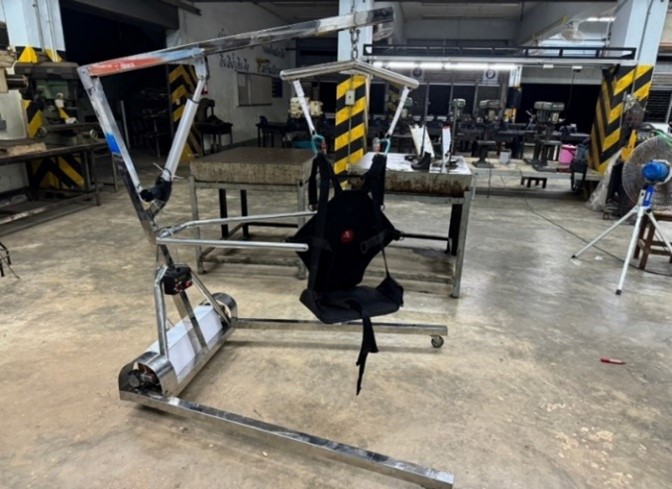
This research aimed to 1) evaluate the task performance and efficiency of a semi-automated 2-in-1 walking and lifting assist device for patient transfer and walking assistance in physical therapy, and 2) study the satisfaction of general users and physical therapists with the semi-automated 2-in-1 device. The sample group for this study consisted of 10 participants, including general users and physical therapists, selected through simple random sampling. The research instruments included task performance record forms and a satisfaction questionnaire. Data were analyzed using frequency, percentage, mean () and standard deviation (S.D.). The results revealed that: 1) In terms of task performance evaluation, the semi-automated device decreased the personnel workload by 50%, requiring only one caregiver compared to the conventional two-person method. Meanwhile, the participants were able to successfully accomplish the tasks within the simulated scenario as designed, recording an average simulated patient lifting time of 46.45 seconds and an average walking posture preparation time of 53.50 seconds. 2) Regarding the satisfaction with the semi-automated walking and lifting assist device for physical therapy, the overall satisfaction was at a high level (
= 4.48, S.D. = 0.17). When considering specific aspects, design received the highest satisfaction at the highest level (
= 4.57, S.D. = 0.31), followed by structure (
= 4.44, S.D. = 0.29) and usability (
= 4.44, S.D. = 0.26), both at a high level. In conclusion, the developed semi-automated 2-in-1 walking and lifting assist device is highly suitable in terms of structure, design, and usability. It can effectively serve as an alternative device to support physical therapy operations and enhance convenience in patient care.
Article Details

This work is licensed under a Creative Commons Attribution-NonCommercial-NoDerivatives 4.0 International License.
Articles published in this journal are copyrighted by the Faculty of Industrial Technology. Nakhon Si Thammarat Rajabhat University
In addition, research results and academic works published in the journal It is the independent opinion of the author. The author is responsible for any legal consequences that may arise from the published article. The editorial team and the journal's production team, we don't always have to agree.
References
Chan-Ubol, R. and et al. 2012. "Gait training in subacute stroke using a robotic-assisted gait trainer: a randomized controlled trial compared with conventional physical therapy," Journal of Rehabilitation Medicine, 22(2): pp. 40-48. [Online]. Available: https://doi.org/10.14456/jrm.2012.5 (in Thai)
Cho, J. E. and et al. 2018. "Systematic review of appropriate robotic intervention for gait function in subacute stroke patients," BioMed Research International, 2018: pp. 1-13. [Online]. Available: https://doi.org/10.1155/2018/3521369
Fusakul, Y. 2017. "Walking device," Vajira Medical Journal: Journal of Urban Medicine, 61(2): pp. 139-153. [Online]. Available: https://doi.org/10.14456/vj.2017.15 (in Thai)
Thabklam, S., Nilkon, S. and Chaloodprasert, S. 2021. "A pilot study on improving lateral patient transfer devices to reduce back pain risks for hospital personnel," The Journal of the Royal Thai Army Nurses, 22(1): pp. 154-163. [Online]. Available: https://doi.org/10.14456/jrtan.2021.16 (in Thai)
Nelson, A. and Baptiste, A. S. 2006. "Evidence-based interventions for safe patient handling and movement," Online Journal of Issues in Nursing, 11(3). [Online]. Available: https://doi.org/10.3912/OJIN.Vol11No03Man03
Khruanonrat, P. 2017. "Study and development of assist devices for the elderly," M.S. thesis, King Mongkut's Institute of Technology Ladkrabang. [Online]. Available: https://doi.org/10.14456/kmitl.2017.1 (in Thai)
Sitlaothaworn, W. and Roongruangduayboon, B. 2018. "Design of a walking assist device with partial body weight support system for people with gait movement problems, version 2.0," Kasetsart Engineering Journal, 31(105): pp. 1-10. [Online]. Available: https://doi.org/10.14456/kuengj.2018.10 (in Thai)
Konstantinovic, L. M., Veg, A. and Schwirtlich, L. B. 2014. "Gait training of poststroke patients assisted by the Walkaround (body postural support)," International Journal of Rehabilitation Research, 37(1): pp. 22-28. [Online]. Available: https://doi.org/10.1097/MRR.0000000000000035
Khanthaballang, Y., Suwanthen, W. and Chaichana, N. 2022. "Development and efficiency of innovative patient transfer equipment," Journal of Health and Nursing Education, 28(1): pp. 1-15. [Online]. Available: https://doi.org/10.14456/jhen.2022.1 (in Thai)
