
NAMO PATTERN MOLD INNOVATION VIA 3D PRINTING FOR BATIK PRODUCTION IN NAKHON SI THAMMARAT
Article Sidebar
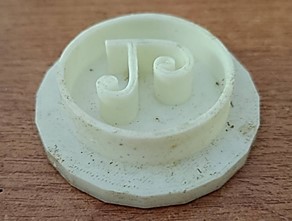
Main Article Content
Abstract
The objectives of this research were 1) to design and develop Namo pattern molds using 3D printing technology, 2) to compare the thermal properties and material efficiency between ABS and PLA plastics in the batik production process, and 3) to develop and evaluate a knowledge set on mold fabrication for technology transfer to batik producers in Nakhon Si Thammarat province. Using a Research and Development (R&D) methodology, the study combined engineering testing with data collection from a pilot group and local batik producers. The results revealed that the developed molds were accurate to the traditional identity and reduced production costs by 94.60% compared to metal molds. ABS was found to be the most suitable material due to its high dimensional stability with a deformation rate of only 0.15% during immersion in hot wax, whereas PLA suffered structural failure. The developed knowledge set achieved an efficiency (E1/E2) of 93.20/90.00 with the highest level of user satisfaction. This research contributes a practical framework for integrating 3D printing technology into traditional crafts, enhancing self-reliance and creative competitiveness for community enterprises.
Article Details

This work is licensed under a Creative Commons Attribution-NonCommercial-NoDerivatives 4.0 International License.
Articles published in this journal are copyrighted by the Faculty of Industrial Technology. Nakhon Si Thammarat Rajabhat University
In addition, research results and academic works published in the journal It is the independent opinion of the author. The author is responsible for any legal consequences that may arise from the published article. The editorial team and the journal's production team, we don't always have to agree.
References
Na Thalang, C. 2016. "Creative tourism and the preservation of local identity: A case study of batik making in Southern Thailand," Journal of Thai Interdisciplinary Research. 11(3): pp. 15-22. [Online]. Available: https://ph02.tci-thaijo.org/ index.php/jtir
Nur, H. I., Ramdhani, S. and Judawisastra, H. 2021. "The making of batik cap using 3D printing technology," In IOP Conference Series: Materials Science and Engineering. 1098: p. 042011. [Online]. Available: https://doi.org/10.1088/1757-899X/1098/4/042011
Yap, Y. L., Yeong, W. Y. and Lam, T. N. 2020. "Design and fabrication of a low-cost 3D printed batik block," Progress in Additive Manufacturing. 5: pp. 275-282. [Online]. Available: https://doi.org/10.1007/s40964-020-00123-x
Vanaei, H. R. and et al. 2020. "Influence of processing parameters on thermal and mechanical properties of 3D printed PLA and ABS," Polymers. 12(10): p. 2443. [Online]. Available: https://doi.org/10.3390/ polym12102443
Alsoufi, M. S. and Elsayed, A. E. 2018. "Surface roughness quality and dimensional accuracy—A comprehensive analysis of 100% infill printed parts," Materials Sciences and Applications. 9(1): pp. 11-27. [Online]. Available: https://doi.org/ 10.4236/msa.2018.91002
Department of Fine Arts. 1999. Silverware and Nielloware of Nakhon Si Thammarat. Bangkok: Department of Fine Arts. (in Thai)
Kaewdee, C. 2025. "The development of a model for promoting local wisdom by applying the Four Noble Truths through the case study of bulrush products from Pru Khuan Kreng," Academic Journal of Industrial Technology Innovation. 3(2): pp. 10-18. [Online]. Available: https://ph03.tci-thaijo.org/index.php/AJITI (in Thai)
Sukkrajang, K. and et al. 2025. "An investigation of brand design factors for value enhancement of crispy fried fish products: A case study of Ko Taeo subdistrict, Mueang district, Songkhla province," Academic Journal of Industrial Technology Innovation. 3(2): pp. 19-27. [Online]. Available: https://ph03.tci-thaijo.org/index.php/ AJITI (in Thai)
Kaewdee, C. and Thaiphan, R. 2025. "Logo design from community economic plant identity: A case study of Phrom Khiri community," Academic Journal of Industrial Technology Innovation. 3(2): pp. 28-36. [Online]. Available: https://ph03.tci-thaijo.org/index.php/AJITI (in Thai)
Kemmis, S. and McTaggart, R. 2005. "Participatory action research: Communicative action and the public sphere," In The Sage Handbook of Qualitative Research. Thousand Oaks, CA: Sage Publications.
