
DEVELOPMENT OF PROJECT-BASED LEARNING MODEL INTEGRATING THE FOUR NOBLE TRUTHS AND STRATEGIC DESIGN (DSNM-PBL) TO ENHANCE CAREER AND TECHNOLOGY SKILLS FOR LOWER SECONDARY STUDENTS
Article Sidebar
Main Article Content
Abstract
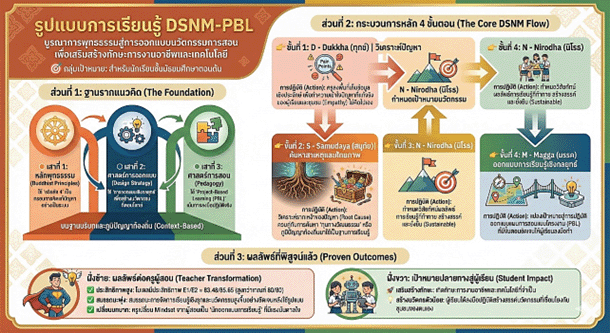
The objectives of this research were to: 1) develop and determine the efficiency of the DSNM-PBL learning management model integrating the Four Noble Truths and Strategic Design for teachers; 2) compare teachers' active learning and innovative management competencies before and after using the model; and 3) study teachers' satisfaction with the model. A distinct feature of this model, differentiating it from general Project-Based Learning (PBL), is the emphasis on cognitive processes based on Buddhist principles to deeply analyze the root causes of problems prior to designing innovations. The target group consisted of 23 teachers at Wat Si Somboon Municipal School during the 2025 academic year. The research instruments included: 1) a workshop manual for the DSNM-PBL model, 2) a knowledge and competency assessment for instructional plan writing, and 3) a satisfaction questionnaire. Data were analyzed using mean, standard deviation, and t-test for dependent samples. The research findings were as follows: 1) The DSNM-PBL learning management model for teachers consists of four steps: Problem Analysis (Dukkha), Cause and Potential Finding (Samudaya), Innovation Goal Setting (Nirodha), and Strategic Learning Design (Magga). The model’s efficiency (E1/E2) was 83.48/85.65, which met the specified 80/80 criterion. 2) Teachers' active learning and innovative management competencies after using the model were significantly higher than before using the model at the .05 level. 3) Teachers’ satisfaction with the learning management model was at the highest level. Teachers reflected that the DSNM model enabled systematic and profound instructional design, capable of effectively connecting local wisdom to innovation.
Article Details

This work is licensed under a Creative Commons Attribution-NonCommercial-NoDerivatives 4.0 International License.
Articles published in this journal are copyrighted by the Faculty of Industrial Technology. Nakhon Si Thammarat Rajabhat University
In addition, research results and academic works published in the journal It is the independent opinion of the author. The author is responsible for any legal consequences that may arise from the published article. The editorial team and the journal's production team, we don't always have to agree.
References
Jitjarern, R. 2022. “The Application of the Four Noble Truths for Analytical Thinking Skill Development in Daily Life of New Gen Youth,” Journal of Buddhist Studies, 5(2): pp. 45–63. (in Thai)
Phrakhru Suthee Jariyawat and et al. 2023. “Academic Administration Model According to the Four Noble Truths for Educational Institutions,” Journal of Innovation in Educational Management and Research, 5(3): pp. 717–730. (in Thai)
Panyaporn, K., Kammantakun, W. and Pa-hae, S. 2024. “The Results of Competency Development in Active Learning Management of Teachers under Nakhon Ratchasima Primary Educational Service Area Office 7,” Research and Development Journal Buriram Rajabhat University, 19(1): pp. 85–98. (in Thai)
Kaewdee, C. 2025. “Guidelines for Integrating the Four Noble Truths into the Strategic Design Process to Enhance Community Products,” Journal of MCU Nakhondhat, 12(9): pp. 1–12. (in Thai)
Thammawithikul, A. and et al. 2023. “The Development of Management Model for Learning Center Based on Philosophy of Sufficiency Economy,” Academic Journal of Industrial Technology Innovation, 5(1): pp. 22–35. (in Thai)
Nilratsirikul, S. 2020. “Teacher Competency Development in Active Learning: A Case Study of Satuk Wittayakhet School,” Journal of Administration and Educational Development Mahasarakham University, 2(1): pp. 45–58. (in Thai)
Trisuntornrat, S. 2024. “Transformative Learning: From Youth Group to New Generation Community Leaders of Thai Boeng Grain Seed Youth Group,” M.Ed. thesis, Thammasat Univ., Bangkok, Thailand. (in Thai)
Jeerawatwong, C., Wetcha, P. and Yawirat, P. 2024. “Learning Innovation in Career Occupation Substance Group in Artificial Intelligence Era,” Surindra Rajabhat University Academic Journal, 2(5): pp. 1–14. (in Thai)
Pa-hae, S. 2022. Smart Education: Theory and Research into Practice. Lampang: Khamnam Press. (in Thai)
