
Efficiency of Concrete Mixer Blades for Enhanced Cellular Lightweight Concrete Production: A Comparative Experimental Analysis
Article Sidebar
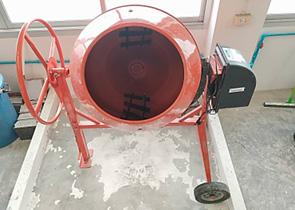
Main Article Content
Abstract
This research aimed at enhancing a rotary drum concrete mixer blade for cellular lightweight concrete (CLC) production. The study systematically examined the influence of blade design on critical mixing parameters, including mixing duration, compressive strength, and dry density. Experimental trials were conducted on cellular lightweight concrete specimens with varying dry density levels of 700, 800, 900, and 1,000 kg/m³, maintaining a constant water-to-cement ratio of 0.45 and a foam agent density of 47 kg/m³. A 260-liter capacity concrete mixer was powered by a 1.5-horsepower electric motor rotating at 24 revolutions per minute. A comparative analysis was performed using three distinct blade designs to evaluate their performance characteristics. The results demonstrated that the three-row blade design generated the highest shear forces during the mixing process, consequently yielding optimal compressive strength across all tested dry density ranges. This research provides valuable insights into the critical role of blade geometry in improving the mechanical properties and overall performance of cellular lightweight concrete mixtures.
Article Details

This work is licensed under a Creative Commons Attribution-NonCommercial-NoDerivatives 4.0 International License.
Articles published in this journal are copyrighted by the Faculty of Industrial Technology. Nakhon Si Thammarat Rajabhat University
In addition, research results and academic works published in the journal It is the independent opinion of the author. The author is responsible for any legal consequences that may arise from the published article. The editorial team and the journal's production team, we don't always have to agree.
References
Lei, M., Liu, Z. and Wang, F. 2024. “Review of lightweight cellular concrete: Towards low-carbon, high-performance and sustainable development,” Construction and Building Materials. 429: pp. 1-13. https://doi.org/10.1016/j. conbuildmat.2024.136324
Raj, A., Sathyan, D. and Mini, K. M. 2019. “Physical and functional characteristics of foam concrete: A review,” Construction and Building Materials. 221: pp.787–799. https://doi.org/10.1016/j.conbuildmat.2019.06.052
Falliano, D., Restuccia, L. and Gugliandolo, E. 2021. “A simple optimized foam generator and a study on peculiar aspects concerning foams and foamed concrete,” Construction and Building Materials. 268: pp. 1-16. https://doi.org/10.1016/j. conbuildmat.2020.121101
Da Silva, J. L. and Lordsleem, A. C. 2021. “Influence of mixer type and mixing time on the multipurpose mortar properties,” Case Studies in Construction Materials. 15: pp. 1-12. https://doi.org/10.1016/ j.cscm.2021.e00562
Dils, J., De Schutter, G. and Boel, V. 2012. “Influence of mixing procedure and mixer type on fresh and hardened properties of concrete: A review,” Materials and Structures/Materiaux et Constructions. 45: pp. 1673–1683. https://doi.org/ 10.1617/s11527-012-9864-8
Amran, Y. H. M., Farzadnia, N. and Ali, A. A. A. 2015. “Properties and applications of foamed concrete; A review,” Construction and Building Materials. 101: pp. 990–1005. https://doi.org/10.1016/j.conbuildmat. 2015.10.112
Williams, D. A., Saak, A. W. and Jennings, H. M. 1999. “The influence of mixing on the rheology of fresh cement paste,” Cement and Concrete Research. 29: pp. 1491-1496. https://doi.org/10.1016/S0008-8846(99)00124-6
Ayanlere, S. A. and et al. 2023. “Effects of water-cement ratio on bond strength of concrete,” Materials Today: proceedings. 86: pp. 134-139. https://doi.org/10.1016/ j.matpr. 2023.04.686
Chapirom, A. and Jaturapitakkul, C. 2020. “Effect of Speed Rotation on the Compressive Strength of Horizontal Mixer,” Suranaree Journal of Science and Technology. 26: pp. 113-120. https://doi.org/10.13140/RG.2.2.25198. 97609
