
Factors of Health Literacy Influencing Secondhand Smoke Prevention Behaviors among Community Public Health Students, Rajabhat Maha Sarakham University
Article Sidebar
Main Article Content
Abstract
Secondhand smoke is a silent threat that severely endangers health, increasing the risk of heart disease, cancer, and respiratory diseases even in non-smokers. Therefore, community public health students must be aware of its dangers and adopt strong self-protection behaviors to serve as role models and promote better health within the community. The objectives of this study were: 1) to examine health literacy regarding secondhand smoke prevention, 2) to study secondhand smoke prevention behaviors, 3) to compare the level of health literacy with secondhand smoke prevention behaviors, and 4) to investigate health literacy factors that can predict the prevention behaviors of students in the Community Public Health program at Rajabhat Maha Sarakham University. This cross-sectional analytic study was conducted on 252 students selected using stratified random sampling. The research instruments consisted of questionnaires that had undergone content validity and reliability testing by Cronbach’s alpha = 0.951. Data analysis were used by descriptive statistics, independent t-test, and stepwise multiple regression analysis.
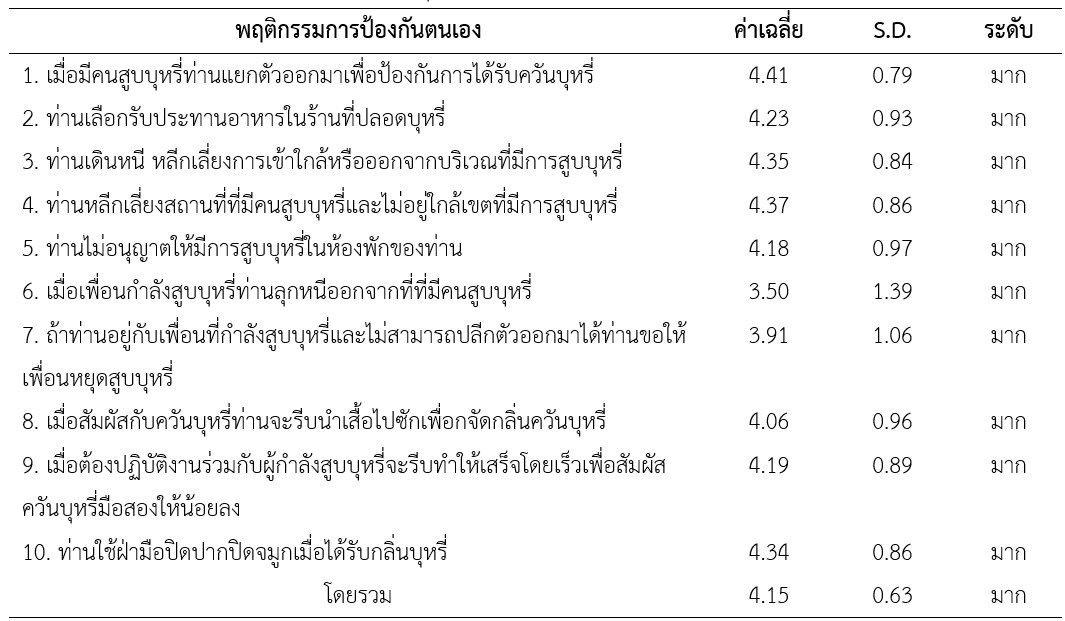
The results showed that most community public health students were female 91.7%, aged 22 years 29.0%, and in their fourth year of study 43.2%. The overall health literacy concerning secondhand smoke prevention was at a good level Mean = 3.97, S.D. = 0.58, with cognitive health literacy having the highest mean score Mean = 4.07, S.D. = 0.67. Students' overall secondhand smoke prevention behaviors were at a high level Mean = 4.15, S.D. = 0.63. Furthermore, a significant statistical difference was found in secondhand smoke prevention behaviors among students with different levels of health literacy (p-value < 0.001). Regression analysis revealed that communicative/advocacy health literacy (β = 0.349) and cognitive health literacy (β = 0.209) significantly predicted 24.7% of the variance in secondhand smoke prevention behaviors (R² = 0.247, p < 0.001). The predictive equation was: Secondhand Smoke Prevention Behavior = 2.181 + 0.292 (Communicative/Advocacy Health Literacy) + 0.196 (Cognitive Health Literacy). These findings underscore the importance of enhancing health literacy, particularly communication and advocacy skills, to foster effective secondhand smoke prevention behaviors among future public health professionals.
Article Details

This work is licensed under a Creative Commons Attribution-NonCommercial-NoDerivatives 4.0 International License.
References
กองสุขศึกษา กรมสนับสนุนบริการสุขภาพ กระทรวงสาธารณสุข. (2562). เครื่องมือสร้างเสริมความรอบรู้ด้านสุขภาพในสถาน
บริการสุขภาพ. นนทบุรี: กรมสนับสนุนบริการสุขภาพ กระทรวงสาธารณสุข.
จักรพันธ์ เพ็ชรภูมิ, รุ่งนภา แย้มกลีบ และญชณัฏฐา พงษ์ปรีชา. (2561). ปัจจัยที่มีผลต่อการได้รับควันบุหรี่มือสองของ
นักศึกษาในมหาวิทยาลัยแห่งหนึ่ง. วารสารสาธารณสุข มหาวิทยาลัยบูรพา, 13(2), 89–101.
ธนะวัฒน์ รวมสุข, สุรินธร กลัมพากร, ทัศนีย์ รวิวรกุล, ทัศนีย์ อรรถสาร, อารยา ทิพย์วงศ์, นภิสสร ดีรณวัตร และจิราภรณ์
อนุชา. (2565). ความสัมพันธ์ระหว่างความรอบรู้ทางสุขภาพกับพฤติกรรมการสูบบุหรี่ของนักศึกษสถาบันอุดมศึกษา
กรุงเทพมหานคร. วารสารพยาบาลทหารบก, 24(3), 357–365.
บุริศร์ ยอดนางรอง, พีรยา จันทร์ศรีทอง, กุลภรณ์ เศวตจิตรไกรสร, วนิดา สิงหาเทพ, และอารยา ทิพย์วงศ์. (2565). ปัจจัยที่มี
ความสัมพันธ์กับความรอบรู้ทางสุขภาพเกี่ยวกับการป้องกันการสูบบุหรี่ ของนักศึกษาพยาบาลมหาวิทยาลัยแห่งหนึ่ง
กรุงเทพมหานคร. วารสารวิจัยธรรมศึกษา, 5(1), 1–9.
ยุรนันท์ เทพา. (2567). ผลของโปรแกรมการเสริมสร้างความรอบรู้ด้านสุขภาพและพฤติกรรมการป้องกันนักสูบบุหรี่หน้าใหม่
ในนักเรียนมัธยมศึกษาตอนต้น โรงเรียนแห่งหนึ่งในพื้นที่อำเภองาว จังหวัดลำปาง. วารสารสาธารณสุขมูลฐาน
(ภาคเหนือ), 34(2), 12-26.
สำนักงานกองทุนสนับสนุนการสร้างเสริมสุขภาพ. (2563). คู่มือความรอบรู้ด้านสุขภาพ: แนวทางและการประเมิน.
กรุงเทพมหานคร: สสส.
สำนักงานกองทุนสนับสนุนการสร้างเสริมสุขภาพ. (2564). รายงานสถานการณ์การควบคุมยาสูบของประเทศไทย ปี 2564.
กรุงเทพมหานคร: สสส.
อารยา เชียงของ และเชษฐ รัชดาพรรณาธิกุล. (2565). ปัจจัยทำนายพฤติกรรมการหลีกเลี่ยงการได้รับบุหรี่มือสองของ
นักศึกษาในมหาวิทยาลัย. วารสารเครือข่ายวิทยาลัยพยาบาลและการสาธารณสุขภาคใต้, 9(3), 49-59.
Intarangkul, T., & Chodnock, K. (2024). Factors related to health literacy in illness prevention among
Buriram Rajabhat University students. South East European Journal of Public Health, 3, 672–677.
Nguyen, H.V., Pham, T.M., & Nguyen, H.L. (2020). Health literacy and preventive behaviors of secondhand
smoke exposure among Vietnamese university students. Journal of Health Research, 34(2), 157–
Nutbeam, D. (2000). Health literacy as a public health goal: a challenge for contemporary health
education and communication strategies into the 21st century. Health Promotion International,
(3), 259–267.
Nutbeam, D. (2008). The evolving concept of health literacy. Social Science & Medicine, 67(12),
–2078.
Panahi, R., Osmani, F., Javanmardi, K., Ramezankhani, A., Dehghankar, L., Amini, R., Haeri Mehrizi, A. A.,
Amjadian, M., Anbari, M., & Hosseini, N. (2021). The relationship between different levels of health
literacy and smoking prevention among medical sciences student. International Journal of Preventive Medicine, 12, 124. https://doi.org/10.4103/ijpvm.IJPVM_460_20
Rao, A., Rungta, N., Nandini, M., Unnikrishnan, B., Shenoy, R., Rao, A., & Shetty, M. K. (2023). Effect of
educational intervention in reducing exposure to second hand tobacco smoke among 12-year-old children as determined by their salivary cotinine levels and knowledge, attitude and behavior – a randomized controlled trial. Frontiers in Oral Health, 4, 1–10. https://doi.org/10.3389/froh.2023.1277307
Sorensen, K., Broucke, S.V.D., Fullam, J., Doyle, G., Pelikan, E., Slonska, Z., & Brand, H. (2012). Health
literacy and public health: A systematic review and integration of definitions and models. BMC
Public Health, 12(1), 80.
Wang, M.P., Ho, S.Y., & Lam, T.H. (2013). Secondhand smoke exposure and avoidance behavior among
Chinese adolescents in Hong Kong. Preventive Medicine, 124, 58–62.
Wang, M.P., Ho, S.Y., Lo, W.S., & Lam, T.H. (2019). The influence of health communication literacy on
adolescents' secondhand smoke avoidance. Journal of Health Communication, 24(2), 113–121.
World Health Organization. (2019). WHO global report on trends in prevalence of tobacco use 2000-2025
(3rd ed.). WHO.
World Health Organization. (2021). Second-hand smoke and children. https://www.who.int
