
Comparison of Physicochemical Properties, Antioxidant Activity and Microbial Content of Caffeinated and Non-caffeinated Coffee Kombucha
Article Sidebar
Main Article Content
Abstract
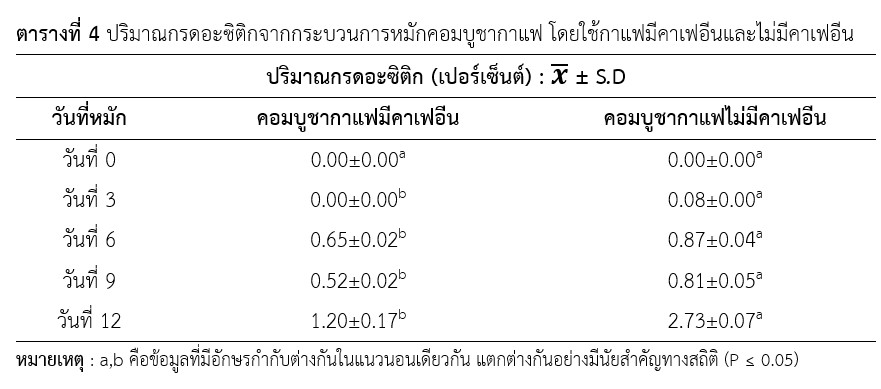
This study aimed to compare the chemical properties, antioxidant activity and microbial content of kombucha produced from caffeinated and decaffeinated coffee fermented for 12 days. Samples were collected every 3 days for 5 time points (day 0, 3, 6, 9 and 12). Kombucha analysis consisted of measurement of soluble solids (degree Brix), fructose, glucose and acetic acid by HPLC, antioxidant activity by DPPH method, total flavonoids by Aluminium chloride colorimetric assay and total phenolics by Folin-Ciocalteu method. And the microbial quantity was analyzed by Spread plate method on PCA and SDA media. The results of the analysis of kombucha fermented for 12 days showed that coffee kombucha with caffeine and coffee kombucha without caffeine had soluble solids of 6.80±0.00 and 6.10±0.14 degree Brix, respectively, fructose content of 4.98±0.18 percent and 5.41±0.06 percent, glucose of 5.13±0.33 percent and 5.27±0.16 percent, acetic acid of 1.20±0.17 percent and 2.73±0.07 percent, antioxidant activity of 27.25±0.24 and 23.67±0.35 mg of ascorbic acid/ml, and total flavonoid content of 759.86±9.09 and 545.57±1.01 microgram of rutin/ml. The phenolic contents were 2134.78±4.99 and 1662.12±5.41 mg of gallic acid/L, the bacterial counts were 4.85×10¹⁴ and 4.35×10¹⁵ CFU/ml, and the yeast-mold counts were 5.50×10¹⁴ and 5.85×10¹³ CFU/ml, respectively. The results of the study concluded that kombucha produced from caffeinated coffee had higher chemical properties and antioxidant activity than kombucha from decaffeinated coffee.
Article Details

This work is licensed under a Creative Commons Attribution-NonCommercial-NoDerivatives 4.0 International License.
References
นิสา ร่มส้มซ่า, จุฑามาศ พรสันเทียะ, ทิพย์วรินทร์ ริมลาดวน และกุณฑิกา เวชกลาง. (2564). คุณสมบัติทางชีวภาพของผลิตภัณฑ์คอมบูชาที่เกิดขึ้นในระหว่างกระบวนการหมัก. วารสารนเรศวรพะเยา, 14(1), 1–12.
นันท์นภัส พิสิษฐ์อาภาภัค และศุภาพิชญ์ ทองรัตน์. (2563). การพัฒนาเครื่องดื่มชาหมักจากใบองุ่นที่มีสารต้านอนุมูลอิสระสูง, โครงการสอนเพื่อเสริมประสบการณ์, จุฬาลงกรณ์มหาวิทยาลัย กรุงเทพมหานคร.
ปิยวรรณ พันสี, ศิรประภา รักษาภักดี และกัลย์สุดา ดวงศรีแก้ว. (2567). การศึกษาฤทธิ์ต้านอนุมูลอิสระของสบู่สารสกัดกากกาแฟและสบู่สารสกัดกากกาแฟผสมสารสกัดใบหม่อน. Science and Engineering Connect, 47(1), 26–41.
วิลาวัลย์ บุณย์ศุภา, กรรณิการ์ ทองดอนเปรียง, ชลธิชา ศรีจันทร์, ธิดาธร แพงทอง และกิตติพัฒน์ อารีเอื้อ. (2566). การเปรียบเทียบคุณสมบัติทางเคมี ความสามารถในการต้านอนุมูลอิสระและ การทดสอบทางประสาทสัมผัสของคอมบูชาจากดอกอัญชันและลาเวนเดอร์. วารสารวิทยาศาสตร์ วิศวกรรมศาสตร์ และเทคโนโลยี มหาวิทยาลัยราชภัฏ มหาสารคาม. 2(2), 27-35.
Aguiar, A., Nascimenta, R.A.D.A., Ferretti, L.P., & Goncalves, A.R. (2005). Determination of organic acids and ethanol in commercial vinegars. Brazilian Journal of Food Technology, 5(SIPAL Macro), 51–56.
Brand-Williams, W., Cuvelier, M.E., & Berset, C. (1995). Use of a free radical method to evaluate antioxidant activity. LWT - Food Science and Technology, 28, 25-30.
Giggia, F., Baffoni, L., Galiano, M., Nielsen, D.S., Jakosen, R.R., Castro-Mejia, J.L., Bosi, S., Truzzi, F., Musumeci, F., Dinelli, G., & Gioia, D.D. (2018). Kombucha beverage from green, black and rooibos teas: a comparative study looking at microbiology, chemistry and antioxidant activity. Nutrients, 11, 1. https://doi.org/10.3390/nu11010001
Jayabalan, R., Malbaša, R.V., Lončar, E.S., Vitas, J.S., & Sathishkumar, M. (2014). A review on kombucha tea—microbiology, composition, fermentation, beneficial effects, toxicity, and tea fungus. comprehensive reviews in food science and food safety. Comprehensive Reviews in Food Science and Food Safety, 13(4), 538–550. https://doi.org/10.1111/1541-4337.12073
Johanna, F. (2021). The effect of temperature and fungal-bacterial ratio in kombucha culture fermentation [Unpublished bachelor's thesis]. Department of food technology, engineering and nutrition, Lund university.
Karyantina, M., Surulloh, A., & Suhartatik, N. (2024). Antioxidant activity kombucha coffee (Coffee spp) with variation concentration and type, BIO Web of Conferences, 99, 02009. https://doi.org/10.1051/bioconf/20249902009
Liu, H., Song, Y., & Zhang, X. (2017). Determination of total flavonoids in Leek by AlCl3 colorimetric assay. Chemical Engineering Transactions, 59, 775–780. https://doi.org/10.3303/CET1759130
Nasution, L.R., Permata, Y.M., Keliat, J.M., Pelawi, M.A., Ciunardy, V.K., & Seruni, T.R. (2024). Fermentation effects on caffeine content and chemical parameters of kombucha coffee cascara. International Journal of Applied Pharmaceutics, 16(4), 11-16.
Sales, A.L., Cunha, S.C., Morgado, J., Cruz, A., Santos, T.F., Ferreira, I.M.P.L.V.O., Fernandes, J.O., Miguel, M.A.L., & Farah. (2023). A. volatile, microbial, and sensory profiles and consumer acceptance of coffee cascara kombuchas. Foods, 12, 2710. https://doi.org/10.3390/foods12142710
Singleton, V.L., Orthofer, R., & Lamuela-Raventós, R.M. (1999). Analysis of total phenols and other oxidation substrates and antioxidants by means of Folin-Ciocalteu reagent. In: Methods Enzymol. Academic Press, 152-178.
