
A Study Impact of Light Intensity and Duration on Wolffia Growth (Wolffia arrhiza (L.) Horkel ex Wimm.
Article Sidebar
Main Article Content
Abstract
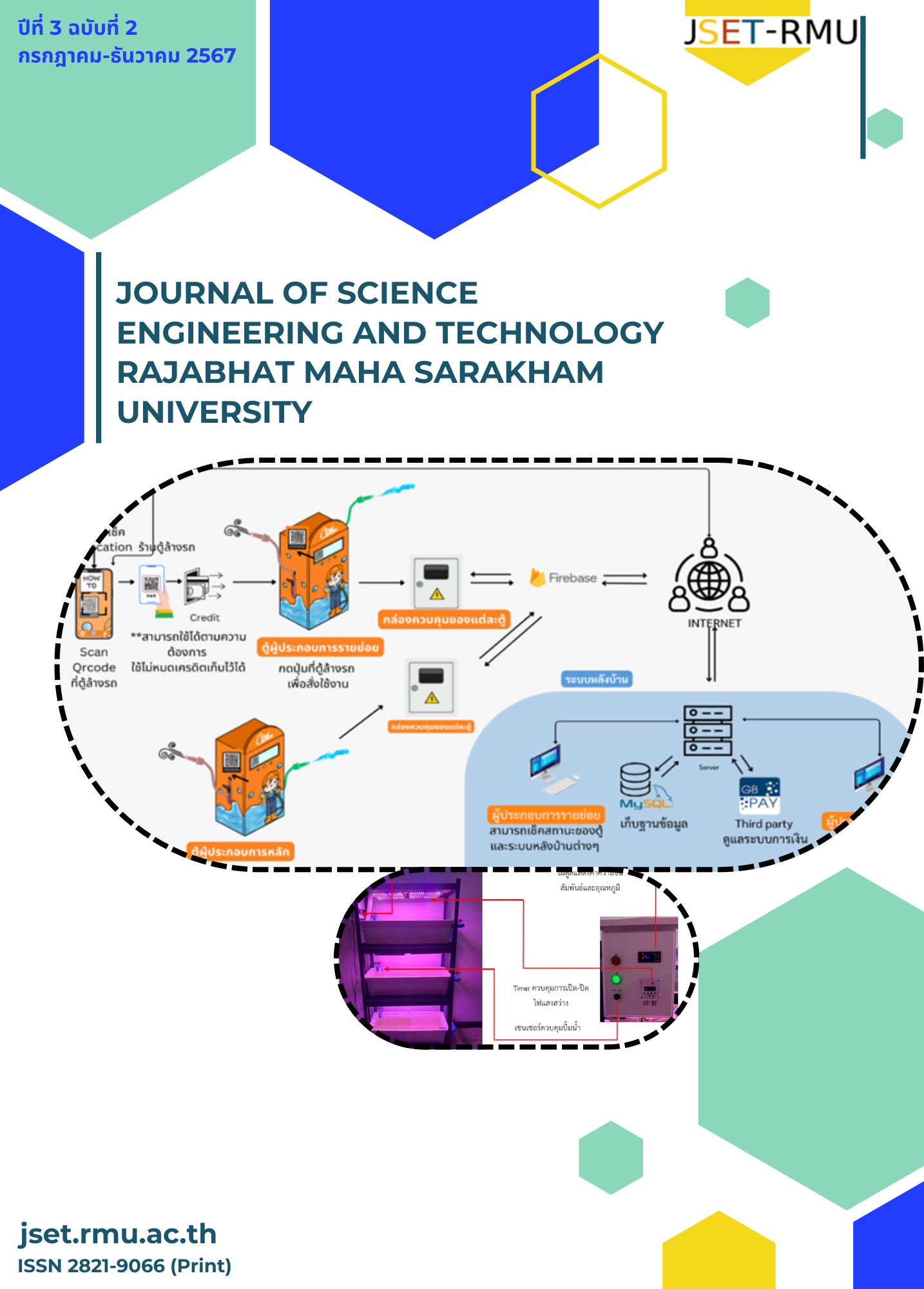
This study aimed to investigate the effects of light exposure on Wolffia cultivation and to evaluate the application of an automated cultivation system for controlling and monitoring its growth. A completely randomized design (CRD) was used, with three treatments, each replicated three times: 1) Cultivation under natural sunlight, 2) Cultivation under LED lighting at an intensity of 9,000–12,000 lux for 12 hours daily, and 3) Cultivation under LED lighting at an intensity of 9,000–12,000 lux for 24 hours daily. The experiment lasted 14 days, with Wolffia growth monitored daily under automatically controlled conditions.
The results revealed statistically significant differences in fresh Wolffia weight among treatments at days 1, 7, and 14. Cultivation under 24-hour LED lighting yielded the highest fresh weight, followed by 12-hour LED lighting, while natural sunlight resulted in the lowest yield. The implementation of the automated cultivation system allowed for maintaining optimal environmental conditions, improved ease of management, and increased cultivation precision. This approach significantly enhanced Wolffia production efficiency while reducing labor costs.
Article Details

This work is licensed under a Creative Commons Attribution-NonCommercial-NoDerivatives 4.0 International License.
References
ชนกพร จุฑาสงฆ์. (2542). การเจริญเติบโตและปริมาณโปรตีนของไข่น้ํา (Wolffia arrhiza (L.) Wimm) ที่เพาะเลี้ยงในน้ำทิ้งจากโรงงานผลิตแป้งมันสําปะหลัง [วิทยานิพนธ์ปริญญา มหาบัณฑิตที่ไม่มีการตีพิมพ์]. มหาวิทยาลัยมหาสารคาม.
ชนิดา จรรยาเพศ แบมฟอร์ด. (2552). ตัวชี้วัดความมั่นคงด้านอาหารระดับชุมชน. สํานักพิมพ์มูลนิธิชีววิถี.
ชนะชัย ฤทธิ์ทรงเมือง, กัมพล ไทยโส, ประภาพรณ์ ขันชัย, ประหยัด สืบเมืองซ้าย และ สมหวัง กูกขุนทด. (2566). การเพาะเลี้ยงไข่น้ําด้วยการใช้แสงไฟทดแทนแสงอาทิตย์ร่วมกับระบบ Internet Of Things (IoT). วารสารวิจัยศิลปวิทยาการลุ่มน้ําโขง, 16-30.
นิศาชล ฤาแก้วมา. (2548). การศึกษาความต้องการแสงสว่างที่มีผลต่อการเพาะเลี้ยงไข่นํ้า. สถาบันวิจัยและฝึกอบรมการเกษตรสกลนครมหาวิทยาลัยเทคโนโลยีราชมงคลอีสาน.
พิพัฒน์พงษ์ วงศ์ใหญ่ และ ศศิธร ชาววัลจันทึก. (2554). เภสัช มช.วิจัย “ผำ” สุดยอดแหล่งโปรตีนเพื่อ สุขภาพ. http://www.manager.co.th/campus/viewnews.aspx?NewsID= 9540000146844
วิลาสินี อดุลยานนท์ และ เดชรัตน์ สุขกําเนิด. (2556). พบความมั่นคงทางอาหารไทยวิกฤติ. www.thairath.co.th/content/edu/351337.
สมศักดิ์ สันวิลาส. (2542). การเจริญเติบโตและปริมาณโปรตีนของไข่น้ํา (Wolffia arrhiza (Linn.) Wimm)ที่เพาะเลี่ยงด้วยสูตรอาหารและระดับความเข้มของแสงต่างกันในสภาพกลางแจ้ง [วิทยานิพนธ์ปริญญามหาบัณฑิตที่ไม่มีการตีพิมพ์]. มหาวิทยาลยัมหาสารคาม.
สิทธิโชค พรรค์พิทักษ์, กาญจนา ดงสงคราม, ศศิธร อ่อนเหลา, กฤตภาส ยุทธอาจ, และ อุดมศักดิ์ พมิ พ์ พาศรี. (2564). การพัฒนาระบบควบคุมการให้น้ําอัตโนมัติผ่านเซ็นเซอร์ไร้สายเพื่อเพิ่มผลผลิตอ้อยคั้นน้ํา. วารสารวิชาการการประยุกต์ใช้เทคโนโลยีสารสนเทศมหาวิทยาลัยราชภัฏมหาสารคาม, 7(1), น.7-17.
สุขุม เร้าใจ และ สุทิน สมบรูณ์. (2550). การศึกษาความเป็นไปได้ของการเพาะเลี้ยงไข่น้ํา Wolffiaarrhiza (L.) Wimm. สังกัดภาควิชาการจัดการประมง มหาวิทยาลัยเกษตรศาสตร์. กรุงเทพฯ
อุมาพร นิยะนุช. (2553). การเปลี่ยนแปลงหลังการเก็บเกี่ยวขององค์ประกอบและกิจกรรมในการต้านออกซิเดชั่นของไข่น้ํา [วิทยานิพนธ์ปริญญามหาบัณฑิตที่ไม่มีการตีพิมพ์]. มหาวิทยาลยัขอนแก่น.
โอภา วัชระคุปต์. (2549). ภาวะถูกออกซิไดซ์เกินสมดุลโดยอนุมูลอิสระและดัชนีชี้วัด. ใน โอภา วัชระคุปต์, ปรีชา บุญจูง, จันทนา บุณยะรัตน์ และ มาลีรักษ์ อัตต์สินทอง (บ.ก.), สารต้านอนุมลู อิสระ (น. 44-74.). พี.เอส.พริ้นท์.
Bunea, A., Andjelkovic, M., Socaciu, C., Bobis, O., Neacsu, M., Verhé, R., & Van Camp, J. (2008). Total and individual carotenoids and phenolic acids content in fresh, refrigerated and processed 1 spinach (Spinacia oleracea L.). Food chemistry, 108(2), 649-656.
Landolt, E. (1986). The Family of Lemnaceae—A Monographic Study: Vol 1: Morphology, Karyology, Ecology, Geographic Distribution, Systematic Position, Nomenclature, Descriptions. Veroffentlichungen des Geobotanischen Institutes der ETH, Stiftung Rubel, Zurich.
Suppadit, T., Jaturasitha, S., Sunthorn, N., & Poungsuk, P. (2012). Dietary Wolffia arrhiza meal as a substitute for soybean meal: its effects on the productive performance and egg quality of laying Japanese quails. Tropical Animal Health and Production, 44(7), 1479-86.
Yan, Y., Candreva, J., Shi, H., Ernst, E., Martienssen, R., Schwender, J., & Shanklin, J. (2013). Survay of the total fatty acid and triacylglycerol composition and content of 30 duckweed species and cloning 37 of a Δ6-desaturase responsible for the production of γ-linolenic and stearidonic acids in Lemna gibba. Bio Med Central Plant Biology, 13, 201.
