
การวิเคราะห์เวลาแสงต่ำสุดและการเปลี่ยนแปลงคาบวงโคจรของระบบดาวคู่อุปราคา PV Comae Berenices
Article Sidebar
Main Article Content
บทคัดย่อ
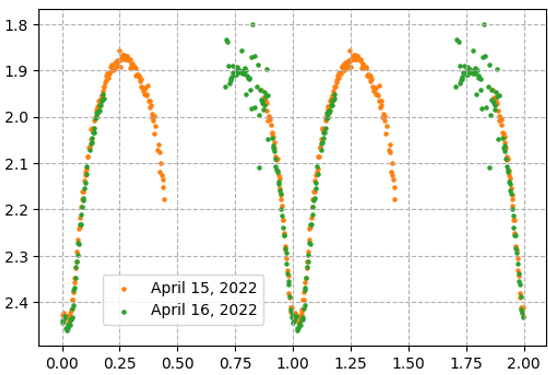
ระบบดาวคู่อุปราคาเป็นระบบดาวที่มีความสำคัญต่อการศึกษาโครงสร้างและวิวัฒนาการของดาวฤกษ์ งานวิจัยนี้มีวัตถุประสงค์เพื่อศึกษาการเปลี่ยนแปลงคาบวงโคจรของระบบดาวคู่อุปราคา PV Comae Berenices โดยการสังเกตการณ์ในช่วงความยาวคลื่นกึ่งกลางแสงที่ตามองเห็น (551 nm) ณ หอดูดาวแห่งชาติ ในวันที่ 15-16 เมษายน พ.ศ. 2565 ผลการศึกษาพบว่าค่าเวลาที่แสงน้อยที่สุดอยู่ที่ 2459685.272 และ 2459686.166 ตามลำดับ เมื่อนำข้อมูลเหล่านี้ไปวิเคราะห์ร่วมกับข้อมูลในอดีตตั้งแต่ปี 2545-2563 สามารถคำนวณสมการ Linear ephemeris ใหม่ได้ การวิเคราะห์แผนภาพ O–C กับ Epoch แสดงลักษณะเป็นพาราโบลาคว่ำที่ชัดเจน บ่งชี้ว่าระบบคู่มีการลดลงของคาบวงโคจรอย่างต่อเนื่อง โดยมีอัตราการเปลี่ยนแปลงคาบวงโคจรเท่ากับ –4.55 × 10⁻² วินาทีต่อปี ซึ่งการลดลงนี้เกิดจากการถ่ายโอนมวลระหว่างดาวทั้งสองดวงหรือการสูญเสียโมเมนตัมเชิงมุมผ่านกลไก Magnetic Braking ผลการศึกษาในครั้งนี้จะเป็นข้อมูลสำคัญในการเพิ่มความเข้าใจเกี่ยวกับวิวัฒนาการของระบบดาวคู่ PV Comae Berenices
Article Details

อนุญาตภายใต้เงื่อนไข Creative Commons Attribution-NonCommercial-NoDerivatives 4.0 International License.
เอกสารอ้างอิง
Alton, K. (2020). PV Comae Berenices (VSX entry). AAVSO International Variable Star Index. https://www.aavso.org/vsx/index.php?view=detail.top&oid=95127
Alton, K.B., & Stępień, K. (2021). Roche modeling and evolutionary history of six low mass contact binary systems. Acta Astronomica, 71(2), 123-161. https://doi.org/10.32023/0001-5237/71.2.4
Czech Astronomical Society. (2002). PV Com - Eclipsing binary. Variable Star and Exoplanet Section of the Czech Astronomical Society. https://var.astro.cz/en/Stars/12558
Darwish, M.S., Abdelkawy, A.G., & Hamed, G.M. (2024). Light curve analysis and evolutionary status of four newly identified short-period eclipsing binaries. Scientific Reports, 14(1), 3998. https://doi.org/10.1038/s41598-024-54289-1
Diethelm, R. (2009). Timings of minima of eclipsing binaries. Information Bulletin on Variable Stars. 5894(1), 1-10. https://ibvs.konkoly.hu/pub/ibvs/5801/5894.pdf
Diethelm, R. (2010). Timings of minima of eclipsing binaries. Information Bulletin on Variable Stars, 5945(1), 1-9. https://ibvs.konkoly.hu/pub/ibvs/5901/5945.pdf
Diethelm, R. (2011). Timings of minima of eclipsing binaries. Information Bulletin on Variable Stars, 5992(1), 1-22. https://ibvs.konkoly.hu/pub/ibvs/5901/5992.pdf
Diethelm, R. (2012). Timings of minima of eclipsing binaries. Information Bulletin on Variable Stars, 6029(1), 1-22. https://ibvs.konkoly.hu/pub/ibvs/6001/6029.pdf
Diffraction Limited. (2013). MaxIm DL Pro (Version 5.24) [Computer software]. Diffraction Limited. https://diffractionlimited.com
Fang, X., Wang, Q., & Qian, S. (2024). Orbital period change of SW Sex star TT Tri. Monthly Notices of the Royal Astronomical Society, 531(1), 213-218. https://doi.org/10.1093/mnras/stae1184
Qian, S.B., Dai, Z.B., He, J.J., Yuan, J.Z., Xiang, F.Y., & Zejda, M. (2007). Orbital period changes of the nova-like cataclysmic variable AC Cancri: evidence of magnetic braking and an unseen companion. Astronomy & Astrophysics, 466(2), 589-594. https://doi.org/10.1051/0004-6361:20065970
Hahs, G., Ortmann, C., & Gokhale, V. (2020). Light curve asymmetries in three short period eclipsing binary stars. Journal of the American Association of Variable Star Observers (JAAVSO), 48(1), 57. https://apps.aavso.org/jaavso/article/3580/
Hu, K., Meng, Z.B., Wang, H.W., Yu, Y.X., & Xiang, F.Y. (2022). First photometric and orbital period investigations of four W UMa-type eclipse binaries. Publications of the Astronomical Society of Australia, 39, e057. https://doi.org/10.1017/pasa.2022.53
Jayasinghe, T., Stanek, K.Z., Kochanek, C.S., Shappee, B.J., Holoien, T.W.S., Thompson, T.A., Prieto, J.L., Dong, S., Pawlak, M., Pejcha, O., Shields, J.V., Pojmanski, G., Otero, S., Britt, C., A., & Will, D. (2018). The ASAS-SN catalog of variable stars II: Uniform classification of 412,000 known variables. Monthly Notices of the Royal Astronomical Society, 489(2), 1907–1943. https://doi.org/10.1093/mnras/stz844
Jones, D., Conroy, K. E., Horvat, M., Giammarco, J., Kochoska, A., Pablo, H., Brown, A.J., Sowicka, P. & Prša, A. (2020). Physics of Eclipsing Binaries. IV. The impact of interstellar extinction on the light curves of eclipsing binaries. The Astrophysical Journal Supplement Series, 247(2), 63. https://doi.org/10.3847/1538-4365/ab7927
Khaliullina, A.I. (2021). Variations in the orbital periods of eclipsing binaries RY Aqr, AK Vir, and AX Vul. Astronomy Reports, 65, 126-136. https://doi.org/10.1134/S1063772921020037
Koçak, D., Yakut, K., Southworth, J., Eggleton, P.P., İçli, T., Tout, C.A., & Bloemen, S. (2021). The nature of the eccentric double-lined eclipsing binary system KIC 2306740 with Kepler space photometry. The Astrophysical Journal, 910(2), 111. https://doi.org/10.3847/1538-4357/abe546
Lalounta, E., Christopoulou, P.E., Papageorgiou, A., Lopes, C.F., & Catelan, M. (2024). A study of nine extremely low mass ratio-contact binary systems. The Astronomical Journal, 168(2), 50. https://doi.org/10.3847/1538-3881/ad4882
Li, C.Y., Jiang, L.Q., Zheng, J., Liu, Y.M., Long, X.Y., Sun, M., Zhang H.L., & Tian, X.M. (2024). V0405 Dra: a new deep and low mass ratio contact binary with extremely fast decrease in the orbital period. Research in Astronomy and Astrophysics, 24(6), 065023. https://doi.org/10.1088/1674-4527/ad47dd
Li, L., Zhang, F., Han, Z., Jiang, D., & Jiang, T. (2008). The evolutionary status of W Ursae majoris-type systems. Monthly Notices of the Royal Astronomical Society, 387(1), 97-104. https://doi.org/10.1111/j.1365-2966.2008.12736.x
Lohr, M.E., Norton, A.J., Kolb, U.C., Maxted, P.F.L., Todd, I., & West, R.G. (2013). Period and period change measurements for 143 SuperWASP eclipsing binary candidates near the short-period limit and discovery of a doubly eclipsing quadruple system. Astronomy & Astrophysics, 549, A86. https://doi.org/10.1051/0004-6361/201220562
Lohr, M.E., Norton, A.J., Payne, S.G., West, R.G., & Wheatley, P.J. (2015). Orbital period changes and the higher-order multiplicity fraction amongst SuperWASP eclipsing binaries. Astronomy & Astrophysics, 578, A136. https://doi.org/10.1051/0004-6361/201525747
Meng, F., Zhu, L., Qian, S., Liu, N., Li, L., & Matekov, A. (2023). NY bootes: an active deep and low-mass-ratio contact binary with a cool companion in a hierarchical triple system. The Astrophysical Journal, 954(2), 111. https://doi.org/10.3847/1538-4357/ace8fe
Nelson, B. (2019). Software by Bob Nelson. https://www.variablestarssouth.org/resources/bob-nelsons-software-tools/software-by-bob-nelson
Papageorgiou, A., Christopoulou, P.E., Lalounta, E., Lopes, C.F., Catelan, M., Drake, A.J., Hantzios, P., & Alikakos, L. (2023). A unique low-mass-ratio contact eclipsing binary system under the period cutoff. The Astrophysical Journal, 952(2), 141. https://doi.org/10.3847/1538-4357/acdcf3
Pojmanski, G. (2002). The all sky automated survey. Variable Stars in the 0h - 6h Quarter of the Southern Hemisphere. Acta Astronomica. 52(1), 397-427. https://doi.org/10.48550/arXiv.astro-ph/0210283
Qian, S.B., He, J.J., Zhang, J., Zhu, L.Y., Shi, X.D., Zhao, E.G., & Zhou, X. (2017). Physical properties and catalog of EW-type eclipsing binaries observed by LAMOST. Research in Astronomy and Astrophysics, 17(8), 087. https://doi.org/10.1088/1674-4527/17/8/87
Qian, S.B., Yuan, J.Z., Xiang, F.Y., Soonthornthum, B., Zhu, L.Y., & He, J.J. (2007). Ternarity, activity, and evolutionary state of the W UMa-type binary UX eridani. The Astronomical Journal, 134(5), 1769. https://doi.org/10.1086/521927
SIMBAD Astronomical Database. (2020). BD+16 2387 and BD+16 2388. Centre de Données astronomiques de Strasbourg. https://simbad.cds.unistra.fr/simbad/
Smith, G.D., Gillen, E., Queloz, D., Hillenbrand, L.A., Acton, J.S., Alves, D.R., Anderson, D.R., Bayliss, D., Briegal, J.T., Burleigh, M.R., Casewell, S.L., Delrez, L., Dransfield, G., Ducrot, E., Gill, S., Gillon, M., Goad, M.R., Günther, M.N., Henderson, B.A., ..., Wheatley, P.J. (2021). NGTS clusters survey–III. A low-mass eclipsing binary in the Blanco 1 open cluster spanning the fully convective boundary. Monthly Notices of the Royal Astronomical Society, 507(4), 5991-6011. https://doi.org/10.1093/mnras/stab2374
Thiemann, H.B., Norton, A.J., Dickinson, H.J., McMaster, A., & Kolb, U.C. (2021). SuperWASP variable stars: classifying light curves using citizen science. Monthly Notices of the Royal Astronomical Society, 502(1), 1299-1311. https://doi.org/10.1093/mnras/stab140
Tian, X.M., Jiang, L.Q., Wang, Z.H., & Wang, J.J. (2025). The first photometric investigation of two short-period Algol-type eclipsing binaries: IW UMa and V367 Gem. Frontiers in Astronomy and Space Sciences, 11, 1497989. https://doi.org/10.3389/fspas.2024.1497989
Yang, Y., Yuan, H., Wang, S., & Dai, H. (2022). Magnetic activity on four short-period contact binaries: V0576 Peg, KW Psc, V0873 Per, and FY Boo. The Astronomical Journal, 163(6), 250. https://doi.org/10.3847/1538-3881/ac63c0
